The Best Gravel Cycling Destinations in Europe
There is a moment on every one of these routes when the riding stops being about distance and starts being about the line you are drawing across a map. On the Trans Alp it is the descent through the Sarca gorge when Lake Garda opens ahead and the Alps are suddenly behind you. In the Pyrenees it is the first sight of the Mediterranean from a high col, after eight days that began on the Atlantic. In Scotland it is the moment near Montrose when the farmland runs out and the North Sea is just there. These are not loops from a hotel. They are crossings — of a mountain range, of a country, from one sea to another — and they are, to our minds, what makes Europe one of the great places in the world to ride gravel.
This is a round-up of the gravel cycling destinations we know best, because we ride and test every one of them before it goes on sale. It is written for riders who already know their way around a gravel bike and a long day in the saddle, and who are deciding where to spend a precious week of it. For each destination you will find the real character of the place, the terrain and what it demands, the season that suits it, who it is for, and an honest word on where it sits against the others. We run them all the same way — fully supported, hotel-to-hotel, guided or self-guided, with the van carrying everything but the riding — so the comparison is between landscapes and routes, not between logistics.
There is no single best gravel destination in Europe, and we would distrust anyone who told you there was. There is a best one for you, this year, at the fitness you are at and in the month you can travel. That is what this guide is for.
How to read this round-up
A few things hold true across all of these gravel bike tours, and it is worth saying them once rather than repeating them seven times.
Every route is a genuine point-to-point — you finish somewhere different from where you started, having crossed something real in between. Every tour runs two daily pace options (we call them Explore and Adventure, or Adventure and Explorer depending on the route): a steadier line and a fuller one, so a couple or a group riding at different speeds can share the same week and the same hotel each night. Every tour has a mid-week rest day built in, which experienced riders know is the difference between arriving at the finish strong and arriving merely relieved.
And every tour is graded for capable riders. Most of the people who ride with us are experienced riders who have ridden for decades — they pace themselves intelligently, and they would far rather travel thoughtfully across a great landscape than sprint through it. None of these routes is technical in the mountain-bike sense; what they ask for is endurance, judgement and the patience to keep a rhythm through a long valley. We will tell you plainly which are the hardest.
A practical note on kit, true of every destination below: a gravel bike with clearance for at least 38 mm tyres (wider is better), tubeless, and a low gear around 0.9 for the sustained climbs. Have it freshly serviced before you travel. Beyond that, the differences are in the riding.
The Alps — the classic crossing, north to south
If there is one route that defines what a gravel crossing can be, it is the Trans Alp Gravel: eight days from Füssen in Bavaria over the spine of the Alps to Lake Garda, through four countries — Germany, Austria, Switzerland and Italy — on gravel roads, forest paths and old military routes.
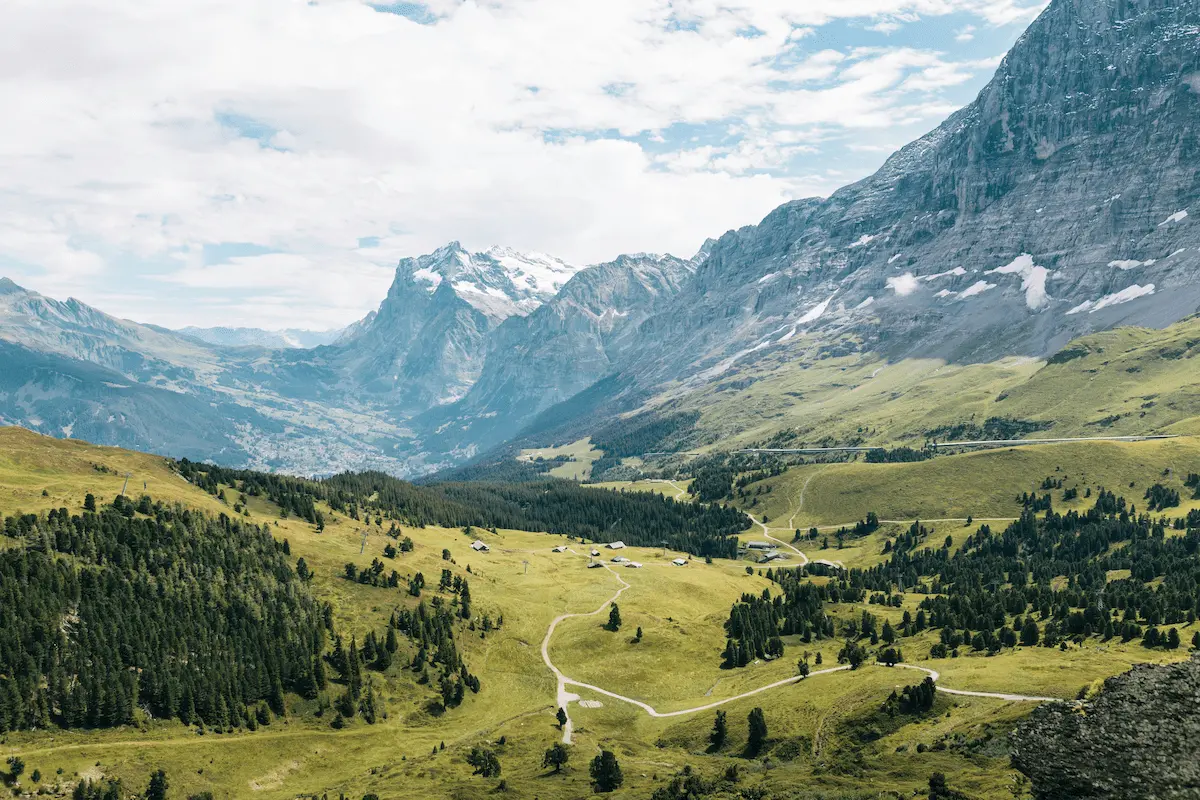
The character. This is a high-mountain journey with a clear narrative arc. You start in the green lake country at the northern foot of the Alps and climb steadily into the alpine rhythm — long, rideable ascents, big views, the varied terrain where a gravel bike genuinely earns its keep. By the middle of the week you are in high-alpine country: the iconic view over the Reschensee and its half-sunken bell tower, the three-country corner where Austria, Switzerland and Italy meet, and — on the Explorer route — the Stelvio Pass itself, one of Europe’s great climbs, before the long descent into South Tyrol and the spa town of Merano. Then the country softens through Trentino wine country toward Lake Garda, the air turning warmer and almost Mediterranean, olive trees replacing the pine, until the final descent through the Sarca gorge delivers you to the waterfront at Riva del Garda.
The terrain. Alpine passes, high forestry roads and valley tracks on both sides of the watershed. Across the week, 380–440 km depending on route choice, with a serious 8,000–10,500 m of cumulative climbing — this is an endurance route, graded challenging. The Explorer route asks the most: 5–6 hour days, up to around 2,000 m of climbing per stage, and the Stelvio on day four. A genuine rest day in Merano sits in the middle, with thermal baths, café culture, and an optional ride for those who want one.
The season. High summer to late summer. Departures run late June, mid-July and late August across 2026 and 2027 — chosen so the high passes are clear of snow and the long alpine days are at their best. Temperatures swing from 5°C on a high pass to 25°C in the valley in a single stage, so this is a route where a packable shell and arm warmers live in your day bag every day.
Who it’s for. Strong, experienced riders who want the full drama of an alpine crossing and the satisfaction of riding from one side of the Alps to the other under their own legs. If the Stelvio has been on your mind for years, this is how to ride it on gravel. We wrote about the route in more depth in our guide to gravel cycling in the Alps.
Tuscany — the most photogenic gravel in Europe
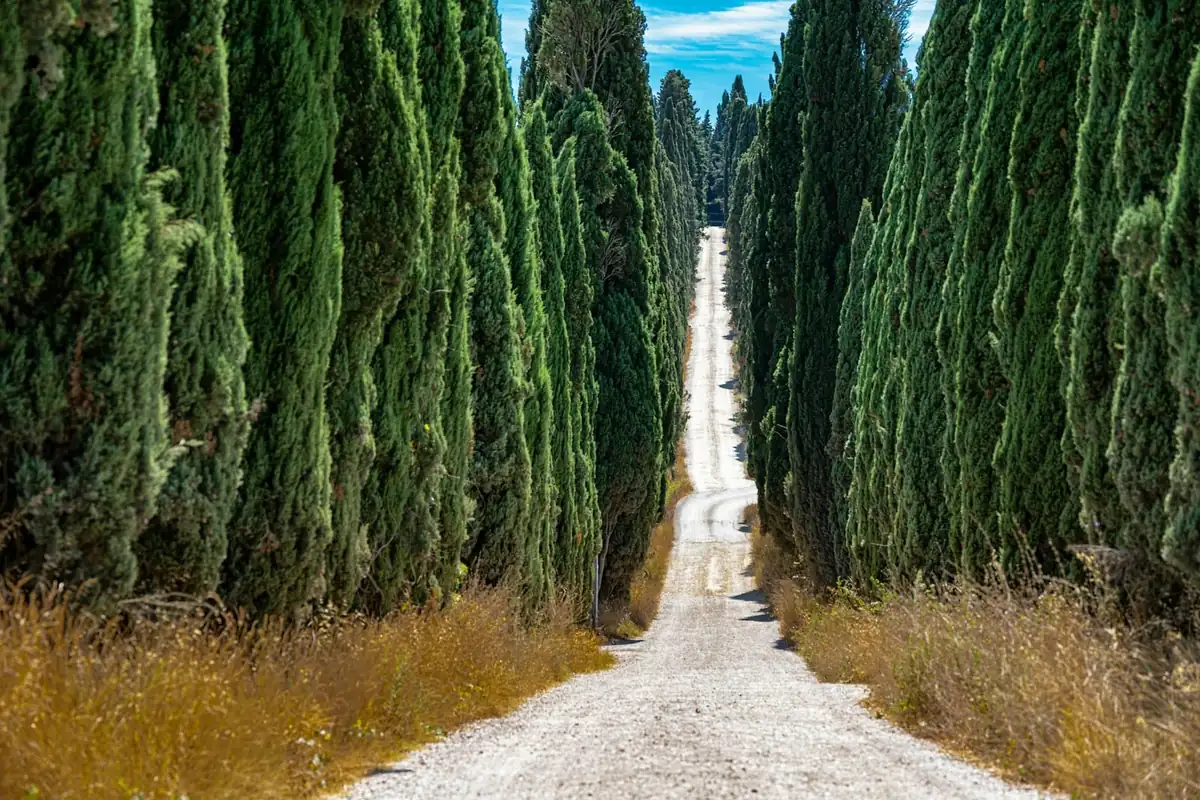
If the Alps are about altitude, Tuscany is about texture: the white gravel Strade Bianche, the cypress alleys, the hilltop towns built by merchants who wanted their wealth seen from miles away. Eight days from Pisa to the Maremma coast, almost entirely off tarmac.
The character. This is the gravel most people picture when they imagine riding in Italy, and the reality lives up to it. The first two days follow the southern flank of the Apennines through the Arno valley, past Lucca and Pistoia and into Florence. Then the route turns south into the Chianti Classico zone — rolling clay hills, narrow white gravel roads, vineyard lanes — through San Gimignano with its towers and on to Siena. The queen stage crosses the Crete Senesi, bare clay hills that go almost lunar in the September light, before climbing into Brunello di Montalcino wine country. It finishes with a ridge crossing and a long descent through the Maremma to a beach spa hotel on the Tyrrhenian coast — a swim in the Mediterranean and a gala dinner at the end of the road.
The terrain. Mostly unpaved: compacted limestone and clay, smooth in places and loose in others depending on season and weather. Across the week, 460–615 km with 5,000–9,950 m of climbing — graded intermediate to challenging. No technical difficulty to speak of, just fitness and pacing. The Adventure route runs gentler valley lines; the Explorer route adds climbs toward Monte Serra and Pistoia and a forest singletrack detour or two. This is one of the few routes where rental bikes are easy to arrange locally through our partner in Pisa, which makes it a natural first supported tour.
The season. Classic September riding — golden light, stable temperatures, the vines heavy before harvest. There is also an early-June departure in 2027 for those who prefer the longer days and the green of late spring. September evenings in the hills can still drop to 10–12°C, so a light layer earns its place.
Who it’s for. Riders who want the riding and the place in equal measure — the food, the wine, the Renaissance hill towns — without sacrificing the quality of the gravel. It is comprehensively rideable for a confident gravel rider, and the steadier Adventure route makes it one of our more approachable weeks. Our Tuscany destination guide goes stage by stage.
The Pyrenees — the great Atlantic-to-Mediterranean traverse
The Trans Pyrenees Gravel is our longest and most demanding tour, and one of the great point-to-point gravel journeys anywhere: the full length of the Pyrenees from the Atlantic to the Mediterranean, San Sebastián to Roses, eight riding stages over ten nights, 780 km, mostly unpaved.
The character. This is sea-to-sea across an entire mountain range, and the riding changes completely as you cross it. The first stages climb out of San Sebastián into the Basque hills — green, wet, technical, with steep climbs and big ridge lines and long gravel passages above 1,000 metres — before crossing into the high Pyrenees proper via Roncesvalles. From Jaca eastward the character shifts: longer climbs, drier air, fewer villages, more altitude. The central section through Ordesa and the Noguera Ribagorzana valley is among the most remote on any route we run, and the Zona Zero gravel country around Aínsa is legendary among riders who know it. The last days carry the sense of the Mediterranean drawing closer even high in the mountains, until the final descent delivers you to the sea at Roses on the Costa Brava.
The terrain. Eight stages, run as a single Explorer level — there is no soft option here. Expect 5–7 hour days, 1,500–3,000 m of climbing per stage, and 17,000–20,000 m of cumulative ascent across the week. The hardest day, Aínsa to El Pont de Suert, packs one of the longest climbs of the route and 2,900 m of ascent. Note that guided groups on this tour run eight to ten riders per guide. A rest day in the medieval town of Aínsa sits two-thirds of the way through.
The season. September, when the high passes are clear and the air is dry. Both the 2026 and 2027 departures run in the first half of the month.
Who it’s for. Strong, experienced riders with real endurance who want one of the big lines — the sort of crossing you spend the rest of the year telling people about. This is not a first supported tour. If you can ride long gravel days back to back and still enjoy your dinner, and the idea of crossing an entire range from one sea to the other quickens the pulse, this is the one. More on it in our Pyrenees gravel guide.
Scotland — the emptiest gravel in Europe, coast to coast
The Highlands Scotland Gravel is a full coast-to-coast traverse of the Scottish Highlands — Fort William on the Atlantic to Montrose on the North Sea — on some of the emptiest, most genuinely rideable gravel anywhere on the continent.
The character. What sets Scotland apart is the scale of the emptiness. Much of the best riding here was never built for bicycles: after the Jacobite risings, General Wade and his successors cut military roads through the glens, and three centuries later long stretches survive as firm, well-drained gravel and estate track. Add the forestry roads and old drove routes, and you have a backcountry network that crosses almost the entire country off tarmac. You ride through the Great Glen past Loch Ness, climb toward the Cairngorms — the largest tract of wild high land in Britain — reach Tomintoul, Scotland’s highest village, and on the signature day run through Glen Builg, where the track unspools for kilometres with no fence, no car, no other soul, just heather and an enormous sky. Then the country softens to Deeside and down to the salt smell of the North Sea.
The terrain. Five riding stages, 520–540 km, with 5,100–6,500 m of climbing — graded intermediate to challenging. Roughly 80–110 km and 1,000–1,300 m per day. It is about distance, weather and remoteness rather than technical riding: fast estate track, looser original military road, exposed moorland that is occasionally wet underwheel, and sustained (if not Alpine) climbs. A rest day in Tomintoul, on the edge of Speyside whisky country, sits in the middle.
The season. Late June to mid-September, with departures in high summer and early autumn. High summer brings the longest days this far north; September brings quieter trails, the first turn of colour on the moor, and far fewer midges. Scottish weather is changeable in any month — you ride prepared rather than ride around it, with a proper waterproof always in the day bag.
Who it’s for. Riders who value space and solitude over café culture, and who find the idea of crossing a whole country on old roads more appealing than ticking off famous climbs. It rewards endurance and good pacing, which is exactly what experienced riders tend to bring. Our full Scotland Highlands gravel guide covers it glen by glen.
The Algarve — Portugal’s quiet interior, east to west
Most people think of the Algarve as a coastline. The Trans Algarve Gravel ignores the coast almost entirely and crosses southern Portugal’s quiet interior from east to west — Tavira to Sagres, on the ancient Via Algarviana through cork-oak forest and the Serra de Monchique, finishing at the south-western tip of continental Europe.
The character. This is the Algarve few visitors ever see. The route leaves the coast behind on day one and climbs into the Serra do Caldeirão and the cork-oak hills of the interior, through villages that have barely changed in a century and on roads that are almost entirely empty. The Serra de Monchique in the centre rises to nearly 900 metres and brings the most dramatic climbing — from the summit ridge you can see both coastlines on a clear October morning. Then a long descent toward the Atlantic at Aljezur, and a final run along the wild south-west coast through cliff-edge tracks to Cabo de São Vicente and Sagres, the edge of Europe with the Atlantic wind in your face.
The terrain. Five riding stages, 300–350 km, with 5,000–7,500 m of cumulative climbing — but the daily distances are short, which is the point. There is time to enjoy the light, and the days finish with something left in the legs. The Adventure route is among the most approachable we run; the Explorer route adds distance and climbing. As in Tuscany, rental bikes are straightforward here through a reliable local partner, delivered to the start hotel.
The season. October, firmly. The summer crowds are gone, the temperatures are mild, and the afternoon light turns golden. The hills can still be cool at 10–12°C, so a light layer earns its place.
Who it’s for. Riders who want a genuinely beautiful, quiet week without the biggest days — a strong candidate for a first hotel-to-hotel gravel tour, or for anyone who would rather have time in the afternoon than chase a long stage. It pairs the satisfaction of a real country crossing with manageable distances. We go deeper in our Algarve gravel guide.
Cyprus — spring riding, coast to coast over the Troodos
The Trans Cyprus Gravel is a compact, high-quality crossing of an island most cyclists never think to ride: Larnaca to Paphos via the Troodos Mountains, east to west, on gravel roads few maps know.
The character. Cyprus in spring is genuinely overlooked, and the contrast within a single day is what makes it. At sea level the air is warm and the roads are open; the route then climbs through limestone hills and monastery roads — past Stavrovouni Monastery and the white-earth tracks where line choice starts to matter — into the Troodos, where the high point sits above 1,800 metres among cedar and pine. The gravel roads up here are largely unknown outside the island: wide, well-graded forest tracks connecting villages that see almost no through traffic. Then the long descents through valleys and forest toward the Akamas peninsula and the run down to the Mediterranean at Paphos.
The terrain. Five riding stages, 300–375 km, with 5,500–8,000 m of cumulative climbing. Distances are moderate but there is real climbing — the route reaches near 2,000 m. The Adventure route suits 3–4 hour days; the Explorer route adds elevation. A rest day near Mount Olympos sits in the middle. The limestone tracks are rocky in places, so tubeless tyres are worth their weight.
The season. Spring — the single departure runs late April into early May 2027. That is the right month: wildflowers on the upper stages, cool air at altitude, warm evenings at sea level. For riders who want to start the year early, Cyprus is the answer the rest of the calendar cannot give.
Who it’s for. Riders who like the idea of a quieter, more unusual destination, and who want a spring objective when the alpine and northern routes are still out of season. The moderate distances and the spring timing make it a fine choice for a rider building toward a bigger summer crossing. Our Cyprus gravel guide has the full picture.
Beyond Europe — South Africa’s Western Cape
We should be honest about this one: South Africa is not in Europe. But it belongs on any serious gravel rider’s list, and it is the route our European guests most often ride next, so it earns its place here as a bonus — clearly flagged as the long-haul exception.
The character. The tour crosses the Western Cape in nine days and three distinct landscapes: the Cape Winelands, the Klein Karoo semi-desert, and the Overberg, on up to 84% gravel. The defining day is the Swartberg Pass — nearly 1,000 metres of climbing on a Victorian-era gravel road still in its original condition, with a view from the top that stops you. From there the character changes completely: wider skies, longer distances between villages, red dirt farm roads with almost no traffic. It finishes back in the Winelands at Franschhoek, over the Franschhoek Pass — where, memorably, baboons tend to hold the road on the descent.
The terrain and season. Seven riding stages, 480–660 km, 5,500–8,000 m of climbing — intermediate to challenging, with some long days over big passes. Because it is the southern hemisphere, the season is our winter: departures run November, late February and early December, the Cape’s early summer. That counter-season timing is part of the appeal, giving you a gravel week when Europe is cold.
Who it’s for. Riders who have done a European crossing or two and want something further afield. It is the natural next step after the Alps or the Pyrenees. Our South Africa gravel guide tells the full story; just plan for the long-haul flights and the visa where it applies.
So which one should you ride?
Here is the honest short version, the way we would put it over a coffee.
- Your first supported gravel week: the Algarve or Tuscany — manageable distances or a steady Adventure line, rental bikes available, and a real crossing without the biggest days.
- The famous climbs and the full alpine drama: the Trans Alp, with the Stelvio on the Explorer route and Lake Garda at the finish.
- The biggest line you can ride: the Trans Pyrenees, sea to sea across an entire range — only if your endurance is genuinely there.
- Space, solitude and emptiness: Scotland, coast to coast on roads built three centuries before the bicycle.
- An early-season or off-beat objective: Cyprus in spring, over the Troodos.
- A reason to fly south when Europe is cold: South Africa, three landscapes and the Swartberg Pass.
Spread across the year, they make a rather good calendar: Cyprus in spring, Tuscany and the Alps in summer, the Pyrenees and Scotland in late summer, the Algarve in October, South Africa when the nights draw in. More than one rider has worked through several of them, one a year, and we are always quietly pleased when someone comes back for the next crossing.
What a supported, hotel-to-hotel week includes
The reason these routes work as a week away — rather than a logistical project you spend months planning — is the supported, hotel-to-hotel model. It is the same on every tour above, so it is worth setting out once.
You carry the riding; we carry everything else. You ride point to point and sleep in a different hotel each night — hand-picked places chosen for location and a good dinner, from South Tyrolean mountain hotels to Tuscan agriturismi, Highland lodges, Algarve quintas and Karoo farm stays. Your luggage travels in the support van between hotels and is waiting for you when you arrive; you ride with only a day bag. The support vehicle is on the route through the day for a spare, a mechanical or a lift, carrying tools, spare parts and a spare bike, with mechanic help from the crew (you pay only for parts, at cost). The van meets the group most days at lunch, where you can change kit, refill your bottles, the energy-drink refill free (energy bars and chews available to buy).
Guided or self-guided, your choice. On a guided tour an experienced English-speaking guide leads each stage and handles the navigation — up to ten riders per guide, eight to ten on the Trans Pyrenees — which is a genuine comfort in remote terrain and the more sociable way to ride. On a self-guided tour you take the full GPS route for Garmin, Wahoo and Komoot and ride at your own pace, not tied to a group, with the same hotels, the same luggage transfer and the same vehicle behind you. Most riders mix the two. Either way, how our tours work walks through the support in detail, and the two daily pace options are explained on our tour levels page.
What’s in the price. Every tour includes the hotel nights in a shared double room, breakfast daily and a number of dinners (including the celebration dinner at the finish), the daily luggage transfer, the support vehicle, GPS routes, a Gravel-Adventure jersey, a shared photo album and lifetime membership of the RIDERS network. You arrange your own flights; most tours include the relevant airport or start-point transfers. A €500-per-rider deposit secures a place, with the balance due 60 days before departure.
We are a small, family-run company — the same Danish crew behind MTB-Adventure — and we have been running cycling trips since 2013. We ride and test every route ourselves before it goes on sale, which is the only reason we are comfortable writing about them the way we have here.
Where to start
If one of these has been sitting at the back of your mind, the best next step is simply to look at the route in detail. Each tour page has the full day-by-day, the 2026 and 2027 departure dates, the distances and climbing per stage, and exactly what is included: the Trans Alp, Tuscany, Trans Pyrenees, Scotland Highlands, Trans Algarve, Trans Cyprus and, beyond Europe, South Africa. You can browse them all from the tours overview, and the rest of the Journal goes deeper on each destination, on training for a multi-day tour, and on what to pack.
There is no rush and nothing to miss — these routes will still be here next season. But if this is the year you cross the Alps, or ride from the Atlantic to the Mediterranean, or draw a clean line across Scotland, we would be glad to carry the rest while you ride it.
Questions riders ask
What is the best gravel cycling destination in Europe for a first supported tour?
For a first hotel-to-hotel gravel week, the Algarve and Tuscany are the gentlest doors in. The Trans Algarve covers 300–350 km over five short stages with a mid-tour rest day, so the days finish with time to spare; Tuscany offers a steadier Adventure route alongside the longer Explorer one. Both have rental bikes available locally, both reward riders who would rather travel well than race, and both run with two daily pace options so mixed-ability groups stay together. If you already ride long gravel days at home, the Alps, Scotland and the Pyrenees are all within reach too — they simply ask more endurance.
When is the best time of year to go gravel cycling in Europe?
It depends on the region, which is part of why a calendar of destinations is so useful. The Alps and Scotland ride best in high summer and early autumn (late June to mid-September), when the high passes are clear and the tracks firm. Tuscany and the Pyrenees are classic September riding, with golden light and stable temperatures. The Algarve comes into its own in October, once the summer crowds have gone. Cyprus is a spring destination, ridden in late April with wildflowers high in the Troodos. Spread across the year, the six routes give you a reason to ride almost any month.
What makes gravel cycling in Europe different from riding gravel at home?
Scale and continuity. The best European gravel routes link into genuine point-to-point journeys — an entire mountain range, a full country crossing, coast to coast — rather than loops from a single base. You ride from the Atlantic to the Mediterranean across the Pyrenees, or from Germany over the Alps to Lake Garda, sleeping in a different hotel each night and watching the landscape change beneath your wheels. Much of the surface was never built for bicycles: old military roads, drove routes, Victorian mountain passes and ancient pilgrim tracks that happen to ride beautifully on 40 mm tyres.
Do I need to be an experienced rider for these gravel destinations?
These are routes for capable, experienced riders rather than beginners — most of our guests are experienced riders who have ridden for years. You should be comfortable on a gravel bike in hilly terrain over consecutive days, and confident handling loose surfaces. You do not need to be fast: every tour runs two daily pace options, a genuine mid-week rest day, and a support vehicle on the route, so endurance and good pacing matter far more than speed. The Pyrenees is the most demanding; the Algarve and Tuscany the most approachable.
How does riding these destinations hotel-to-hotel actually work?
You ride point to point and sleep in a different hotel each night, while your luggage travels in the support van and waits for you at the next hotel. The van is on the route through the day for a spare, a mechanical or a lift, and it meets the group most days at lunch with a free energy-drink refill (energy bars and chews available to buy). You can ride guided — with an experienced English-speaking guide navigating, up to ten riders per guide (eight to ten on the Trans Pyrenees) — or self-guided on the full GPS route for Garmin, Wahoo and Komoot. Either way the hotels, the luggage transfer and the support are identical. You arrange your own flights; we handle the rest.
Planning a gravel week of your own?