Why Experienced Cyclists Keep Switching to Multi-Day Gravel Touring
A road racer we know well spent fifteen years building a season around a handful of timed days — the same loop, the same car park, the same effort measured against a clock and a results sheet. Then, three years ago, he rode a week with us across the Alps and came home having barely looked at his power meter. What he talked about instead was a bell tower sticking out of a lake, a descent into Merano with the Dolomites behind him, and a dinner in a village he’d never have found on his own. He has booked a different tour with us every year since, and he has not raced a crit in two seasons.
We hear some version of that story often enough that it stopped being an anecdote and started being a pattern. Strong road riders tired of chasing the same loop. Serious mountain bikers whose knees have quietly asked for fewer rock gardens and more distance. Both groups keep arriving, independently, at the same answer: a supported, point-to-point gravel week. This is an honest account of why, written for the rider still deciding whether gravel touring is actually for them — not a sales pitch, but gravel cycling route inspiration grounded in what the switch genuinely changes.
What a road racer notices first
The first thing most road riders feel on gravel is relief, which surprises them. Racing rewards narrow margins — a wheel’s width in a bunch sprint, a few watts over threshold, a result that either happened or didn’t. Multi-day gravel touring removes nearly all of that. There’s no bunch to fight for position in, no clock deciding whether the day mattered. What’s left is the thing that drew most road riders into cycling in the first place: a bike, a long day, and a line across real country.
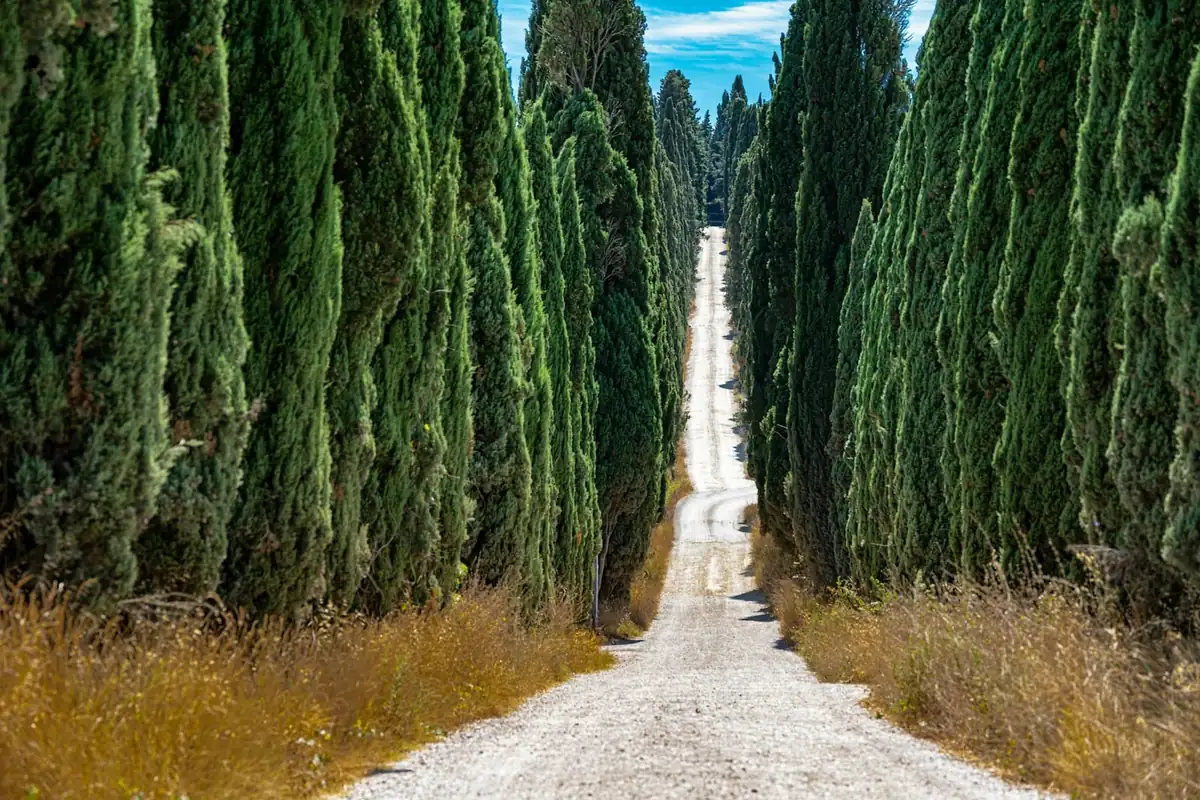
The surfaces help the transition along. Tuscany’s white gravel roads — the Strade Bianche, the same roads the professional one-day race takes its name from — are a natural first step for a rider who has only ever known tarmac. They’re compacted limestone and clay, firm and fast when dry, and the tour’s own route notes describe them as “generally rideable on standard gravel tyres” with the Chianti stages holding the most iconic sections. A road rider arrives expecting to feel out of their depth and instead finds a surface that rewards the same smooth, efficient pedalling they already have.
What does change, and what most road converts underestimate, is the bike itself. Every route we run calls for a minimum 38 mm tyre and a gravel-specific gear range — a road bike, however good, isn’t suitable on any of the seven. That’s not a small adjustment, but it’s the only one most road riders need to make before the rest of the skillset — pacing, reading the road, riding efficiently for hours — transfers directly.
What a mountain biker notices first
Mountain bikers arrive from the opposite direction, and what strikes them first is usually distance. A technical MTB ride measures itself in metres of elevation and features cleared; a multi-day gravel tour measures itself in the country it crosses. The Trans Pyrenees runs 780 km over eleven days, Atlantic to Mediterranean, with 17,000–20,000 m of cumulative climbing across eight riding stages — a scale that dwarfs almost any trail-centre weekend, carried entirely on roads an MTB rider can ride without technical drama.
The terrain itself is the other draw. Highlands Scotland Gravel crosses the northern half of Britain — Fort William on the Atlantic to Montrose on the North Sea — almost entirely on forestry roads, droving routes, moorland tracks and the old General Wade military road, over 520–540 km and 5,100–6,500 m of climbing across five stages. The tour’s own fitness FAQ is explicit that the Explorer route “is about distance, weather and remoteness rather than technical riding.” For a mountain biker used to reading a trail metre by metre, that’s a genuine change of register — less about line choice through a feature, more about pacing yourself across a glen with no fence, no car and no one else in sight for hours. South Africa offers the same trade from a different landscape: thorny farm roads and sharp-stone sections across the Western Cape rather than rock gardens, with the reward being real distance through genuinely remote country rather than a loop you already know.
What carries over cleanly is bike handling and self-sufficiency — reading a loose surface, staying relaxed over washboard and stones, fixing your own puncture mid-stage. What’s new is the week-long rhythm: ride, arrive somewhere different, sleep, ride again, rather than a single intense session and a drive home.
Where gravel cycling route inspiration actually comes from
Neither group is chasing a photograph. The riders who switch and stay switched are usually chasing a specific, remembered morning — the kind that only comes from riding a route built around real terrain rather than a route built to be ridden twice. The Stelvio’s hairpins on the Trans Alp. The Crete Senesi’s bare clay hills on day six of Tuscany, “long climbs, long descents, no technical difficulty — just fitness and pacing.” Glen Builg on Scotland’s sixth stage, where the tarmac simply stops and doesn’t come back for hours. The Swartberg Pass outside Prince Albert, still carrying the dry-stone walls of the 1880s road it was engineered as.
These moments aren’t curated for Instagram; they’re what’s actually on the itinerary, on the pace most riders already ride by default. That’s the real source of gravel cycling route inspiration for anyone weighing a switch: not a feed of other people’s photos, but the knowledge that a specific, demanding, beautiful day of riding is genuinely on the map, reachable on a bike you can own and ride at home.
Why the switch usually means a supported tour, not a solo trip
Plenty of strong riders could, in theory, plan and ride a route like this unsupported — carrying camping kit, booking their own string of guesthouses, navigating cold. Some do, and love it; we’ve written honestly about that choice in our comparison of supported touring and bikepacking. But most riders switching from road racing or serious mountain biking already have a precious, limited amount of annual leave, and they’ve usually spent years being the one who plans, drives, and fixes things for a club or a riding group. What they want from a gravel week isn’t another logistics project — it’s a week where the only decision left is how hard to ride that day.
That’s the actual case for a supported, hotel-to-hotel model: the route is scouted and tested before it’s sold, a support van carries the luggage and meets the group most days at lunch, and either a guide navigates for you or you ride the same line yourself from a GPS file at your own pace. Every tour is graded Adventure (55–85 km a day, 600–1,500 m of climbing) or Explorer (70–100 km a day, 1,200–2,500 m), so the question is never “can I keep up” but “which pace matches the rider I am this year.” The Trans Pyrenees is the one exception worth naming honestly: it runs as a single, hardest-tier level with no softer daily option, 1,200–2,900 m of climbing a stage — it’s the route for a rider who already knows they want the harder end of the range. Full detail on how levels and pacing actually work is on our tour levels page.
What a supported gravel week actually gives you
Stated plainly, because it’s worth knowing exactly what you’re buying into before you commit a week to it: hand-picked hotels, a different one most nights, with your main bag carried ahead by the support van and waiting for you on arrival. A support vehicle on the road all day, carrying spares, a spare bike and a mechanic, with parts available at cost. A lunch stop most days where you can change kit and refill your energy drink for free. Breakfast every day and some dinners included, guided or self-guided on every route, and English-speaking guides on the guided option. You arrange your own flights; the rest — the planning, the bag, the mechanical safety net — is carried for you. The full mechanics are set out on how our tours work, and our longer piece on what a supported gravel tour actually is goes deeper still for anyone who wants the whole model before booking.
Matching the switch to the right route
If you’re coming from road racing and want the surface that will feel most familiar fastest, Tuscany’s Strade Bianche are the gentlest introduction, with the Trans Pyrenees waiting once you want the hardest sustained climbing we offer anywhere. If you’re coming from mountain biking and want scale over technicality, Scotland’s empty Highland crossing or South Africa’s Western Cape will feel like the natural next step up from a trail-centre weekend — real distance, real remoteness, nothing a capable MTB rider with the right tyres can’t handle. The Alps and Cyprus sit between the two, each with their own single defining climb. None of this is a rule; plenty of road converts end up loving Scotland’s wildness and plenty of mountain bikers fall for the Pyrenees’ pure climbing. If you want the full route-by-route breakdown rather than the short version here, our comparison of which gravel tour is right for you walks through all seven in depth.
The honest truth is that the switch rarely needs a reason beyond curiosity. Most of the riders we meet who’ve made it didn’t set out to leave road racing or mountain biking behind — they just took one week on a gravel bike, somewhere real, and found they wanted another. If that’s starting to sound familiar, our tours has all seven routes, their dates and what’s included, and we’re glad to talk through which one fits the rider you are now.
Questions riders ask
Do I need to be a racer to enjoy a multi-day gravel tour?
No, and the people who switch from racing are often relieved to hear it. Every route we run offers two daily pace options — Adventure and Explorer — so a strong rider and a merely fit one ride their own day and still share the same hotel at night. Guided groups are capped at a maximum of ten riders per guide (eight to ten on the Trans Pyrenees), small enough that the pace flexes to the people in it. Endurance and sensible pacing matter far more than raw speed.
Can I ride a multi-day gravel tour on my road bike or mountain bike?
Not as they come stock. Every tour we run specifies a gravel bike — mechanical or e-assist — or a light MTB fitted with suitable tyres and gearing; road bikes and hybrids aren't suitable on any route. The baseline across all seven tours is a minimum 38 mm tyre, tubeless strongly recommended, and a low gear around 0.9 for the climbs. A capable MTB with the right rubber swapped on works; a narrow-tyred road bike does not.
Is multi-day gravel touring technical, the way mountain biking can be?
Generally no. Our routes are built around fitness, distance and remoteness rather than technical skill — the Highlands Scotland FAQ puts it plainly: the Explorer route asks for 'the confidence to navigate loose gravel and estate tracks independently,' which is about terrain and weather, not technical riding. Tuscany's queen stage through the Crete Senesi is 'long climbs, long descents, no technical difficulty — just fitness and pacing.' If you've ridden singletrack, these roads will feel wide and forgiving by comparison.
Which of your routes suits a rider switching from road racing, and which suits a mountain biker?
There's no strict rule, but the grain of each route does lean one way. Tuscany and the Trans Pyrenees reward a road background — Tuscany's Strade Bianche are the same white roads the professional race is named after, and the Pyrenees is pure sustained climbing, 1,200–2,900 m a stage. Scotland and South Africa reward a mountain-bike background — remote estate tracks, droving routes and farm roads where handling and self-sufficiency matter more than a smooth cadence. Most riders end up loving a route built for the other temperament just as much.
How is a multi-day gravel tour different from a one-day gravel sportive or gran fondo?
A sportive is a single timed day, usually a loop, back at your car or hotel by evening — you carry what you need and the structure ends when the ride does. A multi-day tour like ours is a week-long, point-to-point journey: a different hotel each night, your luggage carried ahead in a support van, and the terrain, weather and fatigue compounding gently over several days rather than one hard effort. It rewards pacing and recovery over a single peak performance.
Planning a gravel week of your own?