Tavira to Sagres — across the cork oak hills to the edge of Europe.
About this tour
Trans Algarve Gravel crosses southern Portugal from east to west — Tavira on the Spanish border to Sagres at the edge of Europe — on quiet gravel through cork oak forest, mountain roads, and coastal headlands. Five riding stages, 345 to 435 kilometres, with 4,300 to 6,800 metres of cumulative elevation. October is the right month: the summer crowds are gone, the temperatures are mild, and the light turns golden in the afternoons.
The route avoids the coastal strip entirely. Instead, it follows the Via Algarviana — the ancient cross-Algarve route through the interior — climbing through the Serra do Caldeirão into the cork oak hills that most visitors to the Algarve never see. The villages up here have barely changed in a century. The gravel is loose and dusty in places; the roads are almost entirely empty.
The Serra de Monchique in the centre of the route rises to nearly 900 metres and brings the most dramatic climbing of the tour. From the summit ridge you can see both coastlines on a clear October morning. The descent toward Aljezur and the Atlantic brings the character of the riding sharply back to the coast.
The final stages follow the southwest coast through Carrapateira and on to Cabo de São Vicente and Sagres — the southwestern tip of continental Europe. English-speaking guides lead daily; GPS tracks available. Support vehicle handles luggage throughout.
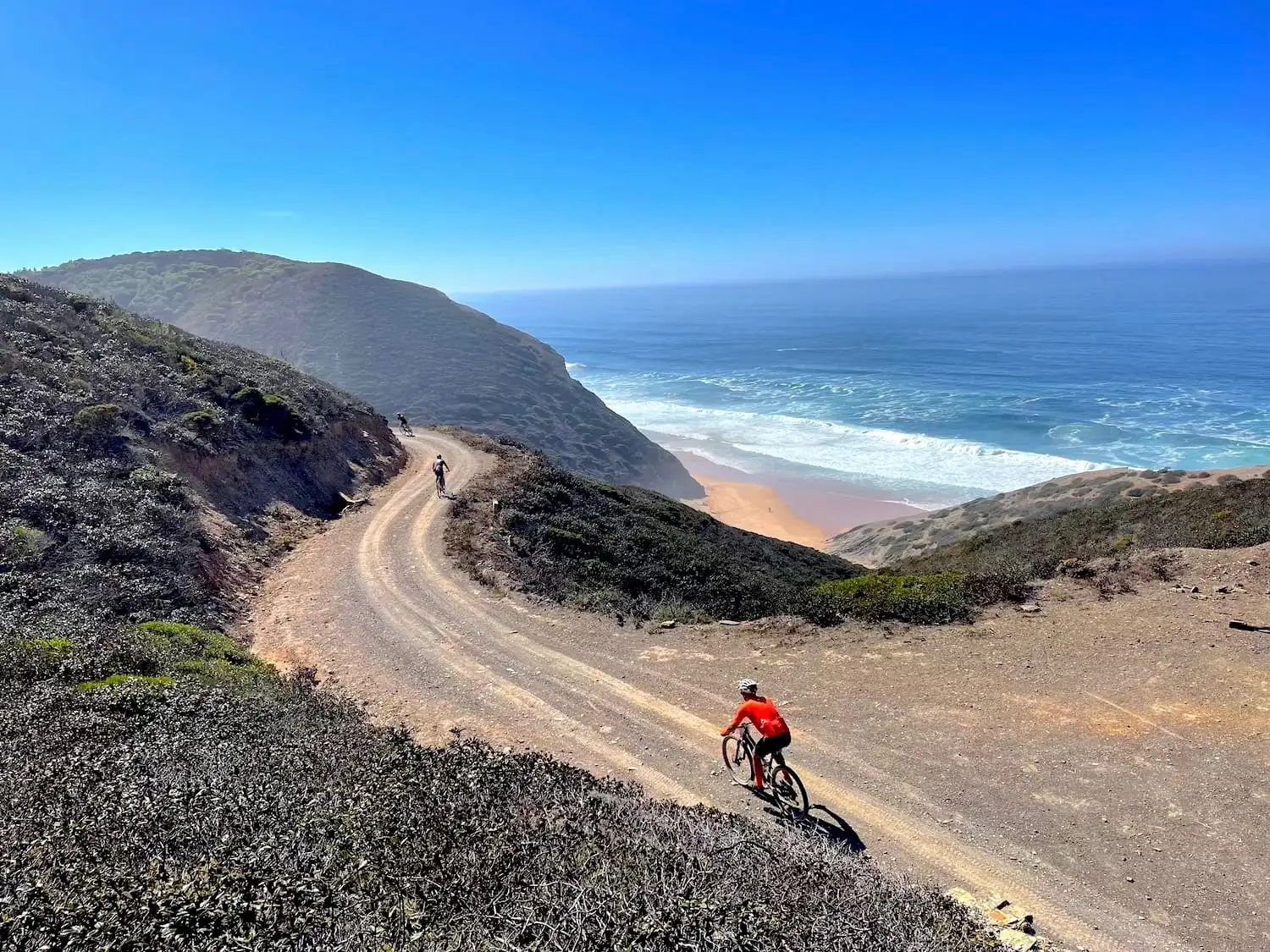
The Algarve on gravel is something most people haven't imagined. The coast stays in the distance as you ride from east to west — through citrus groves, cork forest and the hills of Serra de Monchique — until the Atlantic opens up at Sagres on the final day.
Route overview
345–435 km · 4,300–6,800 m total · Tavira → Sagres, Portugal
What you get
Cork oak forest, mountain roads, coastal headlands and ancient mule tracks through an interior Portugal few tourists reach.
Seven nights in small guesthouses and rural quintas in the Algarve interior — not a resort hotel in sight.
The route ends at the edge of Europe — Cabo de São Vicente, the Atlantic wind, and the feeling of having crossed southern Portugal on gravel.
Day by day
Fly to Faro and transfer to Tavira. After settling in and a light intro gravel ride, the evening brings the welcome meeting and group dinner.
Leave the coast behind and climb gently inland through orchards and open country to São Brás de Alportel, the gateway town to the Serra do Caldeirão. Long, rolling gravel where the pace finds itself.
Rough, continuous gravel through the cork-oak hills of the interior before the land tips back toward the central Algarve, the day ending near the coast at Açoteias.
The coastal atmosphere gives way to the green slopes of the Serra de Monchique. A climbing day that finishes at the thermal spa village of Caldas de Monchique.
Set your own tempo — the thermal spa and pool, or an extra gravel loop and viewpoints high in the Serra. The guide offers route options so you get the day you want.
The most dramatic climbing of the tour up the Monchique ridge, then a long descent toward the Atlantic on fine gravel, the air turning coastal as Aljezur nears.
The wild southwest coast toward Europe's south-western tip — cliff-edge tracks, short punchy climbs and the Atlantic alongside. As Sagres comes into view, the crossing is complete.
Transfer to Faro airport at scheduled times, or extend your stay — we're happy to advise on extra nights.
How we ride
Follow the guide across the passes and long descents. The support vehicle is positioned at key points, navigation and logistics are handled — you focus on the riding.
Load the day's route and set off when you're ready — you control the breaks and stops. The crew is positioned along the route and meets you at the hotel each evening.
Every tour is run in English — guiding, daily briefings, route notes and all documents are in English.
What's included
Common questions
Daily distances here are shorter, which makes it one of our more approachable tours. The Adventure route suits riders comfortable with 3–4 hours in the saddle over consecutive days; the Explorer route adds distance and climbing and the confidence to navigate loose gravel independently.
A gravel bike (mechanical or e-assist), or a light MTB with suitable tyres and gearing — road bikes and hybrids aren't suitable. Minimum 38 mm tyres (wider is better), tubeless strongly recommended for the dry trails and cork-forest paths, and a low gear around 0.9 for the climbs. Have it freshly serviced before you travel.
Yes. If you'd rather skip the transport and packing, you can rent locally through our long-term, reliable Algarve partner. Bikes are delivered to the start hotel and collected from the finish hotel, and we send the full rental details once you've booked the tour.
Both, daily. An English-speaking guide leads each stage at a relaxed pace, or follow the GPS files (Garmin, Wahoo, Komoot) at your own — the manageable distances make self-guided riding very easy here. The support vehicle follows the route regardless.
The support vehicle carries tools, spares and a spare bike, and the guides help with repairs — you only pay for parts. On Explorer stages you may be further from the vehicle, so be able to handle a puncture or chain issue yourself.
Very much so — the shorter days, mid-tour rest day and option of the support vehicle make this a good first hotel-to-hotel gravel tour. Most of our riders are 45–65. Cycling fitness and multi-day experience matter more than age.
Yes — many riders come solo. Groups are up to 10 per guide and typically international. Accommodation is a shared double room by default; a single-room supplement is available.
Before you go
Fly to Faro (FAO) — direct services are frequent in season. We coordinate shared transfers at set times on the arrival day, and the return transfer to Faro airport on the final day is included in the tour price. Alternatively, fly to Lisbon and transfer to the start at your own cost (roughly 2.5 hours).
Bring a gravel bike (mechanical or e-assist) or a light MTB with suitable tyres and gearing — road bikes and hybrids aren't suitable. Minimum 38 mm tyres (40–45 mm better), tubeless strongly recommended, and a low gear around 0.9 for the steeper climbs. Have it freshly serviced before you travel and carry a spare tube. Rental can be arranged through a local partner — ask when you book.
Comprehensive travel and accident insurance — including medical cover and repatriation — is required and not included. Take out cover that includes cycling before you travel; ask us if you'd like a recommendation.
October days are warm but the hills can be cool (10–12°C), so a light packable layer earns its place, and tubeless tyres handle the dry, dusty trails well. Towels and toiletries are provided. Off-bike: comfortable walking shoes and something smart-casual for dinner.
Intermediate — challenging. This tour is graded Explore & Adventure. You don't need to race, but you should be comfortable riding back-to-back days on mixed terrain. A good benchmark is 70–80 km with 1,000–1,200 m of climbing with energy to spare. See our levels page, or get in touch if you're unsure.
When to go
| Dates | Availability | Price per person |
|---|---|---|
| 2026 | ||
| 3 – 10 Oct 2026 | Open | From €2,695 |
| 2027 | ||
| 2 – 9 Oct 2027 | Open | From €2,695 |
Per person, shared room. Single supplement on request. A deposit secures your place; the balance is due 60 days before departure.
Private & group tours
A cycling club, a group of friends or colleagues — we can arrange a private departure on dates that suit you, same route and same support, just your own group. We also run fully custom private tours for smaller groups.
Also worth considering
Stay in the loop
New routes, trip reports and quiet-season departure alerts — before anyone else. No spam, just the good gravel.
Thanks — you're on the list.