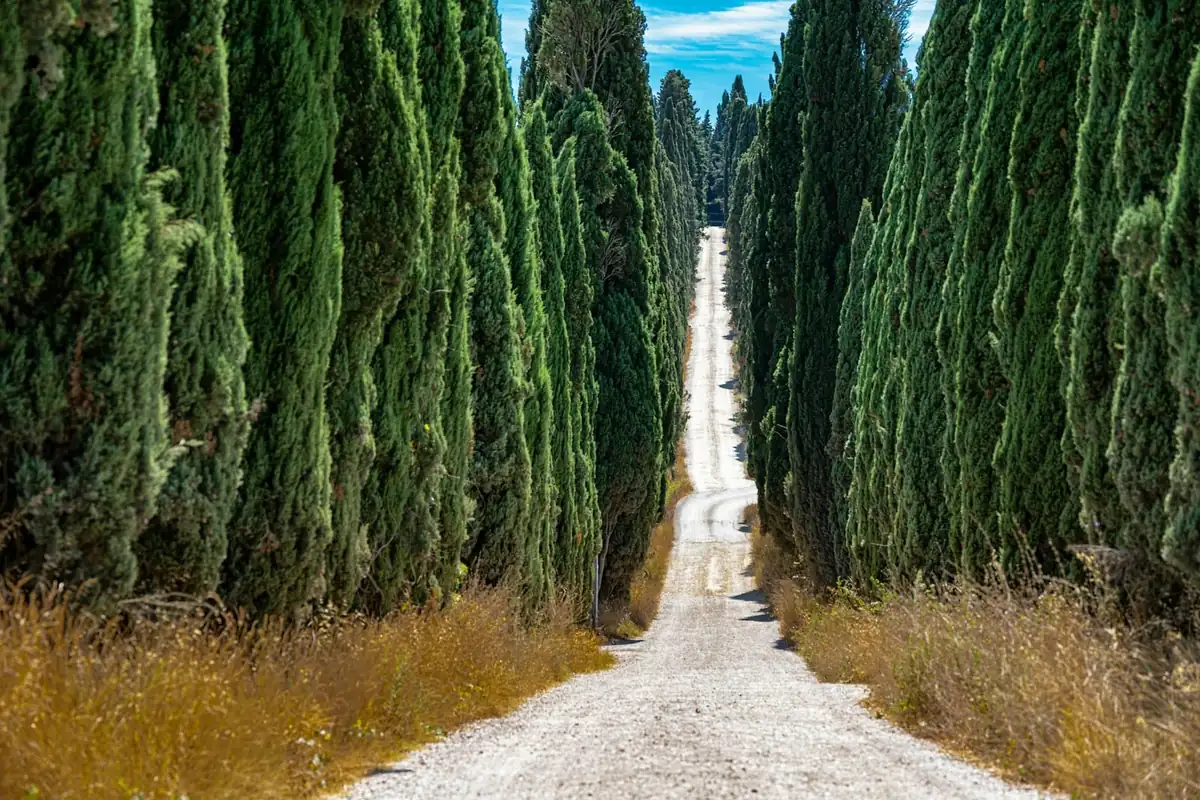
Tavira to Sagres: Gravel Across the Algarve
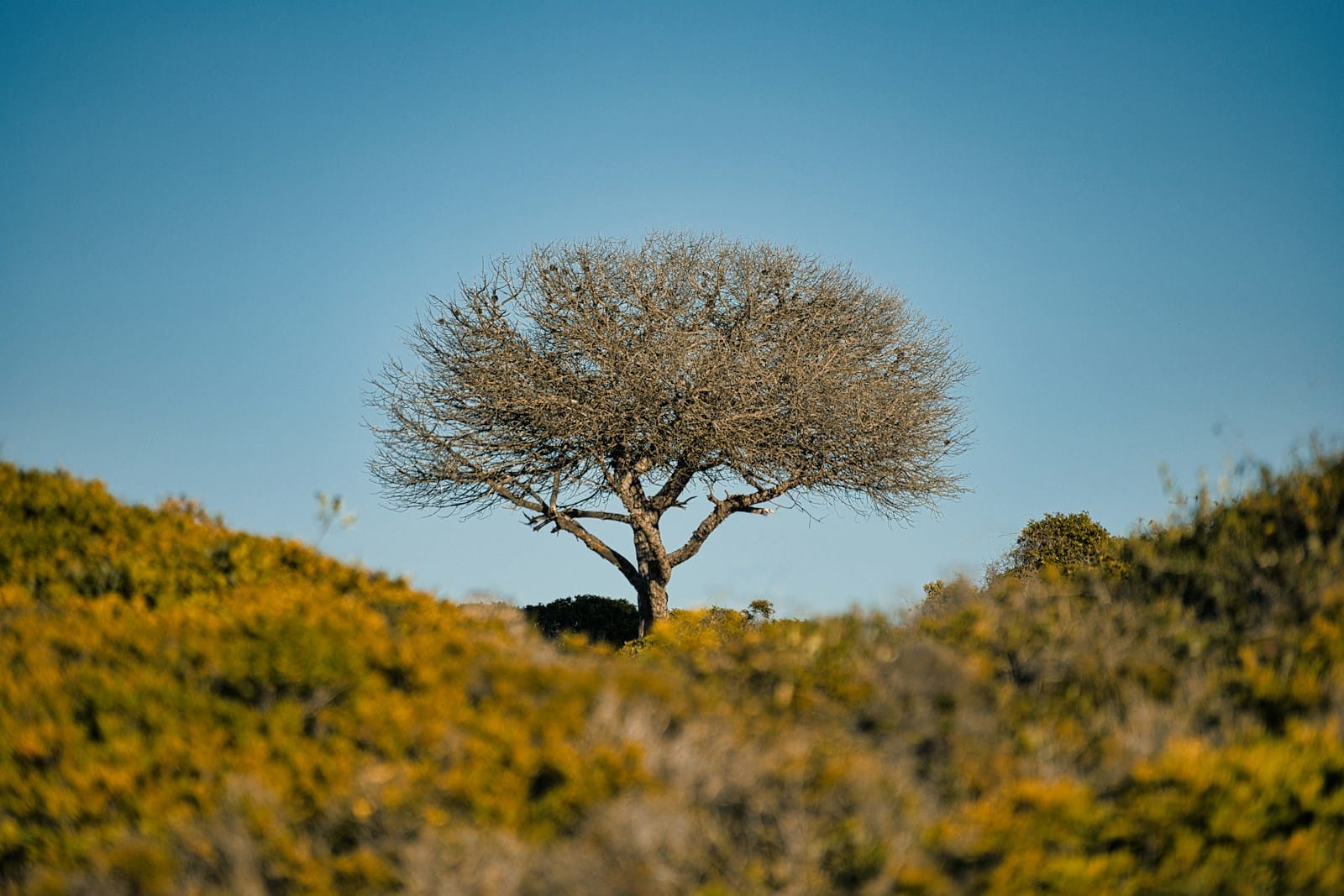
The coast is behind you within the first hour out of Tavira, and it stays behind you for most of a week. That is the thing nobody tells you about the Algarve. You climb away from the salt pans and the orange groves on a gravel road that simply empties out — no cars, no other riders, a Roman-era track threading up into the Serra do Caldeirão — and the southern Portugal of the brochures, the one with the resorts and the golf and the crowded beaches, is gone. In its place is an interior almost nobody rides: cork-oak forest, citrus terraces, white villages that have barely changed in a century, and the kind of quiet you usually have to fly much further to find.
This is a guide to the full crossing — Tavira on the Spanish border to Sagres at the south-western tip of Europe — on a gravel bike, away from the coast, over five riding stages and a week. It follows the Via Algarviana, the ancient cross-Algarve route through the hills, and it ends where the continent does, on the cliffs at Cabo de São Vicente. This is the long version: what the riding is actually like, the route stage by stage, why autumn is the only month to do it, the bike and kit that suit it, and how to ride the whole thing across a week without carrying your own logistics. It’s written for riders who already know their way around a gravel bike and a long day, and who are deciding where to spend a precious week of it.
Why the Algarve is a gravel destination, not a beach
Say “Algarve gravel cycling” to most riders and you get a blank look, or a mention of the coast road. The coast is not where the riding is. The interior of the Algarve — the swathe of hills between the resort strip and the Alentejo plain to the north — is one of the quietest, most rideable corners of southern Europe, and it is laced with gravel: old mule tracks, forestry roads, farm lanes, and the long-distance footpath network that became the Via Algarviana.
The Via Algarviana itself is the spine of the route. It is a waymarked cross-Algarve trail running roughly 300 km from Alcoutim on the Guadiana, near the Spanish border, west to Cabo de São Vicente. Much of it predates any of that signage — these are the tracks by which cork was carried out of the forests and citrus to the coast, the paths that linked villages before the EN roads were ever metalled. For a gravel rider, that history is a gift: routes graded for mules and carts turn out to be close to ideal for a loaded gravel bike, and they connect into a near-continuous line across the whole region off tarmac.
What sets it apart from the better-known gravel regions — the Alps, Tuscany, the Pyrenees — is the emptiness combined with the warmth. You ride for an hour and pass a single farmer and a dog. The villages are small and far apart. There are no café stops every twenty minutes; this is a destination of distance, light and the slow change of a landscape. And because it sits this far south, you can ride it comfortably in October when half of Europe is already shutting down for winter. The interior is genuinely undiscovered terrain, which we explore in more depth in our guide to gravel cycling in Portugal’s Algarve.
The riding is varied rather than relentless. There are long, rolling sections through cork-oak country where you settle into a rhythm and hold a good pace. There are rough, loose stretches of original track that ask for a relaxed grip and a little tyre. There is one proper mountain in the middle — the Serra de Monchique — that delivers the week’s real climbing and, from the top on a clear morning, both coastlines at once. And there is the wild south-west coast at the end, where the gravel runs along cliff edges and the Atlantic wind arrives in your face. It earns its grade of intermediate to challenging, but the shorter daily distances mean it never breaks you. It is paced for riders who would rather travel through a landscape than race across it.
The Tavira to Sagres crossing, stage by stage
The crossing runs east to west over five riding stages, with a rest day in the middle at Caldas de Monchique. It begins at Tavira, an old Moorish town near the Spanish border, and finishes at Sagres, on the wind-blown south-western corner of the continent. Across the week it covers 300 to 350 km and 4,750 to 5,500 m of climbing. Here is how it unfolds.
Arrival — Tavira and a coastal start
You fly into Faro and transfer to Tavira, and the first evening is the welcome meeting and a group dinner. There’s usually time for a light intro gravel ride — 25 to 35 km along the coast to settle the legs, check the bike over and feel the surfaces under your tyres before the real crossing begins. Tavira itself is worth arriving with time to walk: a Roman bridge, a castle, tiled churches, and a working fishing town that has none of the resort gloss of the central Algarve. It is the right place to begin a ride that is about the real Portugal rather than the postcard one.
Stage 1 · Tavira to São Brás de Alportel — into the interior
The first proper stage is the one that sets the tone. You leave the coast behind almost immediately, climbing gently inland through orchards and open country toward São Brás de Alportel, the gateway town to the Serra do Caldeirão. This is long, rolling gravel where the pace finds itself — nothing savage, just a steady tilt upward through citrus groves and the first of the cork oaks, the sea dropping away behind you. By the time you reach São Brás the coast feels like another country. It’s a settling-in day: 60 km on the Adventure route, 75 km on the Explorer, with 600 to 1,000 m of climbing depending on which line you take.
Stage 2 · São Brás de Alportel to Açoteias — the cork-oak hills
The second stage is the heart of the interior. Rough, continuous gravel carries you through the cork-oak hills of the Serra do Caldeirão — the landscape that defines this route. The cork oaks here are stripped on a nine-year cycle, their lower trunks raw and orange where the bark has been taken, the year of the last harvest painted on the trunk in white. It is a working forest, quiet and ancient, and you have it almost entirely to yourself. The day tips back toward the central Algarve and ends near the coast at Açoteias. Expect 70 km and 900 m on the Adventure route, 85 km and 1,300 m on the Explorer — the longest sustained off-road riding of the week so far.
Stage 3 · Açoteias to Caldas de Monchique — into the mountains
Here the character changes. The coastal atmosphere of Açoteias gives way to the green, wooded slopes of the Serra de Monchique, the only real mountain in the Algarve. This is a climbing day, finishing at the thermal spa village of Caldas de Monchique — a small cluster of buildings tucked into a wooded valley, where the Romans once took the waters and people have come for the springs ever since. The gravel steepens, the air cools and sweetens with eucalyptus, and the riding takes on the feel of a proper mountain day. 65 km and 900 m on Adventure, 80 km and 1,400 m on Explorer.
Rest day — Caldas de Monchique
The rest day is placed deliberately, and experienced riders know its value on a crossing like this. You set your own tempo: the thermal spa and pool, a slow morning, a walk in the wooded valley — or, if the legs want it, an extra gravel loop and the viewpoints high in the Serra. The guide offers route options so you get the day you want, whether that’s recovery or another summit. It is the difference between arriving at the Atlantic strong and arriving at it merely relieved. Sitting in a spa village halfway through a country crossing, with three stages done and the best two to come, is a particular kind of satisfaction.
Stage 4 · Caldas de Monchique to Aljezur — down to the Atlantic
This is the signature day. The most dramatic climbing of the tour takes you up the Monchique ridge, toward Fóia, the highest point in the Algarve at just over 900 m. On a clear October morning, from the top, you can see both coastlines at once — the south coast you started from and the west coast you’re heading for, the whole crossing laid out in a single view. Then a long descent toward the Atlantic on fine gravel, the air turning coastal and cool as Aljezur nears, the vegetation shifting from mountain woodland to the low, wind-bent scrub of the south-west. 70 km and 900 m on Adventure, 85 km and 1,400 m on Explorer.
Stage 5 · Aljezur to Sagres — to the end of Europe
The final stage is the wild one. You ride the south-west coast — the Costa Vicentina, a protected stretch of cliffs, surf beaches and almost no development — toward Europe’s south-western tip. Cliff-edge tracks, short punchy climbs, the Atlantic alongside you the whole way, and the wind that this corner is famous for. The route passes through Carrapateira and on toward Cabo de São Vicente, where the land simply ends in a 75-metre cliff and a lighthouse, and the Atlantic stretches to the horizon. Then Sagres, and the crossing is complete: from a Moorish town on the Spanish border to the edge of the known world, on gravel, in a week. 55 km and 700 m on Adventure, 75 km and 1,100 m on Explorer. The closing dinner in Sagres is well earned.
Departure — Sagres to Faro
The final morning is a transfer to Faro airport at scheduled times — or you extend your stay, and we’re happy to advise on extra nights. Many riders do; Sagres and the south-west coast reward a couple of slow days at the end of a hard week.
The terrain: what the riding actually demands
For a rider used to gravel at home, the Algarve surfaces will feel familiar in type but distinct in character — dry, dusty, and varied. Expect:
- Rolling cork-forest and farm track — firm, fast in places, the long rhythmic stuff through the interior where you can hold a steady pace.
- Original mule track and old village paths — rougher, looser, sometimes rocky underwheel; not technical in the mountain-bike sense, but it asks for a relaxed grip and a little tyre volume.
- Mountain gravel in the Serra de Monchique — the sustained climbs and the long descent off the ridge, the most demanding riding of the week.
- Coastal cliff tracks on the Costa Vicentina — exposed, punchy, with the Atlantic wind doing whatever it likes overhead.
The defining feature is dust and dryness, not mud. By October the trails have had a long dry summer, and the surfaces are loose and dusty rather than wet and heavy. That rewards a slightly wider tyre run tubeless, and a relaxed attitude to a back wheel that steps out now and then on a loose corner. None of it is beyond a confident gravel rider. What it rewards is steady pacing and the patience to keep turning the pedals through a long, hot interior — and the manageable daily distances mean you finish each stage with something left for the evening.
When to go: why it’s an autumn tour
The riding window that matters here is October, and there is no real competition for it. This is autumn gravel cycling in Portugal at its best, and our departures sit squarely in it — 3 to 10 October 2026 and 2 to 9 October 2027.
The reasons are practical. Summer in the Algarve interior is genuinely too hot for long days on exposed gravel — temperatures that turn a climb into an ordeal and make the dust worse. By October the heat has eased to warm rather than punishing, the resort crowds have thinned, and the light turns golden in the long afternoons. The trails are dry and fast after the summer, but the worst of the dust has settled. And the Serra de Monchique, the one piece of altitude on the route, is at its clearest — the chance of seeing both coastlines from the ridge is far better in stable autumn air than in summer haze.
A word on temperature, honestly: the coast and interior days are warm, often shorts-and-jersey weather, but the Serra de Monchique can be cool at altitude, around 10 to 12°C, and the south-west coast carries an Atlantic wind that has a real bite to it on an exposed cliff track. So you ride prepared rather than ride around it: a light packable layer earns its place in the day bag, and the support van carries everything else. Experienced riders make their peace with the range quickly — it’s part of the character of a crossing that runs from the warm east to the wild west.
Where you sleep: quintas and guesthouses, not resorts
Part of what makes this crossing what it is happens off the bike. There is not a resort hotel on the route. The seven nights are spent in small guesthouses and rural quintas in the Algarve interior — converted farmhouses, village inns, the thermal-spa lodgings at Caldas de Monchique — chosen for character and a good dinner rather than a swimming pool and a buffet.
This is deliberate. The whole point of riding the interior is to stay in it, to eat the local food and sleep in the villages rather than commuting back to the coast each night. After a long day on dusty gravel, arriving at a quiet quinta with your bag already there, a cold drink and a kitchen cooking something local, is no small part of the experience. It’s the difference between a week of riding and a week of travelling through a place properly.
Bike and kit for Algarve gravel
You don’t need anything exotic, but a few choices make the week more comfortable:
- Tyres: 38 mm minimum, and wider is genuinely better here. The dry, loose, occasionally rocky surfaces and the cork-forest paths reward volume. Run them tubeless — it is strongly recommended for the dusty trails, where a sealed puncture you never notice is far better than a roadside tube change in the heat.
- Gearing: bring a low gear, around 0.9, for the Monchique climbs. The climbing concentrates mid-week and the ridge day is a real one; you’ll want the bottom of your cassette on the way up Fóia.
- Layers: a light, packable layer for the cool of the Serra and the Atlantic wind on the west coast, even though most days are warm. You ride with only a day bag — your main luggage travels in the van — so pack that bag for the coolest, windiest hour you might meet, not the warmest.
- The rest: a basic roadside kit — pump, tubes, multitool, levers — in your day bag for self-sufficiency, particularly on the Explorer stages where you may be further from the vehicle. The support van carries a full tool kit and a spare bike, with mechanic help on hand. Have your bike freshly serviced before you travel; the dust is hard on drivetrains.
Towels and toiletries are provided at the accommodation, so leave those at home. Off the bike, comfortable walking shoes and something smart-casual for dinner are all you need. We cover the full picture in our packing guide for a multi-day gravel tour.
Guided or self-guided across the Algarve
This crossing can be ridden either way, and the support is identical. The choice comes down to how you like to navigate and how independent you want to be.
On a guided tour, you ride with the group — a maximum of ten riders per guide — and an English-speaking guide leads each stage at a relaxed pace and handles the navigation. The guide sets the line, so you simply ride and look around, which is the easiest and most sociable way to do a first supported crossing. Because the guide navigates, guided guests are not handed the route file; you ride together as a group.
On a self-guided tour, you take the full GPS route for Garmin, Wahoo and Komoot and ride at your own pace, not tied to a group. The manageable distances on this route make self-guided riding very easy here — the interior is quiet, the Via Algarviana is broadly waymarked, and the days are short enough that you’re never racing the light. You still get the same quintas, the same daily luggage transfer and the same support vehicle on the route; you just navigate yourself, which experienced, independent riders often prefer. Either way, how our tours work walks through the support in detail, and our tour levels explain the two daily paces.
How a supported Algarve week works
The point of riding this as a supported tour is that you carry the riding and we carry everything else. Concretely:
- You ride point to point and sleep in a different place each night — small guesthouses and rural quintas across the interior, with a closing dinner in Sagres at the finish.
- Your luggage travels in the support van between hotels every stage; you ride with only a day bag and collect your main bag at the hotel each evening — it’s not delivered to the room.
- The support vehicle is on the route through the day for a mechanical, a spare or a lift, carrying spare parts, a spare bike and a clothing bag. Mechanic help from the crew is included; you pay only for spare parts, at cost.
- The van meets the group most days at lunch, where you can change kit and refill your PurePower energy drink free of charge. Energy bars and chews are available to buy if you want them — but the drink refill is on us.
- The week includes seven nights with breakfast and three dinners, among them the closing dinner in Sagres, plus shared transfers to and from Faro airport, GPS routes for self-guided riders, a Gravel-Adventure jersey to take home, a shared online photo album, and lifetime membership of the RIDERS network.
You arrange your flights to Faro; we handle the rest from the moment you land. The crossing runs from €2,695, and a €500-per-rider deposit secures a place, with the balance due 60 days before departure. The full breakdown of what’s included sits on the Trans Algarve Gravel tour page.
Who rides the Tavira to Sagres crossing
This is a real week in the saddle, but it’s one of our more approachable crossings, and that is precisely why it suits the riders who tend to come with us. It works for the experienced rider who wants a proper point-to-point through a landscape almost nobody else is riding, but who values the quality of a route over the noise of an event — someone who would rather ride steady, look around, and eat well than chase a Strava time across the Algarve.
The shorter daily distances and the mid-week rest day make it a good first hotel-to-hotel gravel crossing for a rider stepping up from day rides to a multi-day tour. It works beautifully for couples and friends riding at different speeds, thanks to the two daily pace options and the shared accommodation each night — you ride your own day and meet for dinner. And it works for the solo rider: many people come on their own, the groups are small and typically international, and the shared-double default keeps it sociable, with a single supplement available if you’d rather have your own room.
What matters here is cycling fitness and the experience of riding consecutive days, not anything else. If you can ride three to four hours on gravel and still enjoy your dinner, you’ll be at home on this crossing. If you’re weighing whether a supported tour is right for you at all, our guide to choosing a supported gravel tour lays out the honest trade-offs.
Ride from Tavira to Sagres with us
If a full crossing of southern Portugal on gravel is on your list, this is the line — Tavira on the Spanish border to Sagres at the edge of Europe, away from the coast, through the cork-oak interior and over the Serra de Monchique to the Atlantic cliffs at Cabo de São Vicente. We run it guided or self-guided, with the quintas, the luggage transfer, the support vehicle and the airport transfers all handled, so you arrive at the start with nothing to think about but the riding.
The full day-by-day, the October 2026 and 2027 departure dates and everything that’s included are on the Trans Algarve Gravel tour page. We ride this exact crossing each October — five stages, the rest day at Caldas de Monchique, the closing dinner in Sagres — with the support van carrying the rest. Come and cross the Algarve with us.
Questions riders ask
How long is the Tavira to Sagres gravel route, and how is it broken up?
The crossing is five riding stages, 300 to 350 km in total, with 4,750 to 5,500 m of climbing depending on which of the two daily routes you take. We ride it over eight days from Tavira to Sagres, with a rest day in the middle at Caldas de Monchique. Daily distances run roughly 55 to 85 km — shorter than most of our tours, which is deliberate: it leaves time for the light, the long lunch and the interior villages rather than chasing the clock.
When is the best time to ride gravel from Tavira to Sagres?
October. The summer heat has gone, the resort crowds with it, and the interior trails are dry and fast without being dusty to the point of misery. Days are warm but the Serra de Monchique can be cool at altitude, around 10 to 12°C, so a packable layer earns its place. Our departures sit in early October — 3 to 10 October 2026 and 2 to 9 October 2027 — for exactly this window.
Is the Tavira to Sagres crossing hard, and how fit do I need to be?
It's graded intermediate to challenging, but the shorter daily distances make it one of our more approachable crossings. The Adventure route suits riders comfortable with three to four hours in the saddle over consecutive days; the Explorer route adds distance and climbing and asks for the confidence to handle loose gravel independently. The climbing concentrates in the Serra de Monchique mid-week. If you ride steady days on gravel at home, you have the engine for this.
What bike and tyres work best on the Via Algarviana?
A gravel bike, mechanical or e-assist, or a light MTB with suitable tyres and gearing — road bikes and hybrids aren't suitable. Run a minimum of 38 mm tyres, wider is better, tubeless for the dry, dusty trails and the cork-forest paths. Bring a low gear, around 0.9, for the Monchique climbs. Have the bike freshly serviced before you travel. If you'd rather not fly with a bike, you can rent locally through our long-term Algarve partner.
Can I ride it guided or self-guided, and can I come on my own?
Both, every day. An English-speaking guide leads each stage at a relaxed pace, or you follow the GPS files for Garmin, Wahoo and Komoot at your own — the manageable distances make self-guided riding very easy here. Guided groups run a maximum of ten riders per guide. Many riders come solo; groups are typically international, and accommodation is a shared double room by default with a single supplement available.
How do I get to the start, and what about luggage during the week?
Fly to Faro (FAO) — direct services are frequent in season. Shared transfers to Tavira on arrival day and the return transfer to Faro on the final day are coordinated for you, and the return is included in the price. Alternatively fly to Lisbon and transfer at your own cost, roughly 2.5 hours. Through the week your luggage travels hotel to hotel in the support van every stage; you ride with a day bag and collect your bag at the hotel each evening.
Planning a gravel week of your own?