Seven Routes, Seven Moments: A European Gravel Cycling Bucket List
Ask seven riders who have done one of our tours what they remember a year later, and you rarely get the whole week. You get a morning. The hairpins stacking up toward a pass. A track that had no fence and no other soul on it for two hours. A clay hillside with nothing growing on it at all. The memory compresses a week of good, honest riding down to a single frame, and that frame is usually what sends them looking at the next tour.
This is a list of seven of those frames — one from each route we run, chosen not because it is the prettiest postcard but because it is the moment guides hear about afterwards, unprompted, over and over. It is not a ranking and not a route guide. Think of it as a European gravel cycling bucket list built the way we’d actually build one: from what people say when they get home, not from what looks good in a brochure.
Why one moment, not the whole route
Every one of our seven tours is a genuine point-to-point crossing — a mountain range, a country, a coast to coast — and every one of them has a day that does the most talking. We run them all the same way: fully supported, hotel to hotel, guided or self-guided, the support van carrying the luggage and meeting the group most days at lunch. That consistency is deliberate, because it means the difference between these seven moments is entirely about landscape, not about logistics.
So rather than repeat the stage-by-stage detail we’ve already written up elsewhere — our best gravel cycling destinations in Europe round-up and our route-by-route comparison both do that job well — this is narrower on purpose. Seven routes, seven single scenes, and the tour page and full write-up linked for anyone who wants to go deeper on any of them.
South Africa: the Swartberg Pass, where the tar simply stops
Five kilometres out of Prince Albert, on day three of South Africa Gravel, the asphalt ends without ceremony and the road starts folding itself into the mountain. What follows is close to a thousand metres of climbing over fifteen kilometres, on a gravel road engineered in the 1880s by Thomas Bain and a convict labour gang, using hand tools and dynamite, and barely altered since. Sections touch fifteen per cent gradient. The switchbacks are held by the original dry-stone retaining walls, and the view from the top — red dirt and folded rock falling away into the Klein Karoo — tends to stop conversation rather than start it.
It is the Adventure route’s 80 km and 1,200 m day, or 86 km and 1,460 m on Explorer, and it comes early in the week deliberately, while legs are still fresh. We wrote the full story of the pass, the engineer and the road, in Swartberg Pass: the climb that defines gravel cycling in South Africa.
The Alps: the Stelvio, the famous tarmac inside a gravel week
Trans Alp Gravel is honest about one thing most gravel operators would rather blur: the Stelvio Pass itself, 2,758 metres and forty-eight numbered hairpins on its northern side, is tarmac. The reason it belongs on this list anyway is everything around it — days of genuine gravel, forest road and old military route across four countries, with the Stelvio sitting as the famous keystone on day four’s Explorer line, between the iconic view over the Reschensee and its sunken bell tower, and the long descent into Merano.
Riding a legend like this one, inside a week built from the gravel that surrounds it rather than imitates it, is a different thing from riding it as a tourist climb. It comes with 125 km and 2,200 m on the Explorer route that day — the Adventure line skips the pass and still covers 90 km and 1,000 m through the same high country. The full climb, its history and how it sits inside the crossing are in Riding the Stelvio Pass on Gravel.
Scotland: Glen Builg, where the road simply isn’t there any more
On day six of Highlands Scotland Gravel, riders leave Tomintoul — Scotland’s highest village — on what feels like an ordinary morning: tarmac, a river off to the side, a village waking up. Within a few kilometres the tarmac ends and the track turns north along the River Avon into Glen Builg, a glen that has never had a road through it. For hours there is no fence, no car, no other walker, just heather and a sky that feels larger than it has any right to.
It is 90 km and 800 m on the Adventure route, 100 km and 900 m on Explorer, and it comes directly after the week’s rest day by design — the two hardest stages (the old military road and the Cairngorms crossing) sit before it, so riders reach the emptiest country with legs that still work. We go into why the stage is placed exactly there in Glen Builg: Where Gravel Cycling in Scotland Turns Genuinely Wild.
Tuscany: the Crete Senesi, Tuscany with the postcard taken away
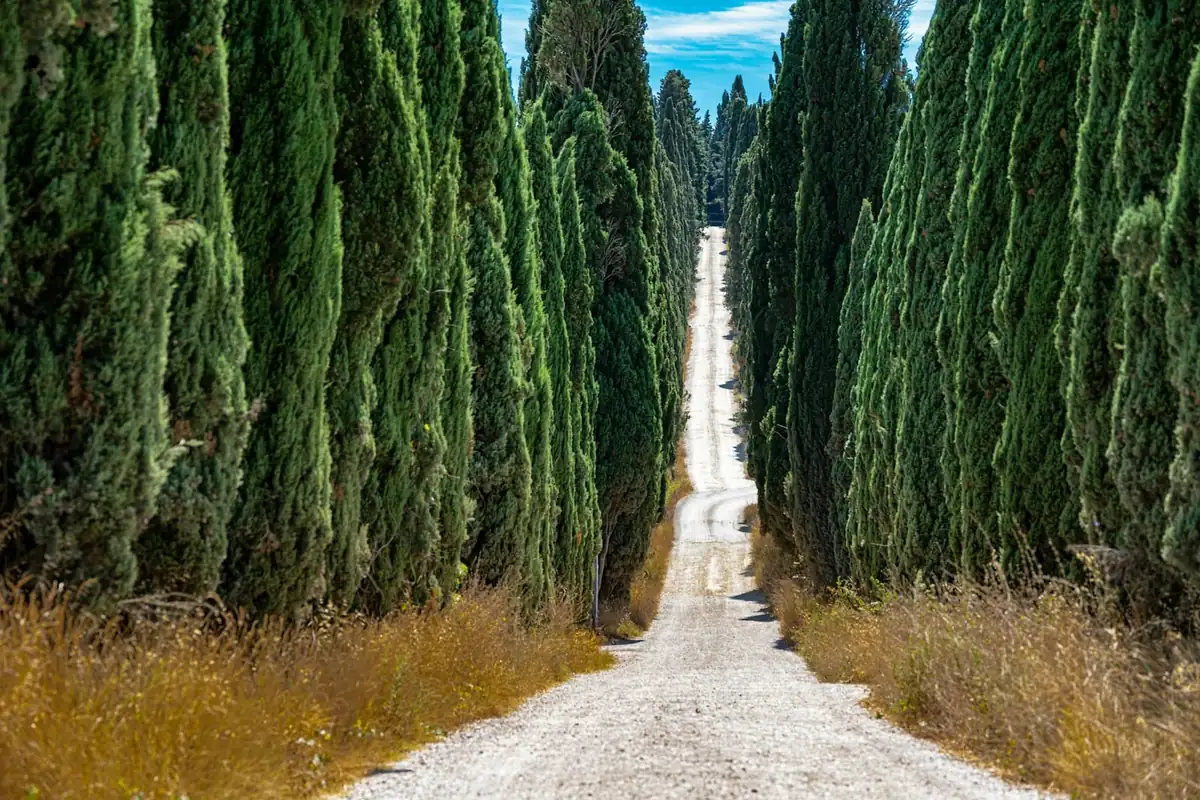
Most people’s idea of Tuscany is vineyards and cypress alleys, and Tuscany Gravel delivers plenty of that. Then comes day six, the queen stage from Siena toward Castel del Piano, and the landscape drops the postcard entirely. The Crete Senesi are bare clay hills with almost nothing growing on them — folded, pale, close to lunar — before the route climbs back into Brunello di Montalcino wine country on the far side.
There’s no technical difficulty in it, just long climbs, long descents and pacing: 65 km and 1,200 m on Adventure, 90 km and 1,700 m on Explorer. It is the one stage on the tour that looks nothing like the rest of the week, which is exactly why riders remember it. The full stage is in The Crete Senesi: Gravel Cycling Italy’s Almost-Lunar Clay Hills.
The Algarve: Cabo de São Vicente, the edge mapmakers once believed was the edge
The final stage of Trans Algarve Gravel runs from Aljezur along the wild Costa Vicentina to Sagres and Cabo de São Vicente — cliff-edge tracks, short punchy climbs, the Atlantic alongside the whole way. For centuries this headland was marked on charts as the literal end of the known world, the point beyond which mapmakers simply stopped drawing. Arriving there under your own legs, after six days crossing southern Portugal’s quiet interior on the ancient Via Algarviana, gives the history some weight it doesn’t have from a car park.
It’s 55 km and 700 m on Adventure, 75 km and 1,100 m on Explorer — one of the gentler closing days we run, which leaves plenty of room to actually stand at the cliff edge rather than just tick it off. The Age-of-Discovery history and the stage itself are in Sagres and the End of the Known World.
Cyprus: cedar and pine above 1,800 metres, in the middle of a Mediterranean island
Trans Cyprus Gravel climbs from the warm coastal plain at Larnaca through limestone hills and monastery roads, and on day four the landscape changes completely: the forest closes in, the air turns cool and dry, and cedar and pine replace the scrub as the route gains altitude into the Troodos, topping out above 1,800 metres. It’s an odd thing to find in the middle of a Mediterranean island most people associate with beaches, and that contrast — warm coast below, cool forest above, both reachable in the same week — is the whole appeal.
The day runs 50 km and 1,350 m on Adventure, 54 km and 2,000 m on Explorer, with a rest day near Mount Olympos immediately after to absorb it. We cover the climb, the season and the forest in full in Gravel Cycling in the Troodos Mountains: a Trans Cyprus Guide.
The Pyrenees: pintxos in San Sebastián, before a single pedal stroke
Not every moment on this list is a climb. Trans Pyrenees Gravel — our longest and hardest tour, 780 km and 17,000–20,000 m across the full Atlantic-to-Mediterranean arc — starts with something gentler: a welcome evening in San Sebastián’s old town, working through pintxos bars before eleven days that will ask a great deal of you. It’s worth including precisely because it isn’t the hardest part of the week. It’s the calm before eight stages that build to the 96 km, 2,900 m day between Aínsa and El Pont de Suert, and it’s the moment that tells you this crossing takes the eating as seriously as the climbing.
Early arrivals can join a relaxed intro ride along the city’s edge before the welcome meeting; the whole week, start to finish, is told in San Sebastián to Sant Pere Pescador: crossing the Pyrenees.
What all seven have in common
None of these seven moments is a stunt or a detour built to be photogenic. Every one of them sits inside the route because the itinerary goes there anyway — on the tour level every rider takes by default, in six of the seven cases. That matters, because it means reaching them doesn’t require the hardest package on offer, just a gravel bike with reasonable tyres, sensible pacing and the fitness to ride three to seven hours a day for a week.
The model behind all seven tours is identical, which is the only reason a list like this can compare a Karoo mountain pass to a Scottish glen to a Portuguese headland in the first place. You ride point to point and sleep in a different hotel each night, your luggage travels ahead of you in the support van, and the van meets the group most days at lunch to refill bottles and swap kit. Guided or self-guided is your choice on every route: a guide leads and navigates, up to ten riders per guide, or you take the full GPS route for Garmin, Wahoo or Komoot and ride at your own pace. How our tours work sets the whole model out in one place.
Building your own list
If one of these seven has already lodged itself somewhere — the Stelvio’s hairpins, the quiet of Glen Builg, the smell of cedar at 1,800 metres — that’s usually enough of a reason to look at the tour page properly: the departure dates, the day-by-day distances and climbing, and what’s included. We ride and test every one of these routes ourselves before it goes on sale, which is the only reason we’re comfortable telling you which morning you’ll still be describing a year from now.
There’s no need to choose just one for good. Several of our guests work through the seven over a few years, one tour at a time, and we’re always glad to see someone back for the next crossing.
Questions riders ask
What's the single best moment on a European gravel cycling holiday?
There isn't one — that's rather the point of this list. The Stelvio's switchbacks, the Swartberg's dry-stone walls, Glen Builg's emptiness and the Troodos cedar forest are entirely different kinds of good. The honest answer is to pick the landscape that pulls at you most, not the one that photographs best, because you'll be in it for a week, not a morning.
Do I have to ride the hardest route to reach these moments?
No. Six of the seven sit on our standard Adventure route, which every rider on that tour rides by default. Only the Stelvio Pass itself is Explorer-only, on the Trans Alp; everything else — the Swartberg, Glen Builg, the Crete Senesi, Cabo de São Vicente, the Troodos summit and the pintxos bars of San Sebastián — is on the route everyone takes.
Can I ride more than one of these seven tours?
Plenty of our guests do, one a year. The seven are spread across the calendar deliberately — Cyprus in spring, Tuscany and the Alps in summer, the Pyrenees and Scotland in late summer, the Algarve in October, South Africa over the Cape's early summer — so there's rarely a bad month to add the next one.
Which of these seven moments is the hardest to reach?
The Stelvio and the Pyrenees' Aínsa-to-El Pont de Suert stage ask the most physically — sustained climbing over 2,000 metres in a single day. Glen Builg and the Crete Senesi are gentler in gradient but remote; the Troodos and the Swartberg sit in between. None of them demand technical mountain-bike skill, just fitness, pacing and a gravel bike you trust.
Planning a gravel week of your own?