Swartberg Pass: the climb that defines gravel cycling in South Africa
Five kilometres out of Prince Albert, the asphalt simply stops. There’s no sign announcing it, no ceremonial gravel start line — one moment you’re on tar, rolling gently out of town past furrow-fed gardens and oak trees, and the next your tyres are on red dirt and the road ahead has started to fold itself into the mountain. This is where the Swartberg Pass begins, and for most riders on our South Africa cycling holiday, it’s the day they’ve been thinking about since they booked.
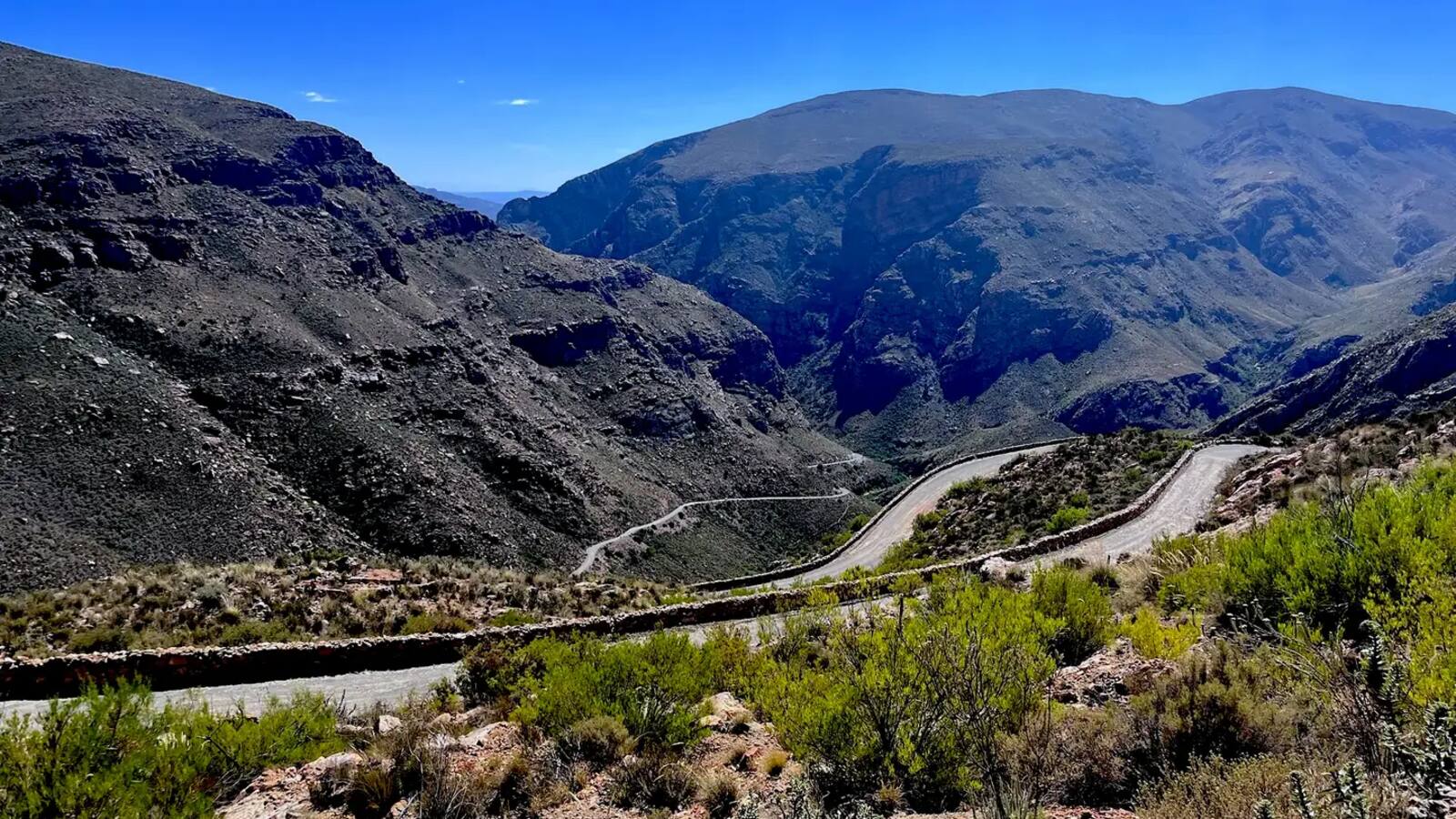
Nearly a thousand metres of climbing over fifteen kilometres, switchbacks stacked against a wall of folded rock, gradients that touch fifteen per cent, and a view from the top that stops conversation. It was built in the 1880s by a road engineer named Thomas Bain and a workforce of convict labourers, using nothing but hand tools and dynamite, and it has barely changed since. That’s not nostalgia talking — it’s the reason the Swartberg is still one of the best gravel climbs on the continent. Nobody ever got around to improving it, and a gravel bike is exactly the right machine for a road nobody improved.
Where the tar runs out at Prince Albert
The South Africa Gravel route runs from Paarl through the Cape Winelands, east into the Klein Karoo, and back west through the Overberg to Franschhoek — seven riding stages, 480 to 660 kilometres, on up to 84% gravel. Day one is a bus transfer and a warm-up ride up Paarl Mountain; day two carries the group east to Prince Albert, a one-street Karoo town at the foot of the mountains. Day three is the Swartberg.
It comes early in the week deliberately. You arrive with fresh legs and the group hasn’t settled into its rhythm yet, so the pass gets ridden while everyone still has something in reserve. The Adventure route covers 80 km and 1,200 m that day; the Explorer route adds a little more distance and climbing at 86 km and 1,460 m. Either way, the pass itself — not that day’s total numbers — is what the week pivots around. Ask any guide which stage riders mention a year later, unprompted, and it’s this one.
A pass built by one stubborn engineer and a prison gang
The Swartberg range stood between the Cape’s southern farmlands and the Klein Karoo for most of the nineteenth century with no practical road across it — travellers went around, adding days to any journey. In 1881 the Cape government sent Thomas Bain, a road engineer who’d already built several of the colony’s mountain passes, to solve the problem directly, over the mountain rather than around it.
What he chose was audacious even by the standards of the age: a route straight up the northern face in a sustained run of hairpins, cut and built largely by hand, with convict labour supplying most of the muscle over the better part of seven years. There was no machinery to speak of — dry-stone retaining walls laid by hand, a roadbed packed and compacted the same way, drainage channels cut to survive a region prone to flash flooding. The pass opened in January 1888, and it was declared a national monument decades later, which is the quiet, bureaucratic reason it has never been resurfaced, widened, or otherwise modernised into something less interesting to ride. What Bain’s crews built in the 1880s is, give or take a century and a half of maintenance, what you ride today.
That history matters for more than trivia. A road engineered to carry ox-wagons at a steady, manageable gradient turns out, by accident of purpose, to be very good to ride on a bicycle: the line rarely wanders for the sake of a view, the gradient holds rather than spiking, and the switchbacks are spaced to a rhythm rather than crammed in. You can feel the intent in the road surface under your wheels — this wasn’t built for spectacle. It was built to get a wagon over a mountain, which is precisely why a gravel bike finds it so rewarding a century and a half later.
What the climb is actually like
The numbers are plain enough on paper — nearly 1,000 m over 15 km, sections at up to 15% — but the experience is less about any single steep pitch than about the climb’s sustained, unbroken character. There’s nowhere to properly recover once you’re on it: the gradient eases at the switchback turns and tightens again on the straights between them, so the climb asks for a steady, metronomic effort rather than a series of hard pushes and rests.
The surrounding country changes as you climb. Low scrub and semi-desert give way to bare folded rock, the colour shifting from red-brown dirt to grey stone, and the views open out behind you across the Klein Karoo in a way that genuinely earns the cliché of stopping riders mid-pedal-stroke. Near the top there’s a saddle where the wind tends to funnel through, often a noticeably cooler, harder gust than anything on the climb below — worth a layer in a jersey pocket even on a warm Karoo morning.
The descent on the far side is just as original, just as gravel, and arguably more demanding of attention than the climb: the same switchbacks, the same dry-stone walls at the road’s edge, and a loose, dry-packed surface that rewards a soft grip on the bars and a willingness to let the bike move under you rather than fighting it into a fixed line. It isn’t technical in the mountain-bike sense — no rock gardens, no exposed scree fields — but it is committing, and riders who treat it with the same respect as the climb get the better version of the descent.
Riding it well
A handful of things change this stage more than fitness does:
- Gear low and plan to sit. A ratio around 0.9 — something like a 34×38 — lets you spin a sustained climb like this rather than grinding it out of the saddle, which costs more energy than it looks like it should over fifteen uninterrupted kilometres.
- Start steady, not fast. The first switchbacks out of Prince Albert feel manageable and invite a pace you can’t actually hold for the whole fifteen kilometres. Settle into the effort you could sustain for an hour, because that’s roughly what the climb asks for.
- Let your tyres down slightly for the washboarded sections. A little more air out than you’d run on tarmac smooths the corrugation on both the climb and the descent, and tubeless means you can do it without worrying about pinch flats.
- Carry a layer for the saddle at the top. The wind through the gap between the two sides of the pass is often sharper than the Karoo morning below it, and you’ll want a jersey pocket’s worth of windproofing for the photos and the regroup before the descent.
- Respect the descent as its own thing, not a reward. The same loose, dry-packed surface and the same dry-stone-walled switchbacks that made the climb interesting make the descent one to ride within yourself, especially on a loaded touring tyre rather than a dry race setup.
Tyres, and why the Klein Karoo asks for width
Our minimum across every tour we run is 38 mm, wider is better, and tubeless is strongly recommended — and the Swartberg is exactly the stage that explains why. The pass’s dry-packed gravel corrugates in long sections, especially on the lower approaches, and a narrow, high-pressure tyre transmits every ridge of it straight into your hands and spine over fifteen kilometres. Width buys comfort on the washboard and a bigger margin against the Karoo’s sharp stone and thorny farm-road sections elsewhere in the week, where a pinch flat on a narrow tube tyre is a far worse proposition than it would be at home. Our guide to gravel bike tyres for touring goes into the wider trade-offs if you’re still choosing a setup.
When to ride it
We run South Africa Gravel across three departures that sit inside the Western Cape’s dry season from the Northern Hemisphere’s point of view — late November into early December, and a late-February-into-March slot the following year. November–December is early summer in the Cape: warm days, cooler evenings in the hills, and a Karoo heat that builds steadily through the morning rather than hitting you at the gate. That’s part of why the Swartberg is ridden early in the day, starting from Prince Albert before the sun is properly up the pass — the climb is hard enough without adding the day’s full heat to it, and the descent’s long afternoon shadow on the western face is a welcome, if accidental, mercy.
What a supported South Africa week includes
Eight hotel nights from a cosy Victorian-style guest lodge in Paarl to small Karoo boutique hotels and wine-farm guesthouses, eight breakfasts and four dinners, luggage transfer hotel to hotel every stage, a support vehicle carrying spares, a spare bike and a clothing bag, English-speaking guides at up to ten riders each, GPS routes for Garmin, Wahoo and Komoot so you can ride the Swartberg at your own pace rather than tied to the group, a daily evening briefing with maps and elevation profiles, mechanic help from the crew with parts at cost, complimentary PurePower energy powder, a Gravel-Adventure jersey, a shared photo album and lifetime RIDERS-network membership.
Both route options — Adventure and Explorer — run every day, and you choose at breakfast rather than locking in the choice at booking, which matters on a stage like this one: if the pass is beating you up more than expected, the shorter option is still there. The levels page sets out exactly what each asks across the week. Full mechanics of how the week actually runs — guided versus self-guided, luggage, the support van’s rhythm — are on how it works.
If you want the shape of the whole crossing rather than one stage of it, our full route guide, a Cape gravel cycling traverse, walks all seven stages end to end; and if it’s the people and small towns along the way rather than the climbing that pulls you in, the farms and small towns along the route covers that ground.
Why the Swartberg is worth building a week around
Plenty of gravel roads are scenic. Fewer have a reason for existing that predates the idea of riding them for pleasure by more than a century, and fewer still have survived that long completely unimproved. The Swartberg is both: a road built to solve a nineteenth-century transport problem by a crew with nothing but hand tools and seven years, left alone ever since because someone, eventually, decided it was worth protecting exactly as it was.
You don’t need to know any of that history to feel the climb do its work on your legs, or to stop pedalling involuntarily at the saddle when the view opens up. But it’s worth knowing anyway, because it’s the difference between riding a pretty road and riding the specific road Thomas Bain’s gang cut into this mountain in the 1880s, more or less unchanged, waiting for a gravel bike that hadn’t been invented yet.
We ride it on day three of South Africa Gravel — guided or self-guided, with the support van somewhere on the switchbacks behind you and your bag already on its way to Calitzdorp.
Questions riders ask
Is the Swartberg Pass actually gravel, or is it paved like some famous passes?
It's gravel, properly. After five kilometres out of Prince Albert the asphalt ends and stays ended for the whole climb and descent — the original 1880s surface, maintained as unpaved road because it's a national monument and because gravel is simply what it has always been. Unlike a famous paved climb, there's no myth to puncture here: the surface under your tyres on the Swartberg is the same kind of road it was engineered as.
How hard is the Swartberg Pass on a gravel bike?
Nearly 1,000 metres of climbing over 15 kilometres, with sections at up to 15%. It's the defining day of our South Africa Gravel week — not the longest stage (that comes the day after, over the Rooiberg and Garcia's passes) but the one every rider asks about beforehand. A gearing low enough to sit and spin rather than stand and grind matters more here than raw fitness.
What's the road surface actually like on the climb and descent?
Dry-packed and corrugated in places, with long, honest switchbacks held up by the original dry-stone retaining walls. It isn't technical in the mountain-bike sense — there's no loose scree or exposed rock garden — but it rewards a bike set up properly: minimum 38 mm tyres, tubeless, and a little more air out of them than instinct suggests on the washboarded sections.
When is the best time to ride the Swartberg Pass?
On one of our scheduled South Africa Gravel departures — 21–30 November 2026, 27 February–7 March 2027, or 4–12 December 2027 — which sit inside the Western Cape's dry, warm season. The pass itself is rideable year-round, but the Karoo's heat builds through the morning, which is why the day starts early and why the descent's long, slightly cooler afternoon shadow is one of the small mercies of the stage.
Do I ride the Swartberg alone, or is there support on the pass itself?
The support vehicle follows the route and the guide leads the group, but on a sustained climb like this one riders naturally spread out at their own pace — that's normal and expected, not a sign anything's wrong. Everyone regathers at the top for the view, and the descent is ridden with the same care: committing, but not technical, and the van is never far behind.
Planning a gravel week of your own?