San Sebastián to Sant Pere Pescador: Crossing the Pyrenees by Gravel Bike
The seafront in San Sebastián is busy on a September morning. Joggers, dog-walkers, the first swimmers testing the Atlantic in the Bahía de la Concha. We roll out along the promenade with the group, unhurried, and someone always says the same thing: enjoy the flat — there won’t be much more of it. They’re right. Within an hour the road has tilted up into the Basque hills, the tarmac gives way to gravel, and the bay drops behind a green ridge. From here the only consistent direction is east, toward a sea you cannot yet imagine — the Mediterranean on the Bay of Roses, 780 kilometres and a whole mountain range away.
That is the line this article is about. San Sebastián to Sant Pere Pescador on gravel is one of the great point-to-point rides in Europe: the entire Pyrenean arc, Atlantic to Mediterranean, ridden almost entirely off tarmac. It is the route we run as our Trans Pyrenees Gravel tour — our longest and most demanding trip — and this is the long version of what it’s actually like. The big mountain days, the villages where you sleep, the way the country changes under your wheels from wet Basque forest to dry Aragonese rock to Catalan coast, and finally the model that lets you ride a traverse this size without carrying your own logistics. It’s written for riders who already know their way around a gravel bike and a long day, and who are deciding whether to spend a precious week on this particular line.
Why ride the Pyrenees coast to coast
Plenty of mountain ranges give you good gravel. Very few give you a clean, continuous traverse from one sea to another, and fewer still do it across a frontier as old and as charged as the France–Spain border. The Pyrenees have divided languages, kingdoms and weather systems for as long as people have lived among them, and to ride their full length is to feel those divisions arrive one by one rather than read about them on a map.
The appeal is partly the scale. Eight riding stages, 780 km, somewhere between 17,000 and 20,000 metres of climbing — numbers that put this firmly above a long weekend’s bikepacking and into the territory of a real expedition, but one ridden hotel to hotel with a support vehicle behind you. And it’s partly the variety. No two days feel the same. The Basque opening is steep, green and technical, almost claustrophobic in its forest; the central Pyrenees are vast, dry and high, with cols that go on for an hour; the run-in to Catalunya softens and opens until the land finally tips you down toward the water. You don’t ride one landscape for a week. You ride a cross-section of a continent.
There is also the matter of solitude. This is not a route lined with café stops and Saturday club runs. On some stages you’ll see more vultures than cyclists. For an experienced rider who has spent years chasing exactly this — empty gravel, big country, a rhythm that the landscape sets rather than the traffic — the Trans Pyrenees delivers it at a length most rides never reach.
The route, stage by stage
The traverse runs west to east over eight riding stages, with a rest day in the middle at Aínsa. Here is how the week unfolds, with the real distances and climbing from the route we ride.
Arrival in San Sebastián
You arrive in time for the Friday-evening welcome meeting, which we time to the flights into Bilbao. San Sebastián — Donostia, in Basque — is a fine place to start a hard week: a city built around a perfect bay, with a pintxos culture that turns dinner into a slow crawl from bar to bar. Early arrivals can join a relaxed intro ride on the edge of the city to check legs and bike before the real work begins. Then the welcome meeting, the first dinner, and an early night.
San Sebastián to Elizondo — Basque country (85 km · 2,500 m)
The first stage starts gently, along the seafront and out through the city, and then it gets down to business. Onto gravel, up into the Basque hills, and into the terrain that makes this tour what it is — steep, wooded, wet underfoot more often than not, with short vicious ramps that ask for that low gear you fitted. It’s a 2,500-metre day to open with, which tells you everything about the week’s ambition. You finish in Elizondo, a handsome stone town in the Baztan valley, the green heart of Navarra.
Elizondo to Isaba — the Basque at its best (90 km · 2,600 m)
For many riders this is the day the Basque country shows its full hand: steep climbs, big ridge lines, long gravel passages above 1,000 metres, and a brief touch of France before you drop back into Spain. The views and the descents are among the best of the whole route. It’s also one of the harder days, 2,600 m of climbing on demanding surfaces, and it ends in Isaba, a Roncal-valley village tucked hard against the high mountains. You are properly in the Pyrenees now.
Isaba to Jaca — rolling mountain roads (85 km · 2,095 m)
A long, varied day with more descent than ascent, though still 2,095 m of work — rolling mountain roads, forest gravel and a string of genuinely fun descents that reward the climbing of the previous two days. The trick is pacing: save something for the final hills into Jaca, an old garrison town on the Aragón river with a Romanesque cathedral and the unmistakable feel of a place that has watched armies cross these mountains for a thousand years.
Jaca to Aínsa — Zona Zero country (86 km · 1,750 m)
Flow, gravel and technical passages, with a classic three-stage climb before you reach the support van for lunch. Toward the end of the day you ride into the terrain around Aínsa that gravel riders know as Zona Zero — a network of trails in the Sobrarbe that has become one of the spiritual homes of the sport in Spain. Aínsa itself is a near-perfect medieval hill town, its arcaded plaza and stone streets crowning a ridge above the meeting of two rivers. You’ll be glad to see it, because tomorrow you stop.
Rest day in Aínsa
A full day off the bike in one of the loveliest towns on the route. There’s a spa for the legs, a medieval quarter to wander, and time for any bike maintenance the first half of the week has demanded. The head guide can offer a short voluntary bonus ride for anyone whose legs are itching, depending on the weather and the group’s energy — but most people are happy to eat well, sleep, and let the body absorb what it’s done. Experienced riders know the value of a mid-traverse rest day; on a route this long it’s the difference between reaching the sea strong and reaching it merely relieved.
Aínsa to El Pont de Suert — the hardest day (96 km · 2,900 m)
For many this is the toughest stage of the lot, and it’s placed deliberately on rested legs. One of the longest climbs of the entire route, changing terrain, bigger views with every hour, and riding close to the highest peaks in the Pyrenees — the Monte Perdido massif and the great limestone walls of Ordesa off to the north. At 2,900 metres of climbing it is the single biggest day of the week, and the reward is exactly proportional to the effort. You finish in El Pont de Suert, a quiet town in the Noguera Ribagorzana valley, one of the most remote sections of the whole crossing.
El Pont de Suert to La Seu d’Urgell — the longest stage (118 km · 2,000 m)
The longest day by distance — 118 km — but more forgiving in profile than the day before, with long descents and easier road sections that keep the momentum going between the climbs. Endurance and pacing are everything here; this is a day to settle into a rhythm and trust it. You arrive in La Seu d’Urgell, the old episcopal seat of the Catalan Pyrenees, a town of arcades and a fortress-like Romanesque cathedral, just south of Andorra.
La Seu d’Urgell to Ripoll — the sea in sight (99 km · 2,100 m)
One of the most iconic up-and-down days on the route. Longer climbs, long descents, and — high in the mountains though you still are — the first genuine sense of the Mediterranean drawing closer. The country has begun to change: drier, more open, more Catalan. You finish in Ripoll, a town wrapped around the monastery of Santa Maria, founded in the ninth century and long regarded as one of the cradles of Catalonia. The sea is one day away.
Ripoll to Sant Pere Pescador — to the Mediterranean (109 km · 1,200 m)
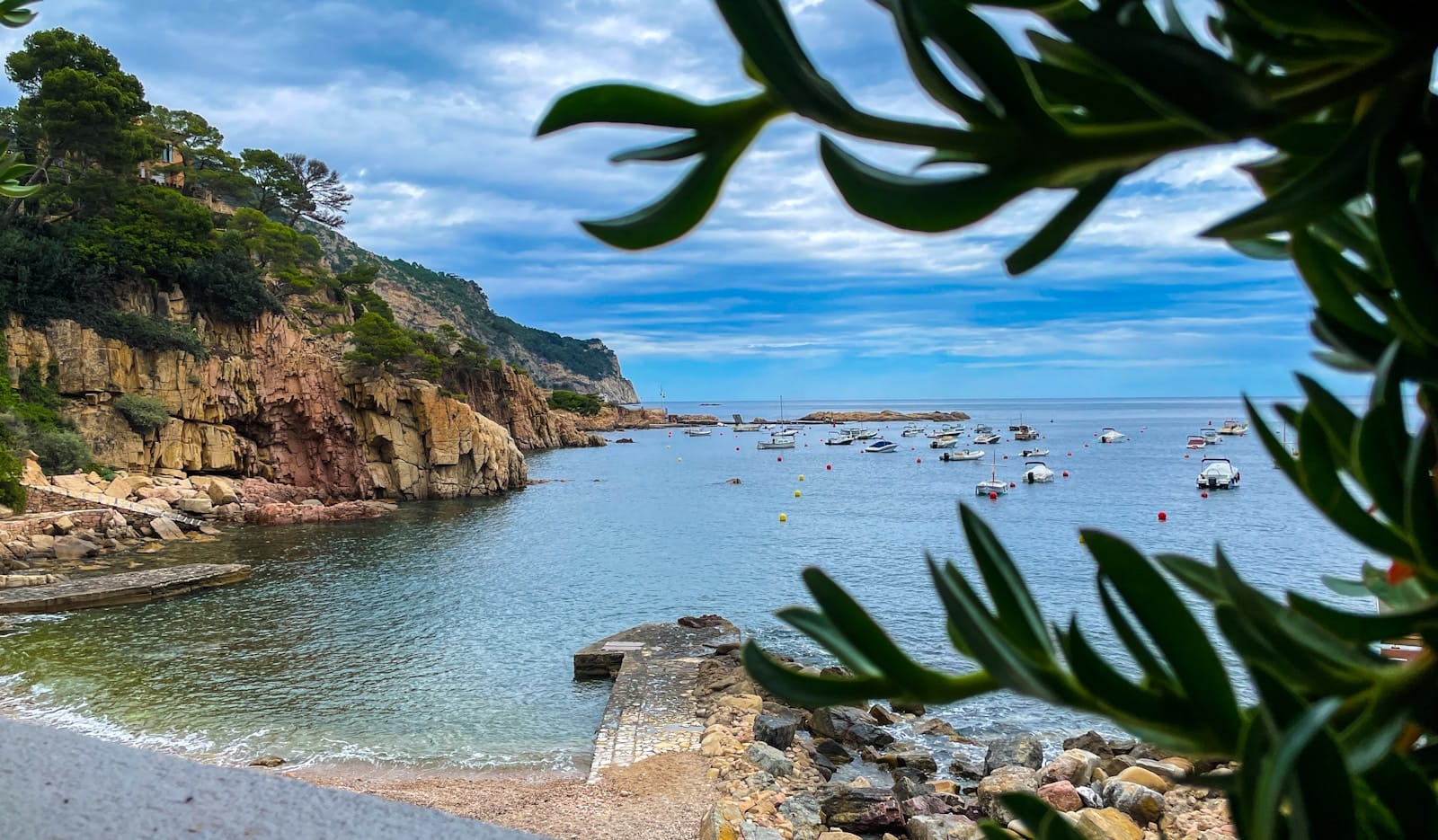
The most manageable stage by climbing — 1,200 m — but still a big day at 109 km, and it carries a particular charge because of where it ends. You roll down out of the last hills on varied terrain, the air warming and softening, the vegetation turning Mediterranean, until the land runs out and the sea is there in front of you. The finish is on the Bay of Roses, at Sant Pere Pescador (Girona) — a Costa Brava town at the southern edge of the Golf de Roses, beside the Empordà wetlands, with the Cap de Creus headland away to the north. After 780 km in the mountains, the sea is a proper arrival. There’s a closing dinner that evening, and it is well earned.
Departure from the coast
On the final morning you can send the bike ahead if you’ve booked it, and take the transfer toward Girona or Barcelona for flights home — or simply stay a few days by the Mediterranean on the Bay of Roses and let the week sink in. Plenty of riders do exactly that.
How the country changes under your wheels
What makes a full Pyrenean traverse more than a fitness exercise is the way the land itself transforms across the week. You are riding through three distinct cultures and three different climates, and the bike is the perfect instrument for feeling the seams between them.
The first three days are Basque and Navarran — green, wet, vertical, intimate. The forests close in, the climbs are short and savage, the rain is never far away, and the place names look like nothing else in Europe. This is Atlantic country, fed by weather coming off the ocean you started beside.
From Jaca eastward you enter the high central Pyrenees of Aragón, and everything opens out. The air dries, the villages thin, the cols lengthen, and the mountains stand higher and barer around you. This is the wild heart of the range — Ordesa, Monte Perdido, the Noguera valleys — and the most remote riding of the trip. You can go a long way between settlements here, which is part of why the support vehicle matters.
Then the route tips you gradually into Catalunya, and the third change begins. The light shifts, the vegetation turns Mediterranean — scrub oak, pine, the first hint of the south — and the towns feel different again. By the time you reach the coast you’ve crossed not just a mountain range but a climate boundary, from the green Atlantic to the dry blue Mediterranean, under your own legs. Few rides give you that, and fewer still let you feel every kilometre of the transition.
The riding: what the terrain actually demands
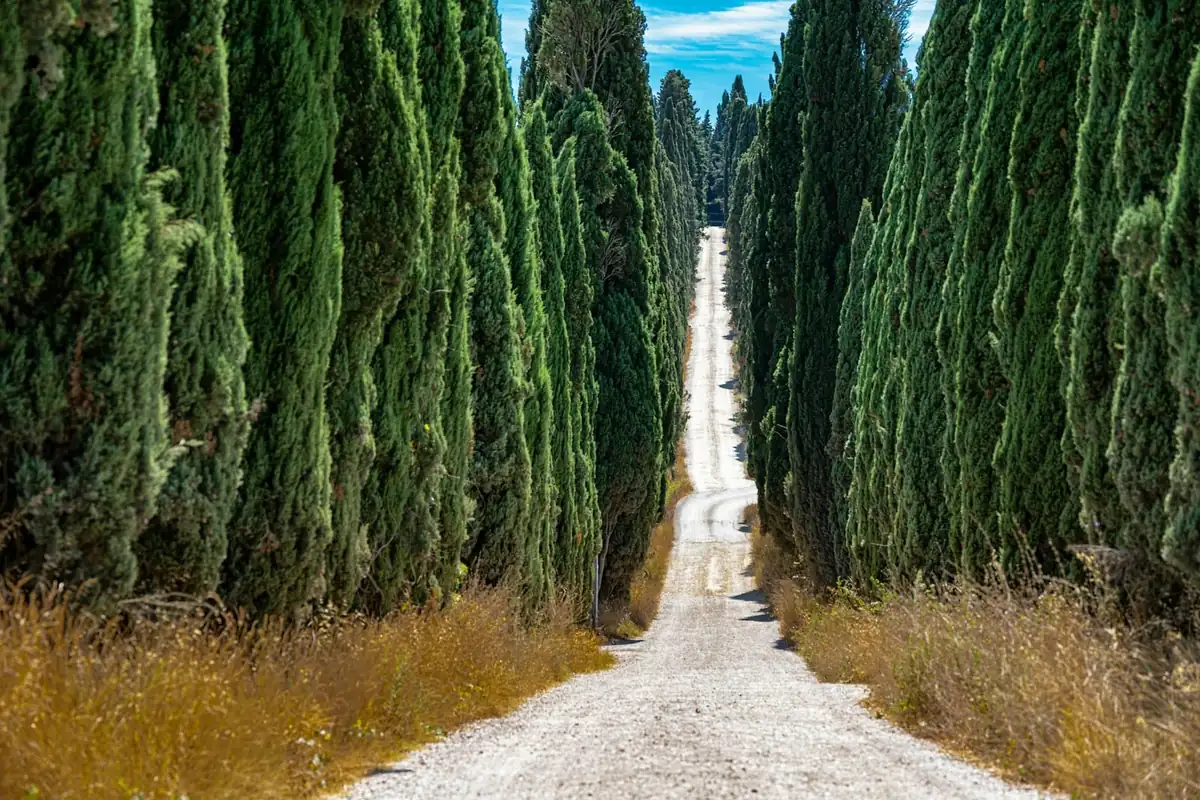
The gravel here is not the fine white chalk of Tuscany’s Strade Bianche. It is mountain gravel — rougher, more angular, shaped by glacier and weather rather than crushed for cart traffic. The surface changes constantly with altitude and region:
- Basque forest track — often damp, sometimes greasy, with roots and loose stone on the steep ramps; technical in the wet, and the wet is common.
- High Pyrenean gravel — looser and rockier at altitude, with scree on the exposed sections and long, sustained climbs that simply keep going.
- Catalan descents — fast, varied, occasionally rough, the kind of terrain where good bike handling buys you real time and real enjoyment.
None of it is beyond a confident gravel rider, but all of it asks for the things experienced riders already have: relaxed hands on a loose descent, the patience to keep turning a low gear up an hour-long col, and the judgement to pace a 2,900-metre day so the last climb doesn’t break you. This is a connoisseur’s terrain. It rewards endurance and good technique over raw speed, which is exactly why it suits the riders who tend to come with us. Our tour levels explain how we grade the riding, and the Trans Pyrenees sits firmly at the demanding end of the scale — a single, challenging level rather than the gentler-and-harder split we offer on shorter tours.
How hard is it, honestly
There’s no point softening this: the Trans Pyrenees is our hardest tour, and the numbers are the numbers. 780 km, 17,000 to 20,000 metres of climbing, eight stages over eleven days. The big mountain days run to five, six, even seven hours in the saddle, and the climbing days come back to back — the challenge is not any single stage but the accumulation, the asking your legs to do it again tomorrow, and again the day after.
Two things make a route this size achievable for the right rider. The first is the rest day in Aínsa, placed at the mid-point precisely so the body can recover before the hardest stage of all. The second is the support vehicle, which follows the route every day and means a stage that turns out longer than your legs wanted never becomes a crisis in the middle of nowhere. You are riding a serious mountain traverse, but you are not riding it unsupported.
What you do need is a real base. If you ride long days on gravel at home, if you’ve done multi-day riding before and know how your body responds to it, if a 2,000-metre day is hard but not frightening — then you have the engine for this. If you’re not sure, talk to us before you book; we would far rather have an honest conversation than have you arrive under-prepared for the biggest week we run. For the wider physical preparation, our companion guide on cycling the Pyrenees on gravel goes deeper into the passes and the demands of the range.
Bike and kit for the Trans Pyrenees
You don’t need anything exotic, but a few choices make a long mountain week considerably more comfortable:
- Bike: a gravel bike, mechanical or e-assist, or a light hardtail MTB with suitable tyres and gearing. Road bikes and hybrids are not suitable for this terrain. Have it freshly serviced before you travel.
- Tyres: a minimum of 38 mm, and wider is better on the loose high passes and rough descents. Run them tubeless — it’s strongly recommended on this route, where a pinch flat on a remote col is the last thing you want.
- Gearing: fit a low climbing gear, around 0.9 or lower. The Basque ramps and the central cols are long and steep, and by day seven you will be grateful for every easy tooth.
- Layers: pack for warm days and cool mountain evenings. The high Pyrenees can drop to 10–12°C even in September, so a light packable shell earns its place in the day bag. Towels and toiletries are provided at the hotels.
- Self-sufficiency: carry a basic roadside kit — pump, tubes, multitool, levers — and be able to handle a puncture or a chain issue yourself, because on the remote central stages you may be a long way from the van. The support vehicle carries a full tool kit, spares and a spare bike, with mechanic help on hand; you only pay for parts.
We cover the wider picture in our general packing guidance, but the Pyrenean-specific note is simple: pack the day bag for the worst hour you might meet on a high col, not the best, and let the van carry the rest.
What a supported Trans Pyrenees week includes
There are two ways to ride the crossing, and the support is identical whichever you choose.
Guided vs self-guided. On the guided option, an experienced English-speaking guide leads each stage and handles the navigation. On a route with this much remote, high terrain, that’s a genuine comfort — you can simply ride and look around rather than watching a screen on a loose descent. On the Trans Pyrenees we run guided groups of eight to ten riders per guide; it keeps the group manageable on the big passes and means the guide can give everyone proper attention. On the self-guided option, you take the full GPS route for Garmin, Wahoo and Komoot and ride at your own pace, not tied to a group — the same hotels, the same luggage transfer, the same support vehicle behind you. Experienced, independent riders often prefer it. Either way, how our tours work walks through the support in detail.
The trip covers eight riding stages plus an optional rest-day ride — and ten nights in hotels and mountain refuges chosen for their location, some of them in villages with little else around them. You get ten breakfasts and four dinners, including the closing dinner on the Bay of Roses. Concretely, here is what travels with you:
- Experienced, English-speaking guides and a daily evening briefing with maps and elevation profiles, so you always know what tomorrow holds.
- A support vehicle carrying spare parts, a spare bike and a clothing bag, with mechanic help from the crew — spare parts only at cost.
- Luggage moved hotel to hotel in the support van, every stage; you ride with a day bag and collect your main bag at the hotel on arrival.
- The van meeting the group most days at lunch, where you can change kit and refill the PurePower energy drink for free — energy bars and chews are available to buy.
- A Gravel-Adventure jersey, a shared online photo album of the week, and lifetime membership of the RIDERS network.
You arrange your own flights — fly into Bilbao for the start, about an hour and a quarter by taxi from San Sebastián, and out of Girona or Barcelona at the end, with shared transfers arranged on the final day. From the welcome meeting on, the logistics are ours; your job is the riding.
For the full day-by-day itinerary, the 2026 and 2027 departure dates and the complete list of what’s included, see the Trans Pyrenees Gravel tour page.
Who rides the San Sebastián to Sant Pere Pescador traverse
This is not a beginner’s trip, and we don’t pretend otherwise. It suits experienced riders who are comfortable with long days on mixed surfaces and who value the quality and ambition of a route over its convenience. In practice the riders who come with us are exactly that — people who have ridden for years, who pace themselves intelligently, who would far rather travel thoughtfully across a great range than sprint through it. The Trans Pyrenees rewards endurance over speed, judgement over bravado, and the patience to keep a steady rhythm through a long, exposed col.
It works well for the solo rider who wants the structure and company of a small international group without organising a thing — with eight to ten riders per guide it’s an easy trip to join alone. It works for couples and friends, with the shared hotel each night and the closing dinner at the sea. And it works for the rider who has done shorter supported tours and is ready for the biggest week we run. If you’re weighing whether a supported tour is right for you at all, our guide to choosing a supported gravel tour lays out the honest trade-offs.
What you’ll remember
Ask a rider what stays with them from the Trans Pyrenees, and it’s rarely a single climb. It’s the first morning’s seafront in San Sebastián and the way the flat ran out so quickly. It’s a steep, wet ramp in the Basque forest and the smell of it. It’s the rest day in Aínsa, legs heavy, the medieval plaza in the evening light. It’s the great climb out of Aínsa on rested legs, riding close to the highest peaks in the Pyrenees. And it’s the last descent toward Sant Pere Pescador, the air turning warm and Mediterranean, the moment the sea appears and the whole week resolves into a single clean line drawn from one ocean to another across an entire mountain range.
Ride the full Pyrenean traverse with us
If crossing the Pyrenees coast to coast is on your list, this is the route — San Sebastián to Sant Pere Pescador, Atlantic to Mediterranean, 780 km of mostly unpaved riding through the Basque country, the high central Pyrenees and Catalunya, finishing on the Bay of Roses at Sant Pere Pescador. We run it guided — eight to ten riders per guide on this one — or self-guided on the full GPS route, with the hotels, the daily luggage transfer, the support vehicle and the closing dinner all handled, so you arrive at the welcome meeting with nothing to think about but the riding.
The full itinerary, the 2026 and 2027 departures and everything that’s included are on the Trans Pyrenees Gravel tour page. If you’re comparing it against another route, how our tours work explains the supported model in full. Come and ride the whole range with us — sea to sea, eleven days — and we’ll carry the rest.
Questions riders ask
How long is the San Sebastián to Sant Pere Pescador gravel route, and how many days does it take?
The full Trans Pyrenees gravel traverse is 780 km over eleven days — eight riding stages plus a rest day in Aínsa and arrival and departure days at each end. Cumulative climbing runs between 17,000 and 20,000 metres, most of it on unpaved roads. Daily stages range from 85 to 118 km with 1,200 to 2,900 m of ascent, so it is a genuine endurance week rather than a series of short days.
Which way does the route run — Atlantic to Mediterranean or the reverse?
We ride west to east, San Sebastián on the Atlantic to Sant Pere Pescador on the Mediterranean. It is the logical direction for a Pyrenean traverse: you start in the green, technical Basque hills while your legs are fresh, build through the high central Pyrenees around Aínsa and the highest peaks, and finish with the long descent to the Costa Brava and the sea on the Bay of Roses. Riding toward the Mediterranean also means the climate gradually dries and warms across the week.
How fit do I need to be for the Trans Pyrenees Gravel tour?
This is our most demanding tour. Expect five to seven hours in the saddle on the big days and the endurance to repeat it for over a week. You don't need to race, but you should be a strong, experienced rider comfortable on loose gravel and long climbs, with multi-day riding already in your legs. The mid-tour rest day in Aínsa and the support vehicle both help, but cycling fitness and pacing matter most on a route this long.
What bike and tyres suit the San Sebastián to Sant Pere Pescador route?
A gravel bike, or a light hardtail MTB with suitable gearing — road bikes and hybrids are not suitable. We recommend a minimum 38 mm tyre, wider is better, set up tubeless for the loose high passes and rough descents. Fit a low climbing gear around 0.9 or lower for the steep Basque ramps and the central Pyrenean cols. Have the bike freshly serviced before you travel, and be able to fix a puncture yourself on the remote stages.
Is this a guided tour, and how big are the groups?
It runs both ways, and the support is the same. On the guided option an experienced English-speaking guide leads each stage and handles the navigation, which is genuinely useful on the big passes — and on the Trans Pyrenees we run guided groups of eight to ten riders per guide. Self-guided riders take the full GPS route for Garmin, Wahoo and Komoot and ride at their own pace. The support vehicle follows the route either way.
Can I join the Trans Pyrenees on my own?
Yes, and many riders do. Groups are international and run eight to ten per guide, so it is an easy trip to join solo. Accommodation is a shared double room by default; a single-room supplement is available on request. You arrange your own flights — fly into Bilbao for the start and out of Girona or Barcelona at the end — and we handle the transfers and everything in between.
Planning a gravel week of your own?