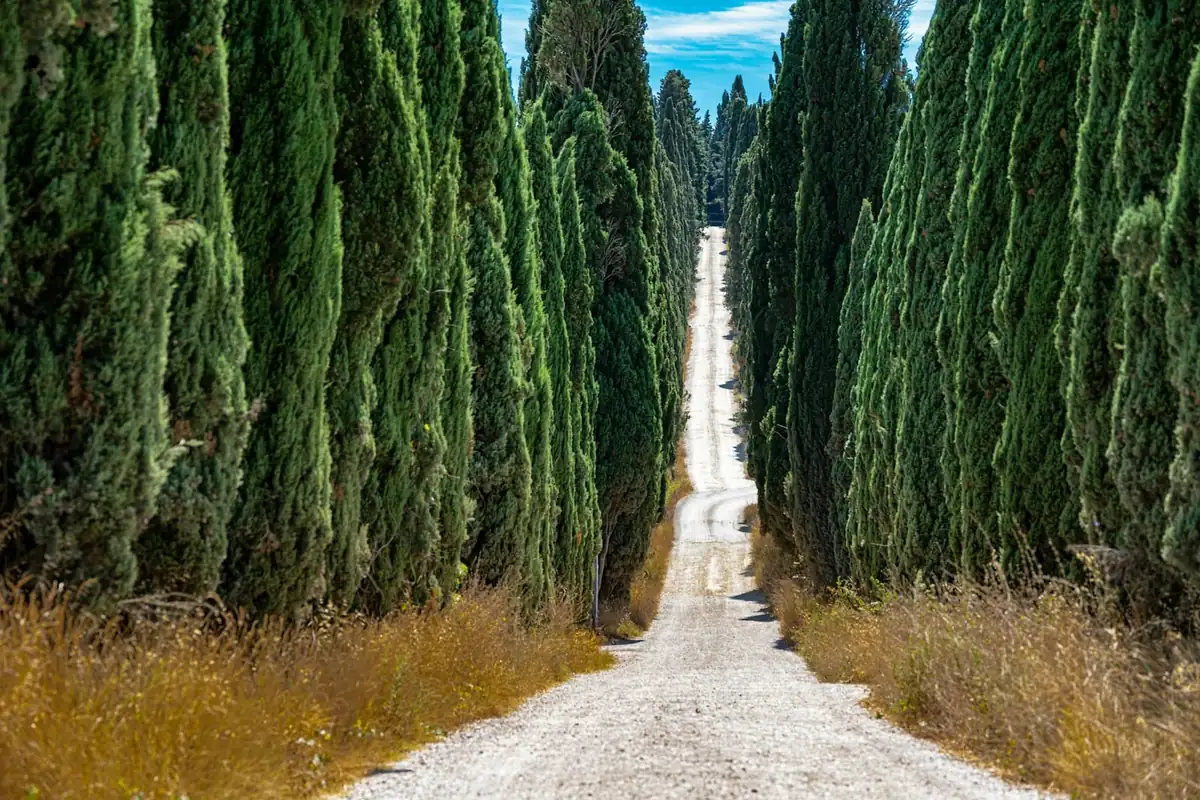
The Crete Senesi: Gravel Cycling Italy's Almost-Lunar Clay Hills
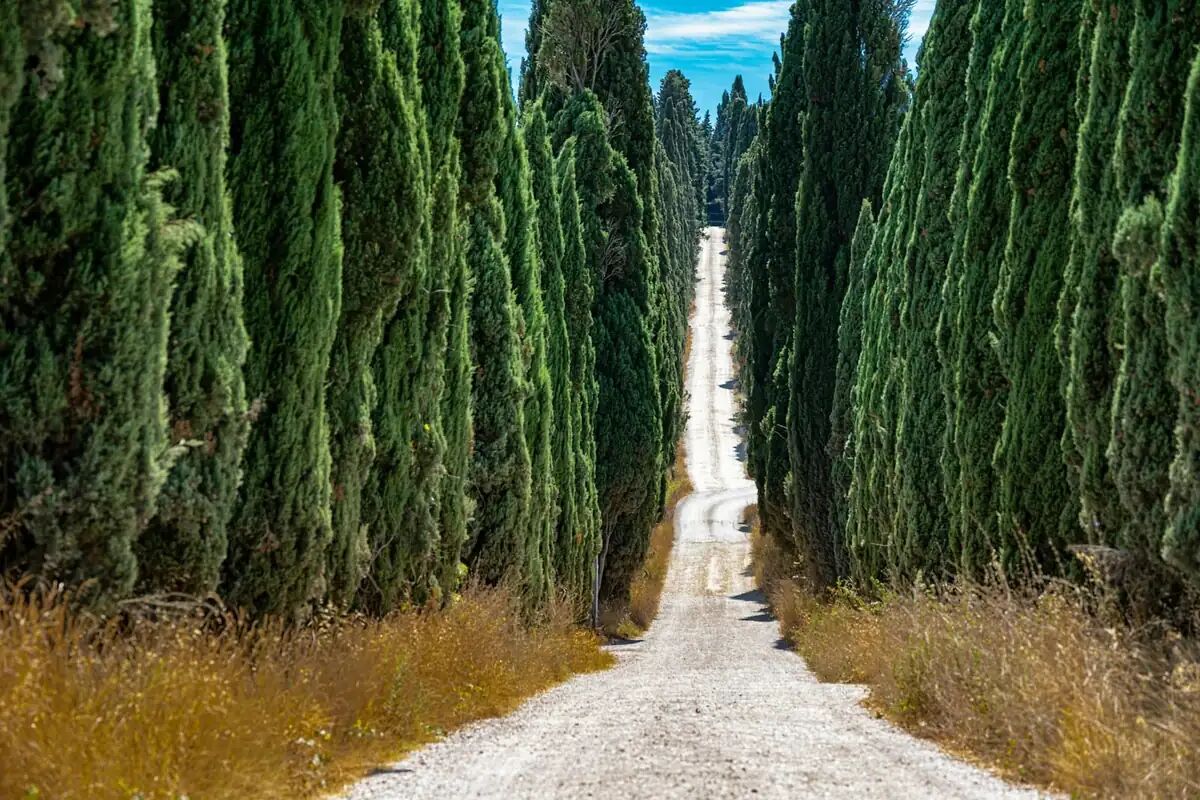
Twenty minutes south of Siena, Tuscany stops looking like Tuscany. The cypress avenues are gone. The vineyards are gone. What’s left is bare clay, grey-gold and treeless, folded into long ridges and sudden gullies that look less like farmland than like something still being formed. There is a single white gravel road running along the top of it, and very little else — no village, no shade, no sign that this is the same region as the hill towns you rode through two days ago. Riders on this stage tend to go quiet here. It isn’t what anyone expected Tuscany to be, and that’s exactly the point.
This is the Crete Senesi — literally, roughly, “the clays of Siena” — and it is the opening act of day six of our Tuscany cycling tour, the day the tour’s own itinerary calls the queen stage.
What the Crete Senesi actually is
The Crete Senesi is a belt of country south and south-east of Siena, loosely bounded by the towns of Asciano, Rapolano Terme, Monteroni d’Arbia and San Giovanni d’Asso. The clay here is a particular kind — marine sediment left behind when this part of Tuscany was seabed, millions of years ago, alkaline and heavy, and in most places too difficult to farm the way the limestone hills of Chianti are farmed. Where the slope is steep and the ground is bare, rain erodes it into calanchi — deep, narrow gullies — and biancane — small, pale, dome-shaped hillocks that give whole hillsides a strange, almost bubbled texture. The net effect, especially in the drier months, is a landscape with none of the softening green that defines the rest of the region: grey, gold and bare, rolling away in every direction with barely a tree to break it.
It’s genuinely disorienting the first time you ride into it, particularly coming from Siena, which sits at the edge of lush, vine-covered hills. Within a few kilometres the vegetation thins, the colour drains out of the ground, and you’re riding a white gravel road across what looks, in the right light, like a lunar surface someone has folded into hills. A handful of solitary cypress trees stand on the ridgelines precisely because they’re rare here — the same tree that forms a dense avenue in Chianti stands alone and conspicuous in the Crete Senesi, which is part of why photographers chase this particular light.
Where this sits in the Tuscany crossing
The Tuscany Gravel route runs Pisa to Marina di Grosseto across eight days and 460 to 615 kilometres, depending on the daily route choice. Day six — the stage that opens on the Crete Senesi — comes straight after the rest day at Siena, and the tour’s own itinerary names it plainly: the queen stage. The route runs south through the Crete Senesi, then climbs into Brunello di Montalcino wine country and on toward Monte Amiata, the extinct volcano that dominates southern Tuscany, finishing at Castel del Piano, a hill town sitting above 600 metres on Amiata’s flank.
On the Adventure route that’s 65 kilometres and 1,200 metres of climbing. On the Explorer route it stretches to 90 kilometres and 1,700 metres. Either way, the tour’s own description is accurate and worth taking at face value: long climbs, long descents, no technical difficulty — just fitness and pacing. There is no single hard metre on this stage. There is, instead, a sustained demand that builds across the whole afternoon, on ground that offers almost nowhere to hide from either the sun or your own legs.
It follows the two-night stop above Siena, which matters more than it might sound. A genuine rest day — not a transfer day in disguise — sits at exactly the point in the week where the route is about to ask the most of you. Riders who used the rest day to push a long Chianti loop the day before tend to feel day six differently from riders who kept the legs fresh. Either choice is fine; it’s worth knowing which one you’re making.
Riding the clay: surface, pace and the heat
The Crete Senesi’s riding surface is a mix of compacted white gravel and bare clay track — the same family of strade bianche that give the wider region its signature, but barer and more exposed here than anywhere else on the route. Dry, it’s fast and firm, genuinely good riding: the bike tracks true, the gradient is honest, and the open sightlines let you see the shape of the next climb from a long way off. After rain, the same clay turns heavy and sticky within an hour, and the stage slows considerably — tyres clog, traction drops, and what was a confident pace becomes a careful one. Our guides watch the forecast closely for this particular day for exactly that reason.
The bigger factor, in practice, is heat and shade — or rather, the lack of it. Chianti and the forested Apennine stages earlier in the week offer tree cover at intervals; the Crete Senesi offers almost none. On a warm afternoon the open clay radiates heat back up at you, and there is nowhere obvious to stop out of direct sun. This is a day to start hydrated, carry more water than feels strictly necessary, and pace the first hour conservatively — the temptation on fast, firm clay is to push harder than the heat of the afternoon will thank you for.
Technically, none of it is demanding. There’s no loose rock, no narrow singletrack, no section that asks for bike-handling skill beyond what any confident gravel rider already has. The standard kit for the week — a gravel bike with a minimum 38 mm tyre, tubeless strongly recommended, a low gear around a 0.9 ratio for the climbs — is exactly right here too. The challenge is entirely a matter of pacing a long, hot, shadeless day well, which is a different skill from riding technical ground, and one that experienced multi-day riders generally find they already have.
From bare clay to Brunello country
The character of the stage changes completely in its second half. South of the Crete Senesi proper, the clay gives way to vineyard again, and you climb into some of the most serious wine country in Italy: Brunello di Montalcino, made from a single Sangiovese clone on the slopes around the town of Montalcino, with a reputation that reaches well beyond Tuscany. The road climbs steadily through the vines, the bare hills behind you now visible as a grey band in the middle distance, framed by the vineyards you’re riding through.
Beyond Montalcino the route keeps climbing, onto the lower flanks of Monte Amiata, the extinct volcano that forms the southern anchor of this half of Tuscany. Castel del Piano, the day’s finish, sits above 600 metres on its slope — high enough that the hotel there looks back out over the whole afternoon’s route, the Crete Senesi included, laid out behind you. Arriving there after a day that opened on bare lunar clay and closed in serious wine country is, for most riders who do it, the single stage of the week they talk about first once they’re home. It’s also covered, from the accommodation and dinner side, in our piece on the evenings between riding days in Tuscany, which looks at what Castel del Piano and the rest of the week’s stops are actually like to stay in.
Riding the queen stage well
A handful of things make a genuine difference on this particular day:
- Start hydrated and carry more water than usual. There’s little reliable shade and few stops once you’re into the Crete Senesi proper — top up before you leave Siena rather than planning to find water mid-stage.
- Check the surface forecast, not just the weather. Dry clay here is fast and rewarding; wet clay slows everything down and changes the character of the whole morning. Our guides adjust pacing advice accordingly on the day.
- Pace the first hour conservatively. The open, firm gravel invites a faster start than the heat of the afternoon will reward. This is a long-game stage.
- Use the rest day sensibly the day before. A hard Chianti loop on the Siena rest day is genuinely enjoyable, but day six is where the bill comes due. If in doubt, keep the rest day lighter.
- Run the same tyre and gearing as the rest of the week. Nothing about the surface here calls for different kit — 38 mm minimum, tubeless, a low gear for the climb into Montalcino.
Guided or self-guided through the Crete Senesi
This stage runs either way, and the choice is mostly about company rather than navigation difficulty — the route is a clear line of gravel road with few confusing junctions. On a guided day you ride with the group, a maximum of ten riders per guide, with an English-speaking guide who knows exactly where the shade (what little there is) and the best stopping points fall. On a self-guided day you take the full GPS route for Garmin, Wahoo or Komoot and ride it at your own pace, with the same support vehicle on the road and the same hotel waiting at Castel del Piano in the evening. Most riders on this tour mix the two across the week; either way, the support model doesn’t change, as how our tours work explains in full.
What a supported Tuscany week includes
Riding across the Crete Senesi and into Brunello country as a supported week means you carry the effort of the stage; we carry the logistics around it. The Tuscany Gravel route gives you six riding stages plus an optional rest-day loop, an English-speaking guide offering two route options every day, GPS files for self-guided riders, and a support vehicle carrying spare parts, a spare bike and a clothing bag — with mechanic help from the crew, spare parts only at cost. Your bag travels hotel to hotel in the van, collected each evening rather than carried on the bike, and the van meets the group most days at lunch with a free refill of PurePower energy drink. Seven nights in agriturismi and boutique stays, seven breakfasts and three dinners, plus the closing sparkling wine and gala dinner on the Tyrrhenian coast at the end of the week. The two daily pace options, Adventure and Explorer, are explained in full on our levels page.
Ride the queen stage with us
The Crete Senesi is one afternoon in an eight-day week, but it’s the one that tends to surprise people most — bare, quiet, almost lunar ground in a region whose whole reputation rests on being green. We ride through it on day six of the Tuscany Gravel tour, guided or self-guided, straight after the Siena rest day and straight into Brunello country, with the support van carrying everything but the riding itself.
The full day-by-day itinerary, departure dates and what’s included are on the Tuscany Gravel tour page. For the wider shape of the week, our guide to gravel cycling in Tuscany and the Apennine high-country stages cover the rest of the route in depth.
Questions riders ask
What is the Crete Senesi?
A belt of bare clay hills south and south-east of Siena, roughly between Asciano, Rapolano Terme, Monteroni d'Arbia and San Giovanni d'Asso. The name means roughly 'the clays of Siena.' Unlike the cypress-and-vineyard Tuscany of the postcards, much of this ground is too alkaline and erosion-prone to farm conventionally, so it stays open and largely treeless — rolling grey-gold badlands, deeply gullied in places (the local calanchi and biancane formations), that genuinely do look closer to a moonscape than to Chianti five kilometres up the road.
Where does the Crete Senesi fall in the Tuscany gravel cycling route?
It's day six of the eight-day crossing — the queen stage, in the tour's own itinerary. You leave the two-night hotel above Siena after the rest day, cross the Crete Senesi, then climb into Brunello di Montalcino wine country and on toward Monte Amiata, finishing at Castel del Piano, a hill town above 600 metres. It's 65 km and 1,200 m of climbing on the Adventure route, or 90 km and 1,700 m on the Explorer route.
Is the Crete Senesi stage technically difficult to ride?
No — it's a fitness and pacing day, not a technical one. The surface is a mix of white gravel and packed clay, generally firm and fast when dry, noticeably stickier and slower after rain. The climbs are long rather than steep, and so are the descents. The difficulty is the accumulated length of the day and the heat of open, shadeless ground, not loose rock or narrow track.
Why is this called the queen stage if it isn't the longest day?
Because it asks the most of the legs across the week, not because it covers the most kilometres. The climbing is sustained rather than broken into short ramps, the terrain offers almost no shade, and it follows directly after the rest day — which is deliberate route design, not an accident. Riders arrive at Castel del Piano having crossed the most dramatic landscape of the week and climbed the most demanding single stage of it in the same afternoon.
Can I ride the Crete Senesi on its own, without the full tour?
Not as a stand-alone day trip through us — it's built into the eight-day Tuscany Gravel route as day six, between the Siena rest day and the finish at Marina di Grosseto. You can ride it guided, with an English-speaking guide and a maximum of ten riders, or self-guided on the same GPS route, at your own pace, with the same support vehicle on the road either way.
Planning a gravel week of your own?