Gravel Cycling the Apennines: Tuscany's High Country
The road out of Pistoia does not look like the Tuscany on the postcards. There are no cypress avenues here, no honey-coloured hill towns floating above the vineyards. Instead the gravel tips upward through a valley of plant nurseries and then into chestnut forest, and you climb — properly climb — for the better part of an hour, the air cooling and thinning as the southern wall of the Apennines rises around you. Near the top there is a short stretch where the path pinches and you shoulder the bike for a few metres. Then the trees open, the whole Arno basin lies below in the haze, and the descent ahead is fast and long. This is the Tuscany that experienced riders come back for: not the soft lower hills, but the high country that hems them in.
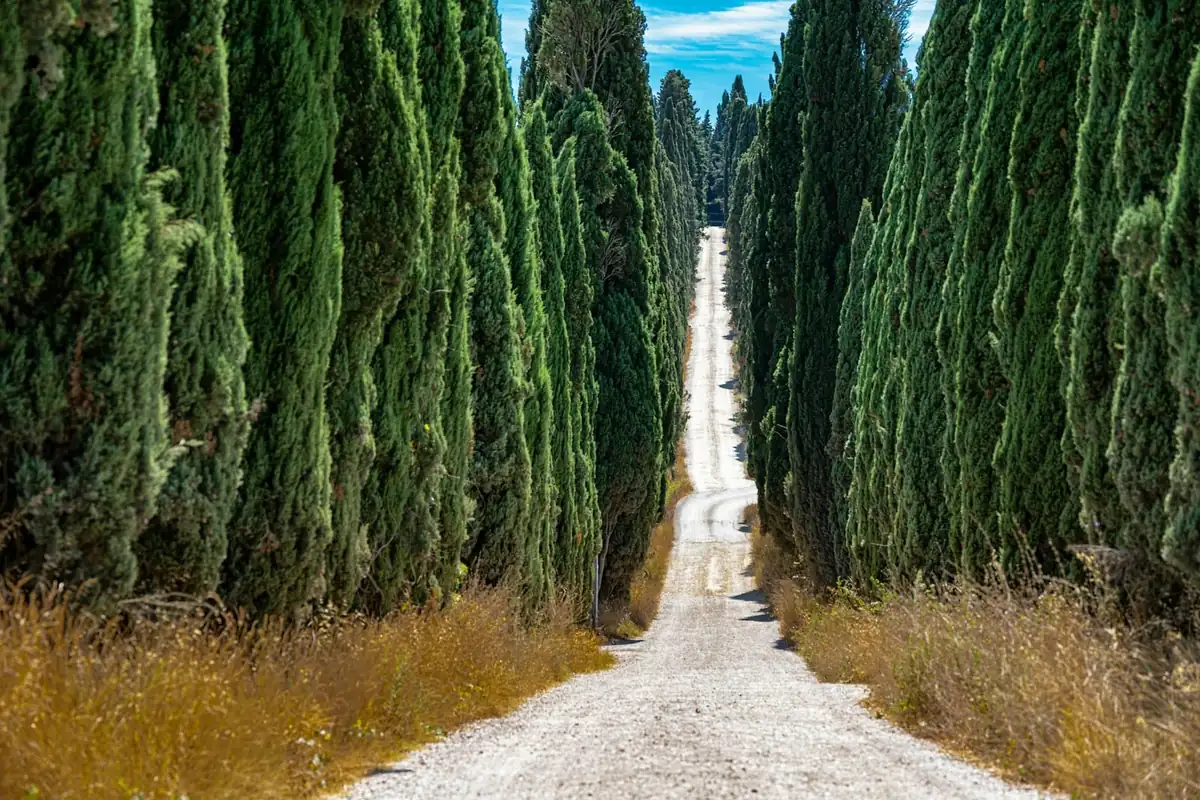
Most accounts of gravel cycling in Tuscany lead on the white roads — the strade bianche around Siena and Chianti, the cypress alleys, the Crete Senesi clay. They are wonderful, and we ride them. But the best week of riding here is built on something the photographs rarely show: the Apennine ridges that run down the spine of the region, and the long, high stages that climb out of the famous lower country into wilder, emptier ground before dropping to the Val d’Orcia and the coast. This guide is the high-country version of a Tuscany gravel tour — the climbs out of Pistoia and toward Pistoiese, the Monte Amiata stage, the Brunello and Val d’Orcia descents — and how to ride the whole thing across a week with the logistics carried for you.
Why the Apennines change what gravel cycling in Tuscany means
The Apennines are the mountain chain that forms the backbone of peninsular Italy, running roughly north-west to south-east for more than a thousand kilometres. In Tuscany they sit along the northern and eastern edges of the region, and they are the reason the riding here has more shape than its reputation suggests. The lower hills of Chianti and the Crete Senesi — the country of the strade bianche — roll constantly but rarely climb in one sustained push. Up in the Apennine high country, the gradients lengthen. You get climbs of 800 to over 1,200 metres in a single effort, on forest road and estate track, rewarded by descents that run for ten kilometres or more.
That contrast is the whole point. A week that only rode the white roads would be relentlessly undulating but never properly mountainous. A week that climbed into the Apennines without the lower country would miss the cypress avenues and the wine towns that make the place what it is. The route we ride does both: it starts on the southern flank of the Apennines above Lucca and Pistoia, drops into Chianti and the Strade Bianche heartland, then climbs again into the high Brunello and Monte Amiata country before the final run to the Tyrrhenian coast. Across eight days that is 460 to 615 kilometres depending on which line you take, with 5,000 to 9,950 metres of climbing — a serious gravel cycling Italy itinerary rather than a sightseeing loop with bikes.
What sets Apennine gravel apart from the better-known Alpine riding is the surface and the texture of the climbing. There are no high passes scraped above the treeline here, no twenty-kilometre tarmac switchbacks. Instead you climb through chestnut and oak forest on packed track, the gradient steady rather than savage, and the views arrive in glimpses through the trees before opening all at once at a col or a ridge. It is a connoisseur’s terrain — earned, varied, and paced for riders who would rather travel through a landscape than race across it.
The route, stage by stage: from the Apennine flank to the Val d’Orcia
The week we ride crosses Tuscany from north-west to south-east — Pisa to the Maremma coast at Marina di Grosseto — almost entirely off tarmac. Six riding stages plus a genuine rest day near Siena. Here is how the high country reveals itself.
Pisa to Le Vedute — onto the southern flank
The opening day eases you on. From Pisa the route heads inland, and where the Adventure line stays low along the flat Serchio river toward Lucca, the Explorer line climbs roughly ten kilometres toward Monte Serra, up to around 800 metres, before dropping into Lucca for lunch. It is the first taste of what the Apennine flank does: a long, steady climb on a quiet road, the Tuscan plain falling away behind, and a descent to a city worth stopping in. Both lines finish across the Padule di Fucecchio marshland at Le Vedute, on the Arno. Lucca’s walls and its coffee are the reward; the legs get an honest introduction to the gradient.
Le Vedute to Florence — the Pistoia climb and the Apennines proper
This is the day the high country announces itself. The Adventure route runs the Arno valley straight into Florence — a fine day in its own right. But the Explorer route climbs another ten kilometres toward Pistoia, up through the valley of plant nurseries that supplies half of Europe’s gardens, into the chestnut forest of the southern Apennines. There is a short hike-a-bike where the path narrows, a stretch of genuine high-country gravel, and then a fast descent back to the Arno. By the time you roll into Florence with the dome of the cathedral ahead, you have already ridden some 1,750 metres of climbing — and earned the evening in the city. This stage is the clearest answer to anyone who thinks Tuscan gravel is all gentle vineyard lanes.
Florence to San Gimignano — into the Chianti and the first white roads
South out of Florence the character changes. You drop into the Chianti Classico zone — clay hills, olive groves, and the first strade bianche, the white roads lined with the cypress avenues that announce each hilltop town. This is the lower, famous Tuscany, and after two days on the Apennine flank it feels almost soft underwheel: firm white limestone, fast when dry. The Explorer line adds a forest singletrack detour before the climb up to San Gimignano, whose medieval towers stand on the skyline for miles before you reach them. Merchants built them tall on purpose, so their wealth could be seen from the next ridge.
San Gimignano to Siena — ridgetop towns and the steepest climb
A loop of San Gimignano’s towers, then white gravel and forest paths past a string of ridgetop hill towns. The steepest climb of the whole tour leads into Siena — short, sharp, on loose ground — and the hotel sits on a hillside above the city with a pool and a panoramic view. Two nights here, which matters: this is the hinge of the week, the point where the high opening country gives way to the Strade Bianche heartland and, after the rest day, to the second range of climbing further south.
Rest day near Siena — Chianti on your own terms
A genuine rest day, not a transfer day in disguise. Siena’s old town is ten kilometres away. For those who want to keep the legs moving, there are guided Chianti loops on the strade bianche through Radda, Gaiole and Lecchi — the heart of the white-road country, the same sectors the professional Strade Bianche race made famous, ridden at your own pace rather than at race speed. Or rest entirely: the pool is there, vineyard visits can be arranged, and the old city rewards a slow afternoon. Experienced riders know the value of a mid-week rest day on a route with this much climbing; it is the difference between arriving at the coast strong and arriving merely relieved.
Siena to Castel del Piano — the queen stage, into Brunello and Amiata
This is the day the high country returns, and it is the queen stage of the tour. The route runs south through the Crete Senesi — the bare, almost lunar clay hills that turn from green to gold across the season — then climbs into Brunello di Montalcino wine country and on toward Monte Amiata, the great extinct volcano that dominates southern Tuscany. The climbs are long and the descents are long; there is no technical difficulty, only fitness and pacing. Castel del Piano sits above 600 metres on the flank of Amiata, and arriving there, with the Val d’Orcia spread below and the day’s climbing behind you, is the emotional summit of the week.
Castel del Piano to Marina di Grosseto — top to coast
The closing stage is a release. A ridge crossing, then a long descent through the Maremma — the wilder, emptier southern country — to the Tyrrhenian coast. The tour finishes at a beach spa hotel: a swim in the Mediterranean to wash off the white dust, cold drinks, and a gala dinner at the end of the road. From the high ground of Amiata to the sea in a single day is the kind of line that stays with you long after the tan lines have faded.
The Val d’Orcia: the country the route descends into
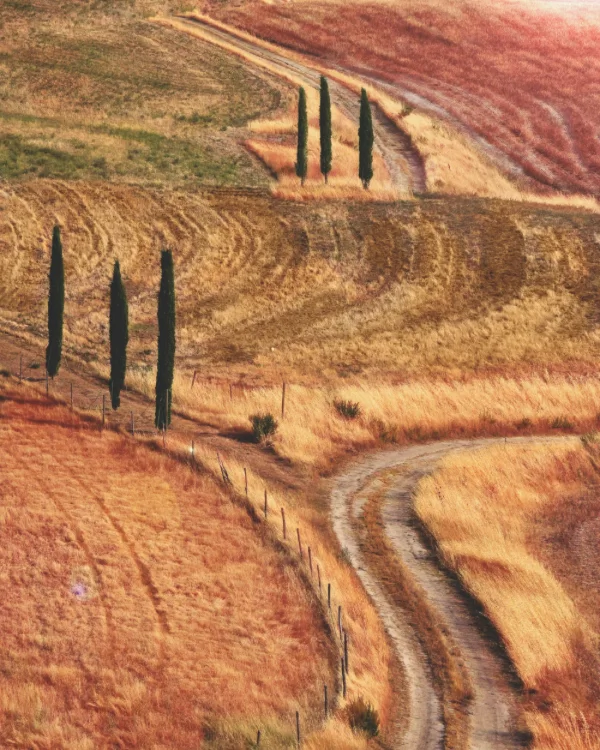
If one landscape defines the southern half of this ride, it is the Val d’Orcia — the valley that opens up below Montalcino and Monte Amiata, a UNESCO World Heritage site precisely because of how it looks: the rolling clay hills, the solitary cypress trees on the ridgelines, the farmhouses placed as if by a Renaissance painter who knew exactly where the eye would rest. Much of what the world pictures as Tuscany was photographed here.
Riding it is different from looking at it. The white and clay roads thread between the hills rather than over the tops, so you spend the day in a series of long, open valleys with the iconic ridgeline scenes arriving and passing. After rain the clay turns sticky and slows everything down; in the dry it is fast and firm. The Brunello vineyards climb the slopes around Montalcino, some of the most serious wine country in Italy, and the route runs through them on the queen stage. You are not riding past the Val d’Orcia — you are riding down into it from the high ground, which is the right way to arrive.
Surfaces and tyres: high forest road versus the white strade bianche
A Tuscany gravel bike tour built around the Apennine high country gives you two distinct surfaces across the week, and it helps to understand both.
- The strade bianche — the lower white roads of Chianti, Siena and the Crete Senesi. Compacted limestone and clay, generally smooth, fast and firm when dry, sticky and slow after rain. This is the iconic Tuscan surface, and the Chianti stages hold the best of it.
- Apennine forest road and estate track — higher up, around Pistoia and Amiata. Browner, sometimes rougher, with occasional loose or rutted sections and the odd short hike-a-bike where a path pinches. Not technical in the mountain-bike sense, but it asks for a relaxed grip and a little more tyre.
For both, the practical kit is the same. A gravel bike (mechanical or e-assist), or a light MTB with suitable tyres and gearing — road bikes and hybrids are not suitable here. Run minimum 38 mm tyres, wider if your frame allows, tubeless strongly recommended for the dry summer vegetation and thorns of the lower country. Bring low gearing — around a 0.9 ratio — for the steeper ramps into the hill towns and the sustained Apennine climbs. Have the bike freshly serviced before you travel; the white dust is fine and gets everywhere. We cover the full picture in our packing and kit guidance and grade the two daily pace options on our tour levels page.
How hard is it, really?
Across the eight days the route covers 460 to 615 kilometres and 5,000 to 9,950 metres of climbing, depending on whether you ride the Adventure or Explorer line each day. That spread is deliberate — it is two different weeks inside one itinerary.
- The Adventure route suits riders comfortable with three to four hours in the saddle over consecutive days: at home on a gravel bike in hilly terrain, but with no need to race. Daily stages sit around 65 to 70 km with 350 to 1,200 m of climbing.
- The Explorer route asks more: five to six hour days, up to around 2,000 m of climbing on the bigger stages, and the confidence to navigate loose gravel and forest tracks independently. This is the line that takes in the full Apennine climbs out of Pistoia and the deepest Amiata efforts.
Two things make it manageable whatever shape your legs are in on the day. First, that daily choice between two routes means a couple or a group riding at different speeds share the same hotel each night without anyone feeling held back or left behind. Second, the support vehicle is on the route: if a climb turns out longer than your legs wanted, the van is there. You are never committing to finish-or-bust in the middle of the high country. The genuine rest day near Siena sits at exactly the right point to reset before the queen stage.
If you can ride 80 km on gravel at home and still enjoy your dinner, the high country will reward you rather than break you. Our existing guide to gravel cycling in Tuscany goes deeper on the lower Strade Bianche climbs around Montalcino if that is the part that draws you most.
The food and wine country you ride through
Part of what makes an Italian gravel cycling holiday in Tuscany more than a fitness exercise is what waits at the end of each stage. The route is threaded through three of Italy’s most serious wine regions, and you ride into them rather than past them.
- Chianti Classico — the clay hills between Florence and Siena, the black rooster on the bottle, the country of the rest-day loops through Radda and Gaiole.
- Brunello di Montalcino — climbed on the queen stage, some of the most prestigious red wine in Italy, made from a single Sangiovese clone on the slopes around the town.
- The Maremma — the wilder southern coast country, newer to fine wine but increasingly serious, where the final descent runs down to the sea.
The accommodation is chosen to match. Seven nights in agriturismi — working farm hotels and boutique stays — picked for location and for the food as much as the bed. Tuscan cooking at this altitude is simple and excellent: pici pasta, wild boar ragù, pecorino from the Crete Senesi, bread without salt, olive oil pressed within sight of where you are eating. The tour includes seven breakfasts and three dinners; the free evenings are an invitation to find your own table in a hill town, which is no hardship here. A glass of something local at the end of a long climbing day is part of the reward, not a distraction from it.
Guided or self-guided in the high country
This route runs either way, and the choice matters more in the Apennines than in the gentler lower hills.
On a guided tour, you ride with the group — a maximum of ten riders per guide — and the guide handles the navigation. On the forest stages above Pistoia and Amiata, where a junction of two estate tracks can look identical in every direction, having someone who knows the line lets you simply ride and look around. It is the more sociable way to do it and the easiest if this is your first supported tour in Italy.
On a self-guided tour, you take the full GPS route for Garmin, Wahoo and Komoot and ride at your own pace, not tied to a group. You still get the same agriturismi, the same daily luggage transfer and the same support vehicle on the route — you just navigate yourself, which independent riders often prefer on the open ridges. Most riders mix the two across the week. Either way, the support is identical, and how our tours work walks through it in detail.
What a supported Tuscany high-country week includes
The point of riding the Apennines and the Val d’Orcia as a supported tour is simple: you carry the riding, and we carry everything else. Concretely, the Tuscany Gravel week gives you:
- Six riding stages plus an optional rest-day loop in Chianti, with an English-speaking guide offering two route options every day.
- GPS routes for Garmin, Wahoo and Komoot for self-guided riders, and a daily evening briefing with maps and elevation profiles.
- A support vehicle carrying spare parts, a spare bike and a clothing bag, with mechanic help from the crew — spare parts only at cost.
- Daily luggage transfer hotel to hotel: your bag travels in the van and waits for you on arrival each evening, so you ride with only a day bag.
- A lunch stop at the van most days, where you can change kit and refill the PurePower energy drink free of charge — energy bars and chews are available to buy.
- Seven nights in shared double rooms in agriturismi and boutique stays, with seven breakfasts and three dinners, including the closing sparkling wine and gala dinner on the coast.
- Locked bike parking every night, a return bus transfer from Marina di Grosseto to Pisa airport, a Gravel-Adventure jersey, a shared online photo album, and lifetime membership of the RIDERS network.
You arrange your own flights to Pisa; we handle the rest from the airport on day one. A €500 deposit secures a place, with the balance due 60 days before departure.
Ride the Apennine high country with us
If the Tuscany that draws you is the high one — the climb out of Pistoia into the chestnut forest, the queen stage over Amiata, the long descent into the Val d’Orcia — this is the week that links it all into a single line from Pisa to the sea. We run it guided or self-guided, with the agriturismi, the luggage transfer, the support van and the airport transfers all handled, so you arrive at the start with nothing to think about but the riding.
The full day-by-day, the 2026 and 2027 departure dates and what is included are on the Tuscany Gravel tour page. If you want to read more on the lower white roads first, our guide to gravel cycling in Tuscany covers the Strade Bianche around Montalcino, and how our tours work explains the supported model end to end. Come and ride the high country with us — we will carry the rest.
Questions riders ask
What makes Apennines gravel cycling harder than riding the lower Chianti hills?
Altitude and sustained climbing. The Apennine stages above Pistoia and around Monte Amiata involve climbs of 800 to 1,200 metres in a single push, on forest road rather than rolling vineyard lanes. The lower Chianti sections are constant short ups and downs; the high country gives you fewer, longer efforts with real descents as the reward. It is fitness and pacing rather than technical difficulty — no single section is beyond a confident gravel rider, but the day adds up. On our Explorer route a high day can reach 1,750 metres of climbing.
Are the strade bianche the same surface up in the Apennine high country?
Not quite. The classic strade bianche — the white compacted limestone and clay roads — belong to the lower country around Siena, Chianti and the Crete Senesi: firm and fast when dry, sticky after rain. Higher up you ride more forest road and estate track: browner, sometimes rougher, occasionally with a short hike-a-bike where a path pinches. Both reward 38 mm tyres or wider, tubeless, with a file-to-medium tread. The contrast between the two surfaces across a week is part of what makes a Tuscany gravel bike tour interesting.
When is the best time for an Italian gravel cycling holiday in Tuscany?
Late spring and early autumn. Our departures sit in early June and early September — both avoid the worst of the summer heat while keeping firm, dry surfaces. September brings the vendemmia, the grape harvest, and the low golden light that the region is known for; the hills can still drop to 10 to 12 degrees in the evening up high, so a packable layer earns its place. June gives longer days and greener country. High summer is rideable but hot on the exposed clay; deep winter turns the white roads to paste.
How does the Apennine high country connect to the Strade Bianche race country?
They are the same landscape at different heights. The Strade Bianche professional race runs its famous white-gravel sectors around Siena and the Crete Senesi — the lower, southern hills. Our route rides through that country on the Chianti and Crete Senesi stages, then climbs out of it into the higher Apennine and Monte Amiata country that the race never touches. You get the iconic sectors and the high ground in one week, which a single-day event cannot give you.
Do I need to be fast to ride the Tuscany high country with a group?
No. Guided groups run a maximum of ten riders per guide, and every day offers two route options — a fuller Explorer line and a steadier Adventure one — so riders at different speeds share the same hotel each night without anyone being held back or left behind. The support van follows the route and meets the group most days at lunch, so a long climb never becomes a problem. Multi-day gravel experience and sensible pacing matter far more than raw speed.
Can I ride the Apennines and Val d'Orcia self-guided?
Yes. Self-guided riders get the full GPS route for Garmin, Wahoo and Komoot and ride at their own pace, not tied to a group — with the same hotels, the same daily luggage transfer and the same support vehicle on the road. Most riders mix the two: ride with the guide on the navigationally tricky forest days, go independent on the open ridges. Either way the van carries the logistics.
Planning a gravel week of your own?