Off the Bike in Tuscany: Wine, Trattorias and the Evenings Between Riding Days
The queen stage finishes at Castel del Piano, six hundred metres up, after a day through the Crete Senesi and into Brunello country. It is the hardest riding of the week — long climbs, long descents, no technical difficulty, just fitness and pacing. And then it is seven in the evening, you have showered, and the day is not over. It is barely half over.
This is the part of a Tuscan week that does not show up in an elevation profile, and it is a substantial part of why people choose Italy over somewhere with better gravel statistics. Our guides to gravel cycling in Tuscany and the Apennine stages cover the riding properly. This one is about the other twelve hours.
Where you sleep, and why it matters
Seven nights, and almost none of them are anonymous.
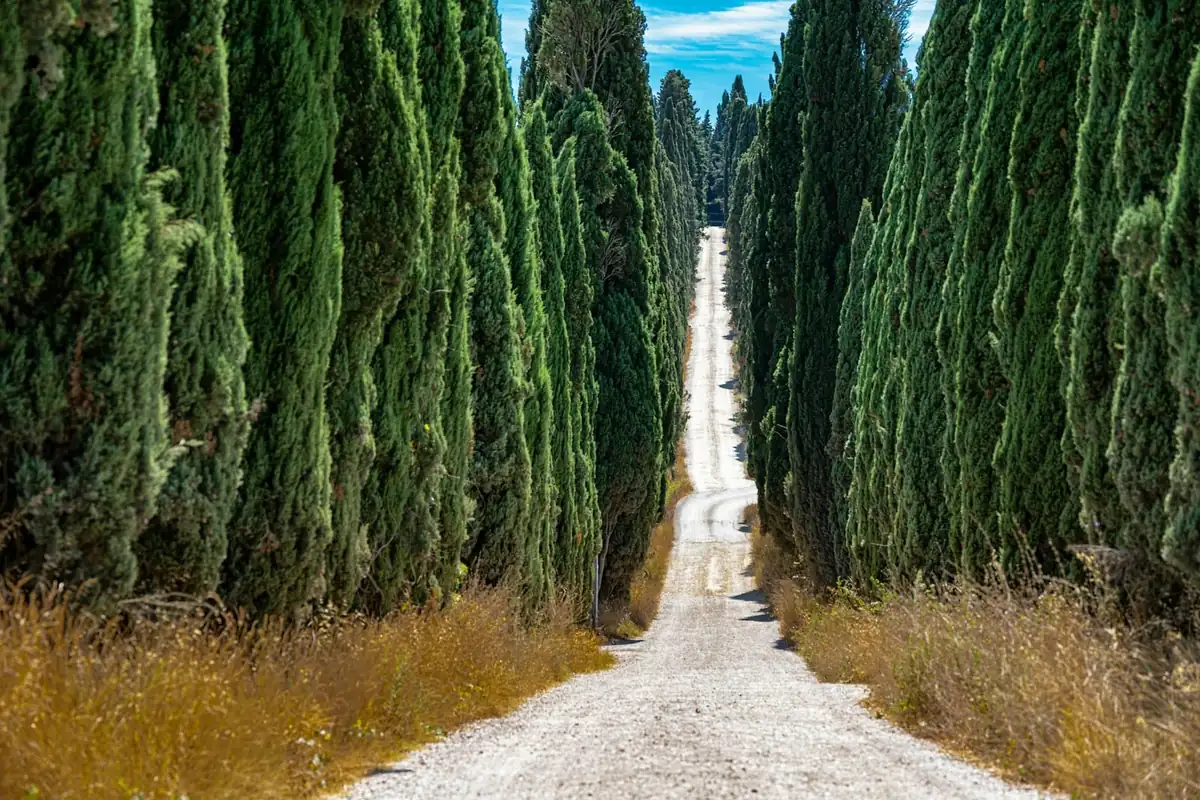
Le Vedute, on the Arno, after a first day that starts at Pisa airport and stops inside Lucca’s walls for lunch. Florence — actually Florence, with time to walk the city, on a stage built so you arrive with the afternoon still available. San Gimignano, approached by white gravel through cypress alleys, with its towers to loop the next morning. Then two nights above Siena, at a hillside hotel with a pool and a panoramic view, the old town about ten kilometres away.
After the rest day, Castel del Piano in Brunello di Montalcino country. And finally Marina di Grosseto, a beach spa hotel on the Tyrrhenian coast, where the week ends with a swim in the Mediterranean, cold drinks and a gala dinner.
That is a deliberate sequence. It would be simpler and cheaper to place a group of ten cyclists in convenient properties at the right distances. What you get instead is a week where the overnight stops are places you would want to go anyway.
The four unbooked dinners
Seven breakfasts and three dinners are included. Which means four evenings are yours, and that is a decision rather than a gap in the package.
The logic is straightforward. In Florence, in San Gimignano, in Siena, the eating is one of the main reasons to be standing there. A fixed group table at a fixed hour in a restaurant chosen for its ability to seat ten cyclists would replace the best thing about the evening with the most convenient version of it. So we book the dinners where a group table genuinely adds something — the arrival, the rest day, the finish — and leave the rest alone.
Practically, this means bringing a little more budget than a fully-inclusive tour would need, and being willing to walk fifteen minutes to eat somewhere better. The guides ride these towns several times a year and will tell you where they eat. Ask them. It is a better system than a review app and it costs nothing.
Wine, and where it actually is on the route
The route runs through two of Italy’s serious wine regions, and it does so in the right order.
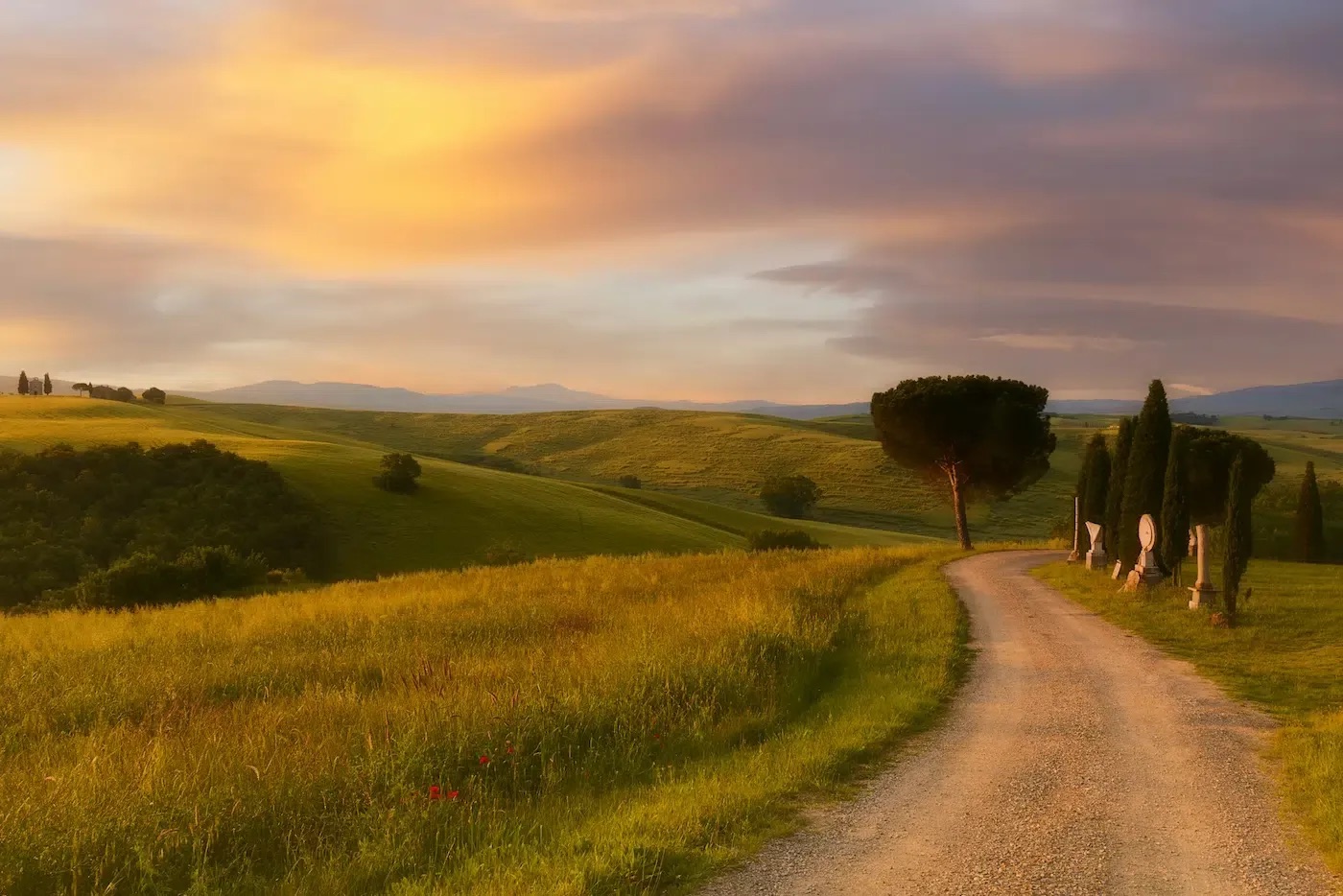
Chianti Classico arrives on day three, heading south out of Florence into clay hills and olive groves, where the first Strade Bianche appear and cypress alleys line the approach to each hilltop town. The rest day at Siena sits in the middle of it — the guided loops run through Radda, Gaiole and Lecchi, which are three of the names you would pick off a wine list without thinking about the roads between them.
Brunello di Montalcino comes on the queen stage, day six, when the route goes south through the Crete Senesi and climbs into Montalcino country toward Monte Amiata.
Two practical notes. Drinks and tastings are not included, so budget separately. And vineyard visits can be arranged around the rest day — worth asking about in advance rather than on the morning, because the good ones want notice.
Using the rest day well
The rest day at Siena is the pivot of the week and it is genuinely optional, which is rarer than it sounds.
If you want to ride, there are guided Chianti loops on the Strade Bianche: 45 kilometres with 850 metres, or 80 kilometres with 1,900 metres. If you want to not ride, Siena’s old town is about ten kilometres away, the hotel has a pool and a view, and the afternoon can disappear pleasantly without you doing anything at all.
Our honest recommendation, given what comes next: the queen stage is the following day. A rider who does the 80-kilometre loop with 1,900 metres of climbing on the rest day has had a very good time and will feel it on the Crete Senesi. The short loop in the morning and Siena in the afternoon is the version most people are happier with by Friday.
The towns you pass through rather than sleep in
Some of the best of it is mid-stage.
Lucca on the first day — both route options converge inside the walls for lunch, which is a genuinely good piece of route design. You are not riding past Lucca; you are stopping in it, in the middle of a riding day, having earned it.
San Gimignano’s towers get looped on the morning of day four before the route heads on toward Siena. Siena itself appears at the end of the steepest climb of the tour, which is a particular way to arrive at a city.
And the finish at Marina di Grosseto is its own kind of ending — a ridge crossing, then a long descent through the Maremma to the coast, then the sea. There is a swim, cold drinks, and a gala dinner. The tour finishes with closing sparkling wine.
What the riding week looks like
Eight days, seven nights, six riding stages plus an optional rest-day loop. Pisa to Marina di Grosseto, 460 to 615 kilometres, 5,000 to 9,950 metres of climbing depending on which option you take each morning — one of the widest ranges on our programme, because the Explorer line adds serious work almost every day.
Included: seven hotel nights in a shared double room, seven breakfasts and three dinners, luggage transfer hotel to hotel on every stage, an English-speaking guide with two route options every day, GPS routes for Garmin, Wahoo and Komoot, a daily evening briefing with maps and elevation profiles, a support vehicle with spare parts, a spare bike and a clothing bag, mechanic help from the crew with parts at cost, locked bike parking every night, the return bus from Marina di Grosseto to Pisa airport, complimentary PurePower energy powder, a Gravel-Adventure jersey, a shared photo album and lifetime RIDERS-network membership.
Not included: flights, lunches, drinks and tastings, and the four dinners on free evenings. Details on how it works, daily options on the levels page.
Why the off-bike half matters
There is a version of a cycling holiday where the riding is the whole thing and the evenings are recovery — eat, sleep, repeat, and the towns are places the bike happens to stop. Plenty of routes are built that way and there is nothing wrong with it.
Tuscany is not that week, and it would be a waste to ride it as though it were. You sleep inside Florence, above Siena, in Brunello country and on the Tyrrhenian coast. Four of the evenings are unbooked so you can use them. The wine regions are not scenery you pass through; they are where the road goes.
The riding is genuinely good — the strade bianche are the reason the region has a race named after them, and the Crete Senesi queen stage earns its title. But if you finish this week having seen only the gravel, you have ridden half of it.
We run Tuscany Gravel on 4–11 September 2026, and again in June and September 2027 — guided or self-guided, finishing with a swim in the Mediterranean and a table booked.
Questions riders ask
Where do you actually stay on the Tuscany gravel tour?
Pisa to Le Vedute on the Arno, then Florence, San Gimignano, and two nights at a hillside hotel above Siena with a pool and a panoramic view. Then Castel del Piano in Brunello country above 600 m, and finally a beach spa hotel at Marina di Grosseto on the Tyrrhenian coast. Seven hotel nights, and you are inside or beside the towns rather than at a roadside property between them.
How many dinners are included?
Seven breakfasts and three dinners across the week. That leaves four evenings deliberately unbooked, which is a choice rather than an omission — in Florence, San Gimignano and Siena the eating is a genuine reason to be there, and a fixed group table would take that away. The guides will happily point you somewhere good.
Is there time to see Florence and Siena properly?
Some. Both stages into those cities are built to arrive with time to walk, and the rest day sits at Siena with the old town about 10 km away. It is not a cultural tour and you will not exhaust either city, but nor do you simply sleep there and leave. The two nights at Siena are what make the difference.
Can I visit vineyards during the week?
Yes — vineyard visits can be arranged around the rest day at Siena, and the route runs through Chianti Classico and up into Brunello di Montalcino country on the queen stage. Drinks and any tastings are not included in the tour price, so budget for them separately.
What is the rest day actually like?
Genuinely optional. You can take a guided Chianti loop on the Strade Bianche through Radda, Gaiole and Lecchi — 45 km with 850 m, or 80 km with 1,900 m — or you can not ride at all. Siena is close, the hotel has a pool and a view, and vineyard visits can be organised. A meaningful number of riders do the loop in the morning and nothing at all in the afternoon.
Planning a gravel week of your own?