Which Gravel Cycling Tour Is Right for You? Our Seven Routes Compared
The question we are asked more than any other is not about tyre pressure or training plans or what to pack. It is simpler and harder than that: which one should I ride? Someone has decided that this is the year they cross something real on a gravel bike, they have a week to spend and a good pair of legs, and now they are looking at seven routes on a screen wondering where the difference actually lies. This article is the long answer we would give over a coffee.
We run seven fully supported, hotel-to-hotel gravel tours — six across Europe and one in South Africa’s Western Cape — and we ride and test every one of them before it goes on sale. They are all genuine point-to-point crossings: you finish somewhere different from where you started, having ridden across a mountain range, a country, or from one sea to another. What separates them is not logistics, which are close to identical, but landscape, difficulty, climbing, season and character. That is what this comparison is for.
There is no single best gravel cycling tour, and we would distrust anyone who told you there was. There is a best one for you — at the fitness you are at, in the month you can travel, and for the kind of week you actually want. Below you will find an at-a-glance comparison table, an honest route-by-route breakdown, and a set of plain “if you want X, ride Y” recommendations. If you would rather read the destinations as stories than as a decision, our best gravel cycling destinations in Europe round-up covers the same routes from the other direction.
How to read this comparison
A few things hold true across all seven tours, and it is worth saying them once rather than seven times over.
Every route runs fully supported, hotel-to-hotel. Your luggage travels in the support van and is waiting at the next hotel; you ride with a day bag. The van is on the route through the day for a spare, a mechanical or a lift, and it meets the group most days at lunch — a chance to change kit and refill your PurePower energy drink free of charge (energy bars and chews are available to buy). You can ride guided — with an experienced English-speaking guide navigating, up to ten riders per guide — or self-guided on the full GPS route for Garmin, Wahoo and Komoot, at your own pace, with the same hotels and the same support behind you. If that distinction matters to your choice, we set it out in full in guided vs self-guided gravel tours and on our how it works page.
Every route is graded for capable riders, not beginners. None of them is technical in the mountain-bike sense; what they ask for is endurance, judgement and the patience to hold a rhythm through a long valley or over a big pass. Most routes offer two daily pace options — a steadier Adventure line and a fuller Explorer one — so a couple or a group riding at different speeds can share the same week. Every route has a genuine mid-week rest day, which experienced riders know is the difference between arriving at the finish strong and arriving merely relieved. And a practical note true of all of them: bring a gravel bike with clearance for at least 38 mm tyres (wider is better), tubeless, and a low gear around 0.9 for the sustained climbs.
With that out of the way, the differences are in the riding.
The seven routes at a glance
| Tour | Region | Length | Distance | Climbing | Season | Best for |
|---|---|---|---|---|---|---|
| Trans Algarve | Portugal | 8 days / 7 nights | 300–350 km | 5,000–7,500 m | October | Shortest days; a first supported week |
| Tuscany | Italy | 8 days / 7 nights | 460–615 km | 5,000–9,950 m | June & September | Place and riding in equal measure |
| Trans Cyprus | Cyprus | 8 days / 7 nights | 300–375 km | 5,500–8,000 m | Late April | A spring objective, off the beaten line |
| Scotland Highlands | Scotland | 8 days / 7 nights | 520–540 km | 5,100–6,500 m | July & September | Space, solitude and empty gravel |
| South Africa | Western Cape | 9 days / 8 nights | 480–660 km | 5,500–8,000 m | Nov–Mar | A long-haul crossing when Europe is cold |
| Trans Alp | Alps (DE/AT/IT) | 8 days / 7 nights | 380–440 km | 8,000–10,500 m | Jun–Aug | The classic alpine crossing and the Stelvio |
| Trans Pyrenees | Spain | 11 days / 10 nights | 780 km | 17,000–20,000 m | September | The biggest line — sea to sea across a range |
Read the table top to bottom and you are reading roughly from the most approachable week to the most demanding. Distance alone does not tell the story — Scotland covers more kilometres than the Alps but climbs far less — so the honest way to compare is dimension by dimension. That is what the rest of this article does.
Comparing on difficulty and fitness
This is the dimension most riders should decide on first, because getting it wrong is the one thing that turns a great week into a hard one. None of our tours is technical, so difficulty here means distance, climbing and how many big days come back to back.
The most approachable: Trans Algarve. The Trans Algarve has the shortest daily distances of anything we run — five stages of roughly 55–85 km — which is the whole point of it. The days finish with something left in the legs and time to enjoy the afternoon light. There is climbing, and the Serra de Monchique in the middle is a real day, but the scale is manageable throughout. If you are choosing your first hotel-to-hotel gravel tour, or you would simply rather travel gently across a beautiful place than chase a long stage, this is where we would point you.
The gentler middle: Tuscany and Scotland. Tuscany sits across a wide range — the steadier Adventure route runs comfortable valley lines, while the Explorer route adds climbs toward Monte Serra and Pistoia and pushes toward 2,000 m on the bigger days. You can calibrate it daily to how you feel, which makes it flexible for mixed groups. Scotland covers more distance — 520–540 km — but with only 5,100–6,500 m of climbing across the week, so the challenge is less about vertical and more about distance, weather and remoteness. Roughly 80–110 km and 1,000–1,300 m per day, on surfaces that range from fast estate track to looser military road.
The real climbing, moderate distances: Cyprus and South Africa. Trans Cyprus keeps distances moderate but does not spare you the vertical — the route climbs to near 2,000 m in the Troodos, and the Explorer stages carry up to 2,000 m of ascent. South Africa has some genuinely long days over big passes: the Swartberg Pass is nearly 1,000 m on a single climb, and the longest stage runs to 115 km with over 1,500 m of ascent on the Explorer line. Both reward a solid endurance base.
The endurance routes: Trans Alp and Trans Pyrenees. The Trans Alp is graded challenging for a reason — 8,000–10,500 m of climbing packed into five riding stages, with the Explorer route adding the Stelvio Pass and up to around 2,200 m on its biggest day. The Trans Pyrenees is our most demanding tour by a clear margin: 780 km, 17,000–20,000 m of cumulative climbing, run as a single Explorer level with no softer option. Expect 5–7 hour days and 1,500–3,000 m of ascent per stage, and the endurance to do it eight times over. This is not a first supported tour, and we will always tell you so.
If you are genuinely unsure where your fitness sits against these numbers, our guide to how to choose a supported gravel tour walks through assessing your longest comfortable day honestly, and our tour levels page explains the daily Adventure and Explorer pace options in detail.
Comparing on terrain and scenery
Difficulty tells you whether you can ride a route. Terrain tells you whether you want to. This is where the seven part company completely.
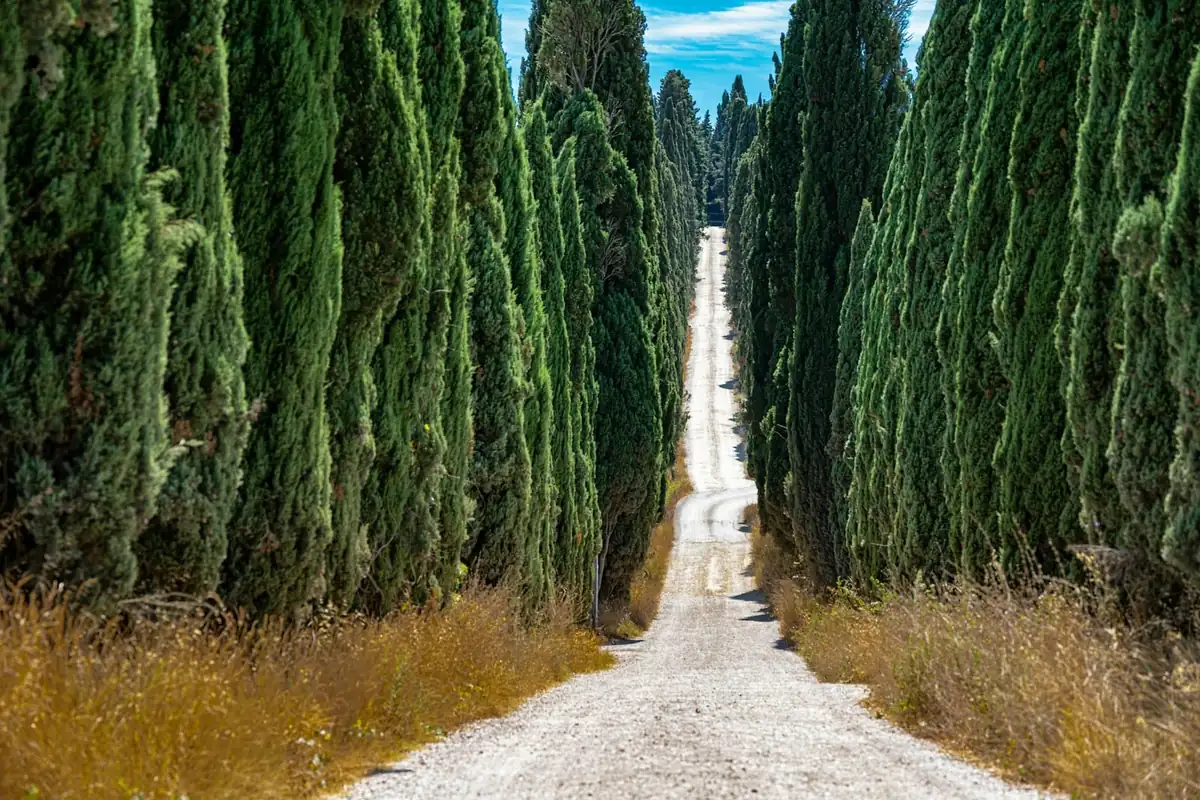
White gravel and hill towns — Tuscany. If you close your eyes and picture gravel in Italy, you are picturing the Tuscany route: the white Strade Bianche of Chianti, cypress alleys, hilltop towns built by merchants who wanted their wealth seen from miles away. The queen stage crosses the Crete Senesi, bare clay hills that go almost lunar in the September light, before climbing into Brunello di Montalcino wine country. It is the most photogenic gravel we run, and it finishes with a swim in the Tyrrhenian at Marina di Grosseto. Our Tuscany destination guide covers it stage by stage.
High mountains and glacier passes — Trans Alp and Trans Pyrenees. The two big crossings are about altitude and the drama that comes with it. The Trans Alp links alpine passes, high forestry roads and old military routes from Bavaria to Lake Garda, through four countries, with the iconic view over the Reschensee and its half-sunken bell tower along the way. The Trans Pyrenees changes character as you cross it: green, technical Basque hills at the Atlantic end, then drier, higher, more remote country through Ordesa and the legendary Zona Zero gravel around Aínsa, until the Mediterranean opens ahead on the final descent.
Emptiness and old roads — Scotland. What sets Scotland apart is the scale of the emptiness. Much of the best riding here was never built for bicycles — General Wade’s military roads, estate tracks and old drove routes — and on the signature day through Glen Builg the track unspools for kilometres with no fence, no car, no other soul, just heather and an enormous sky. If café culture matters less to you than solitude, this is the one.
Three landscapes and red dirt — South Africa. The South Africa route crosses the Western Cape through three distinct worlds in nine days: the Cape Winelands, the Klein Karoo semi-desert and the Overberg, on up to 84% gravel. The defining day is the Swartberg Pass, nearly 1,000 m of climbing on a Victorian-era gravel road still in its original condition. Wider skies, longer distances between villages, and red dirt farm roads with almost no traffic.
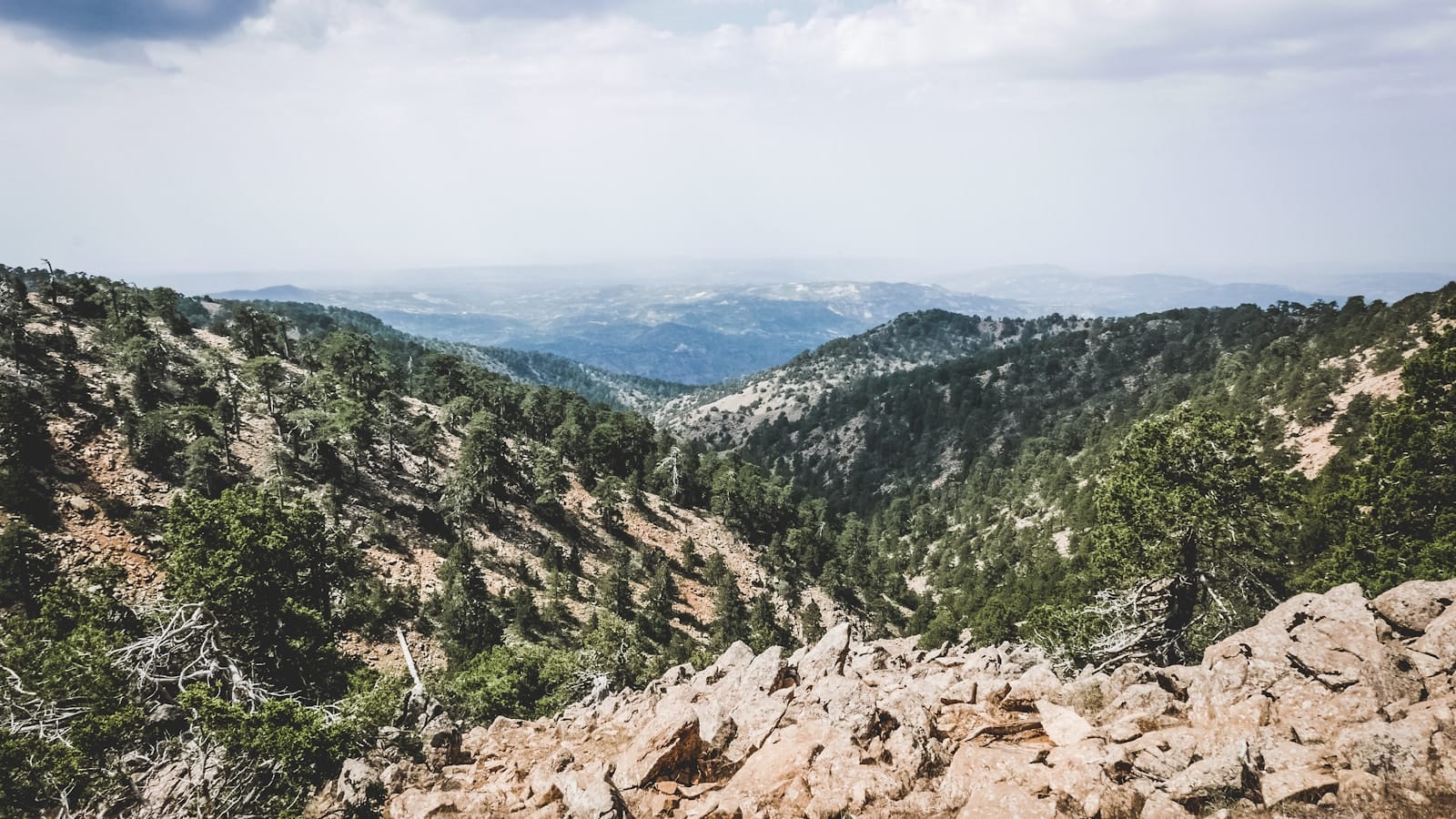
Cork forest and cedar mountains — Algarve and Cyprus. The two quieter routes trade the famous for the unexpected. The Trans Algarve ignores the coast almost entirely and crosses Portugal’s interior on the ancient Via Algarviana, through cork-oak hills and the Serra de Monchique, finishing at Cabo de São Vicente, the south-western tip of Europe. Trans Cyprus climbs from warm limestone coast through monastery roads into the cedar and pine of the Troodos, on gravel roads few maps know, then drops through the Akamas to the Mediterranean at Paphos.
Comparing on climbing
If you love a long climb, this section is the one that decides it. Ranked by cumulative ascent across the week, the order runs:
- Trans Pyrenees — 17,000–20,000 m. In a category of its own. The hardest day, Aínsa to El Pont de Suert, packs one of the longest climbs on the route and 2,900 m of ascent by itself.
- Trans Alp — 8,000–10,500 m. Dense climbing over five stages, with the Stelvio Pass available on the Explorer route on day four — one of Europe’s great climbs, ridden on gravel.
- Tuscany — 5,000–9,950 m. A wide band, because route choice matters here more than anywhere: the Explorer line roughly doubles the Adventure line’s vertical.
- Cyprus and South Africa — 5,500–8,000 m. Concentrated into big set-piece passes — the Troodos summit stage, the Swartberg — rather than spread evenly.
- Algarve — 5,000–7,500 m. Real climbing in the Serra de Monchique, but over short stages, so it rarely feels relentless.
- Scotland — 5,100–6,500 m. The least vertical of the seven, though the exposure and the weather add their own resistance.
A word on the Stelvio, because it comes up in almost every conversation about the Alps. We ride it on the Explorer route on the Trans Alp, gravel on the way up and the view stretching back down the valley the whole way. If it has been sitting on your list for years, our riding the Stelvio Pass on gravel piece is the closest thing to being there before you go.
Comparing on weather and season
One of the quiet advantages of running seven routes is that between them they cover most of the riding calendar. The season is often the deciding factor — you ride when you can travel, and the right destination is the one that is at its best that month.
Spring — Cyprus (late April). Trans Cyprus is the answer the rest of the year cannot give: warm at the coast, cool at altitude, wildflowers on the upper stages, and a spring objective when the alpine and northern routes are still out of season. The single 2027 departure runs 24 April to 1 May.
Summer — the Alps and Scotland. The Trans Alp runs late June to late August, timed so the high passes are clear of snow. Expect temperatures to swing from 5°C on a pass to 25°C in the valley in a single stage — a packable shell lives in your day bag. Scotland rides high summer and early autumn; the weather is changeable in any month, so you ride prepared rather than ride around it, with a proper waterproof always to hand.
September — Tuscany and the Pyrenees. Both come into their own in the golden, stable weeks of early autumn. Tuscany has September departures (plus an early-June option in 2027 for longer days and late-spring green); the Trans Pyrenees runs the first half of September, when the high passes are clear and the air is dry.
October — the Algarve. The Trans Algarve is firmly an October tour: the summer crowds gone, mild temperatures, and afternoon light that turns golden. The hills can still be cool at 10–12°C, so a light layer earns its place.
The southern summer — South Africa (November to March). Because it is the southern hemisphere, South Africa is our winter escape — departures in November, late February and early December give you a gravel week in the Cape’s early summer while northern Europe is dark and cold. That counter-season timing is a large part of the appeal.
If timing is your main constraint, our guide to the best time of year for a gravel tour lays the whole calendar out month by month.
If you want X, ride Y
Here is the honest short version, the way we would put it across a table.
- Your first supported gravel week — ride the Trans Algarve or Tuscany. Short stages or a steady Adventure line, rental bikes available locally, and a real country crossing without the biggest days.
- The place as much as the riding — food, wine, Renaissance hill towns — ride Tuscany, the most photogenic gravel in Europe, finishing with a swim in the Mediterranean.
- The famous climbs and full alpine drama — ride the Trans Alp, with the Stelvio on the Explorer route and Lake Garda at the finish.
- The biggest line you can ride — ride the Trans Pyrenees, sea to sea across an entire range, if your endurance is genuinely there.
- Space, solitude and empty gravel — ride Scotland, coast to coast on roads built three centuries before the bicycle.
- A spring objective or somewhere off the beaten line — ride Trans Cyprus in late April, over the Troodos.
- A reason to fly south when Europe is cold — ride South Africa, three landscapes and the Swartberg Pass, on 84% gravel.
- You ride as a couple or group at different speeds — any route with two daily pace options works, but Tuscany and the Trans Alp flex most easily between Adventure and Explorer, day by day.
Spread across the year, they make rather a good calendar: Cyprus in spring, Tuscany and the Alps in summer, the Pyrenees and Scotland in late summer, the Algarve in October, South Africa when the nights draw in. More than one rider has worked through several of them, one a year, and we are always quietly pleased when someone comes back for the next crossing.
Which is the odd one out?
Two routes deserve a specific flag, because they behave differently from the rest.
The Trans Pyrenees is the only tour with no softer option. Every other route lets you choose a steadier Adventure line on a hard day; the Pyrenees runs as a single Explorer level, ten nights, eight big stages, eight to ten riders per guide rather than up to ten. It is the one route we will occasionally talk someone out of, if the fitness is not there yet — not to be difficult, but because it is a long way to travel to have a miserable week. If it is on your mind, ride one of the others first and build toward it. Our Pyrenees gravel guide is honest about what it asks.
The South Africa route is the only one outside Europe, and the only one that asks for a long-haul flight and, for some passports, a visa. It is the route our European guests most often ride next, after a European crossing or two, and it is worth every hour of the flight — but it is a bigger trip to plan than an October week in the Algarve. Plan accordingly, and read our South Africa gravel guide for the full picture.
Everything else — the Alps, Tuscany, Scotland, the Algarve, Cyprus — is a straightforward week away with a short flight and a transfer, and the choice between them comes down purely to landscape, difficulty and season.
What a supported, hotel-to-hotel week includes
Whichever route you land on, the week works the same way — which is the whole reason a comparison like this can hold difficulty and scenery constant and let you decide on those alone. It is worth setting out once.
You carry the riding; we carry everything else. You ride point to point and sleep in a different hotel each night — hand-picked places chosen for location and a good dinner, from South Tyrolean mountain hotels to Tuscan agriturismi, Highland lodges, Algarve quintas and Cape wine-farm guesthouses. Your luggage travels in the support van between hotels and is waiting when you arrive; you collect it at the hotel and ride with only a day bag. The support vehicle is on the route through the day for a spare, a mechanical or a lift, carrying tools, spare parts and a spare bike, with mechanic help from the crew — you pay only for parts, at cost. The van meets the group most days at lunch, where you can change kit and refill your PurePower energy drink free of charge; energy bars and chews are available to buy.
Guided or self-guided, your choice. On a guided tour an experienced English-speaking guide leads each stage and handles the navigation — up to ten riders per guide, eight to ten on the Trans Pyrenees — which is a genuine comfort in remote terrain and the more sociable way to ride. On a self-guided tour you take the full GPS route for Garmin, Wahoo and Komoot and ride at your own pace, not tied to a group, with the same hotels, the same luggage transfer and the same vehicle behind you. Either way, how our tours work walks through the day in detail, and the tour levels page explains the two daily pace options.
What’s in the price. Every tour includes the hotel nights in a shared double room, breakfast daily and a number of dinners (including the celebration dinner at the finish), the daily luggage transfer, the support vehicle, GPS routes, a Gravel-Adventure jersey, a shared photo album and lifetime membership of the RIDERS network. You arrange your own flights; most tours include the relevant airport or start-point transfers. A €500-per-rider deposit secures a place, with the balance due 60 days before departure (tours starting within 60 days are paid in full).
We are a small, family-run company — the same Danish crew behind MTB-Adventure — and we have been running cycling trips since 2013. We ride and test every route ourselves before it goes on sale, which is the only reason we are comfortable comparing them for you the way we have here.
Where to start
If one of these routes has quietly moved to the front of your mind while you were reading, that is usually the answer. The best next step is simply to open the route in detail — each tour page has the full day-by-day, the 2026 and 2027 departure dates, the distances and climbing per stage, and exactly what is included: the Trans Alp, Tuscany, Trans Pyrenees, Scotland Highlands, Trans Algarve, Trans Cyprus and, beyond Europe, South Africa. You can browse them all from the tours overview, and the rest of the Journal goes deeper on each destination.
And if you have narrowed it to two and cannot separate them, that is exactly the conversation we most enjoy having. Tell us your longest comfortable day, the month you can travel and what you want from the week, and we will tell you honestly which of the two we would put you on — and, just as honestly, if we think you should wait a year and ride the bigger one when your legs are ready. There is no rush and nothing to miss; these routes will still be here next season. But if this is the year you cross the Alps, or ride from the Atlantic to the Mediterranean, or draw a clean line across Scotland, we would be glad to carry the rest while you ride it.
Questions riders ask
Which gravel cycling tour is best for a first supported trip?
The Trans Algarve and Tuscany are the gentlest doors in. The Algarve covers 300–350 km over five short stages with a mid-tour rest day, so the days finish with time to spare; Tuscany runs a steadier Adventure route alongside the longer Explorer one. Both have rental bikes available locally and both reward riders who would rather travel well than race. If you already ride long gravel days at home, Scotland, the Alps and the Pyrenees are within reach too — they simply ask more endurance.
Which is your hardest gravel tour?
The Trans Pyrenees, without much competition. It is 780 km over eight riding stages with 17,000–20,000 m of cumulative climbing, run as a single Explorer level with no softer option — 1,500–3,000 m of ascent per stage, day after day. The Trans Alp is the next step down: 8,000–10,500 m across five stages, with the Stelvio Pass on the Explorer route. Both are for strong, experienced riders with real endurance.
Do I need to be fast to keep up with the group?
No. Guided groups run a maximum of ten riders per guide (eight to ten on the Trans Pyrenees), and most routes offer two daily pace options — a steadier line and a fuller one — so a mixed-ability group shares the same hotel each night. The support van is on the route all day for a lift if you need one, and there is a genuine rest day mid-week. Endurance and sensible pacing matter far more than speed.
Can I book a gravel tour on my own?
Yes — many of our riders come solo. Groups are up to ten per guide and typically international, so you arrive alone and leave having ridden a week with people who understand exactly why you came. Accommodation is a shared double room by default; a single-room supplement is available on request.
Which gravel tour has the best weather, and when can I ride through the year?
The seven routes are deliberately spread across the calendar. Cyprus rides in spring (late April), the Alps and Scotland in summer and early autumn, Tuscany and the Pyrenees in September, the Algarve in October, and South Africa in the Cape's early summer (November to early March) — a gravel week when Europe is cold. There is no single best-weather tour; there is a best one for the month you can travel.
Planning a gravel week of your own?