Riding the Stelvio Pass on Gravel
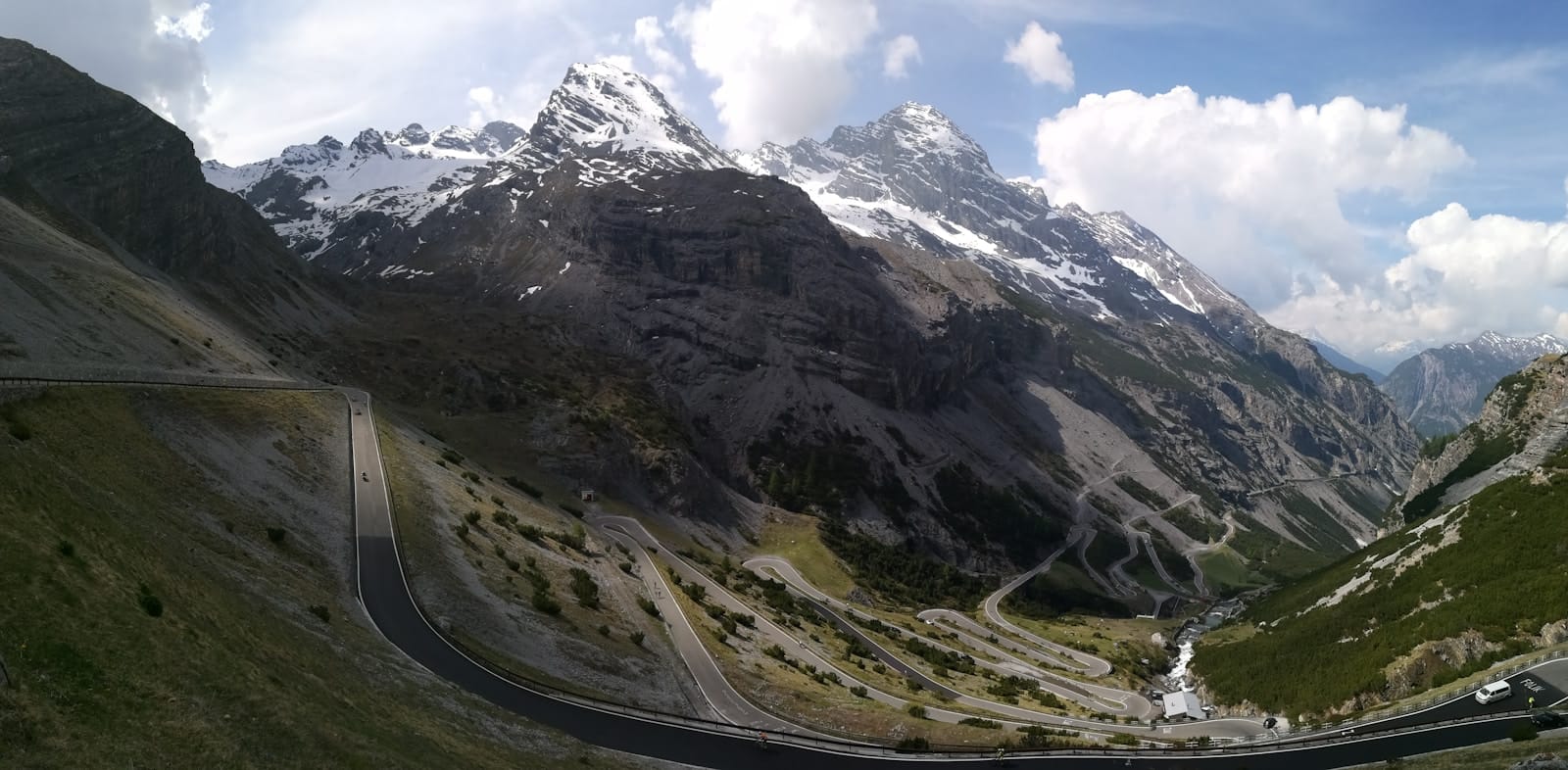
There is a photograph almost every cyclist has seen, even those who have never ridden in the Alps: a ribbon of road stacked back on itself dozens of times up a grey mountain wall, each hairpin numbered on a small stone marker, the whole thing looking less like infrastructure than like something drawn by hand. That is the northern side of the Stelvio Pass, climbing out of Prato allo Stelvio to 2,758 metres — forty-eight hairpins, the highest paved pass in the Eastern Alps, and one of the most recognisable climbs in the sport. It has decided Giro stages and broken the legs of professionals. It is, by any measure, a paved legend.
So let us be honest from the first paragraph, because experienced riders can smell a fudge: the Stelvio is not a gravel climb. Its fame is built on asphalt, and pretending otherwise would insult both the mountain and you. What makes the Stelvio a gravel objective is everything around it — the web of gravel roads, forestry tracks and century-old military routes that lace the Ortler region, South Tyrol and the valleys to the north and south. The pass is the landmark the riding is built around, not the riding itself. On our Trans Alp Gravel crossing it stands at the symbolic centre of an eight-day traverse from Füssen in Germany to Lake Garda in Italy, ridden on the gravel of four countries with the famous tarmac as its high, glittering keystone.
This is a guide to that distinction, and to the riding it makes possible. The myth of the Stelvio and where it really sits in cycling lore; the genuine gravel that surrounds it across the Alpine crossing; the terrain, the altitude, the season; the fitness and the gearing a week of big mountain days demands; and why an objective this size is one you ride supported, with the luggage in a van and a roof over your head each night, rather than self-organised out of panniers.
The myth of the Stelvio, and why it pulls so hard
Every region has a climb that stands for the whole place. In the Eastern Alps it is the Stelvio. Built in the 1820s under the Austrian Empire to link Lombardy with the rest of the realm over the Ortler massif, the road was an engineering act of will: a way over a mountain that had no business having a road on it. The northern ascent from Prato is the one in the photographs — twenty-four kilometres of nearly constant climbing, those forty-eight numbered hairpins stacked up the headwall, the air thinning the whole way to the summit at 2,758 metres. The southern side from Bormio is longer and wilder, threaded through rock tunnels and galleries. The third approach, the Umbrail from Switzerland, joins near the top and was itself gravel until relatively recently.
For a road cyclist the Stelvio is a pilgrimage. It enters the Giro d’Italia as the Cima Coppi, the race’s highest point, in years when the snow lets the race through. It is the climb riders put on a list and tick off, often in a single brutal out-and-back. And precisely because it is so famous, it draws gravel riders too — not because the pass is gravel, but because the region it crowns is some of the best high gravel in Europe, and standing at that summit board at 2,758 metres is a moment that means something regardless of what tyres you arrived on.
That is the honest pull of the Stelvio for a gravel rider. You come for the name and the altitude and the place in cycling history. You stay for the days of riding that surround it — the forestry roads above the Vinschgau, the old waterway paths, the military tracks left over from the First World War front that ran along this exact spine of mountains. The pass is the headline. The gravel is the story.
Where the Stelvio sits on the crossing
On the Trans Alp the Stelvio is not the first thing you ride, and that is deliberate. The crossing begins far to the north, in Füssen in Bavaria, under the foothills where the Alps first rise out of the lake country. From there it works south over five riding stages, through Austria, brushing the corner of Switzerland, and down the long spine of South Tyrol and Trentino to Riva del Garda on Lake Garda. The Stelvio comes in the middle of that arc, on the Explorer route’s biggest day, when you have four or five days of climbing already in your legs and the body has remembered how to do this.
Here is the shape of the week, with the real numbers:
- Day 1 — Füssen, Germany. Individual arrival, a warm-up ride into the lake country at the northern foot of the Alps, and the welcome meeting. The crossing has not started in earnest; you are finding the legs and meeting the people you will ride with.
- Day 2 — Füssen to Imst, Austria (78 km, 1,700 m). Into the alpine rhythm: cycle paths, forest roads, gravel and quiet asphalt, with long rideable climbs and the varied surface where a gravel bike earns its keep.
- Day 3 — Imst to Nauders, Austria (75 km, 1,980 m). Valley floors and alpine plateaux building steadily to a clean climb up to Nauders, near the three-country corner of Austria, Switzerland and Italy.
- Day 4 — Nauders to Merano, Italy. Adventure 90 km / 1,000 m; Explorer 125 km / 2,200 m. The high-alpine heart of the week. The iconic view over the Reschensee with its half-submerged bell tower standing in the water, then a long descent into South Tyrol. The Explorer route adds the Stelvio Pass before rolling on to Merano.
- Day 5 — rest day in Merano. A genuine day off in a spa town: thermal baths, café culture, good food, or an optional local ride with the guides.
- Day 6 — Merano to Tuenno, Italy (71 km, 1,900 m). South into Trentino wine country — valley passages, vineyards and alpine road linked by gravel, forest road and quiet connections.
- Day 7 — Tuenno to Riva del Garda, Italy (88 km, 1,400 m). The final stage, through the Brenta area towards Lake Garda, the surfaces varied to the last, finishing at the Riva del Garda waterfront.
- Day 8 — departure. A chartered bus with a bike trailer returns the group to Füssen.
Across the whole crossing that is 380–440 km and 8,000–10,000 m of climbing, depending on which daily route you take, over five riding stages with a rest day in the middle. Note where the Stelvio falls: day four, after a steady build, on the optional Explorer route that adds distance and height for riders who want the full ascent. The Adventure route that day stays lower and gentler at around 1,000 metres of climbing — so the famous pass is a choice you make with fresh information about how the week is treating your legs, not an obligation dropped on you cold.
That structure is the difference between riding the Stelvio as a stunt and riding it as the natural high point of a crossing. By the time you turn onto its hairpins you have already climbed in three countries. The mountain is not a shock; it is a summit you have earned the right to attempt.
The gravel that surrounds the pass
This is the part that matters most for an honest answer to “can you ride the Stelvio on gravel,” because the real riding — the part that fills your days and lives in your memory — is the gravel that the pass anchors rather than the pass itself.
Old military roads. The Alps along this border were a front line in the First World War, and the armies built roads to move guns and men over ground no civilian would have bothered with. A century later, long stretches of those routes survive as firm, well-graded gravel — cut for artillery mules, which turns out to be close to ideal for a loaded gravel bike. Riding them is the closest thing the Alps offer to time travel: you are moving along a line drawn by people who fought over these exact passes, and the engineering still holds.
High forestry and waterway roads. Above the Vinschgau valley, which the route follows through South Tyrol, runs a network of forestry roads and the old Waale — irrigation channels with maintenance paths beside them, threading the hillsides at a gentle gradient. These give you the high contour lines: gravel that holds altitude across a valley wall with apple orchards far below and the Ortler glaciers across the air. It is some of the most rideable high gravel in Europe, fast and firm and stitched into the landscape.
Valley tracks and plateau crossings. Lower down, the days link together on gravel cycle paths along the rivers, forest roads through the pine, and the open plateaux around Nauders where the surface runs out ahead of you and you can hold a pace. This is the connective tissue of the crossing — not dramatic in the way a hairpin is, but the steady, satisfying gravel riding that makes a long mountain day flow.
The descents. What the Alps ask of a gravel rider, more than the climbs, is competence going down. The descents off the high ground can be loose — angular gravel, scree, the occasional washed-out section — and they demand attention, a relaxed grip and tyres with enough volume to float rather than skitter. This is where the experience in your legs and hands shows. None of it is mountain-bike technical, but it is real gravel, and it rewards riders who have descended on loose surfaces before.
Put together, that is days of genuine off-tarmac riding through four countries, with the Stelvio’s paved summit sitting in the middle as the landmark the whole crossing orbits. The pass gives the week its name and its photograph. The gravel gives it its substance.
Terrain, altitude and the alpine day
A Trans Alp day is a different animal from a flat gravel outing, and it is worth understanding what the mountains actually ask.
The climbs are long, not savage. Alpine gravel climbs tend to be sustained efforts of forty minutes to well over an hour, at gradients that are demanding but rarely vicious. The art is pacing: settling into a gear you can hold and resisting the urge to attack the first ramp. The crossing’s 8,000 to 10,000 metres of total ascent is not made of wall-like pitches; it is made of patient, repeated climbing, day after day, which is exactly the kind of riding that rewards endurance over explosive power.
Altitude is a ceiling, not usually a danger. The Stelvio tops out at 2,758 metres and the gravel high points generally sit between roughly 1,800 and 2,500 metres. At those heights, fit riders mostly notice the thinner air as a slightly lower limit on hard efforts — your maximum feels capped, recovery between surges is slower — rather than as genuine altitude sickness, which is uncommon below 3,000 metres and unusual on a route that climbs gradually. The sensible responses are simple: pace the high climbs, drink more than thirst suggests, and don’t treat a 2,500-metre pass like a 500-metre one.
The weather is the real variable. This is the thing experienced alpine riders respect most. A single high stage can swing from 25°C and sun in the valley to near freezing, wind and rain on a pass, even in August. The route literature is blunt about it: temperatures move between roughly 5 and 25°C in one day between valley floor and high col. That is why a lightweight packable waterproof is non-negotiable, and why arm warmers, a light thermal and gloves are worth carrying on every stage even when the morning is warm. Sunscreen matters more at altitude than most people expect, too — the UV at 2,500 metres is unforgiving.
If you have ridden big mountains before, none of this is new. If your gravel has mostly been rolling rather than alpine, the honest preparation is to get some long, sustained climbing into your legs before you come, and to make your peace with the fact that you will be cold and hot in the same afternoon. The mountains set the terms here, and the riders who enjoy the week most are the ones who ride prepared for them rather than surprised by them.
Fitness for a multi-country crossing
The most common question we get about the Trans Alp is some version of am I fit enough, and the honest answer depends on which route you ride and what you bring to it.
The Adventure route suits riders comfortable with three to four hours in the saddle over consecutive days, at home on a gravel bike in hilly terrain. You don’t need to race; you need to be able to do it again tomorrow. The Explorer route — the one that adds the Stelvio on day four — asks for more: five-to-six-hour days, up to around 2,200 metres of climbing on the big stage, and the confidence to navigate loose gravel independently when you are further up the road.
What matters more than a number is the shape of your riding. A week of consecutive mountain days is an endurance problem, not a power problem. The rider who comfortably handles a long, hilly gravel day at home — and crucially, can back it up the next morning — has the engine for this. Raw speed is almost irrelevant. Judgement, pacing and the ability to recover overnight are everything, which is one reason experienced riders, with decades of knowing their own bodies behind them, tend to do this best.
Two features of the week make it manageable regardless of how a given day finds you. The daily Adventure-or-Explorer choice lets you calibrate stage by stage — take the bigger route the day you feel strong, the steadier one the day you don’t, and meet the group at the same hotel either way. And the genuine rest day in Merano mid-crossing is not a throwaway; it is the difference between arriving at Lake Garda strong and arriving merely relieved. Our tour levels page sets out the two paces in detail so you can judge honestly where you sit before you book.
Bike and gearing for the Alps
Equipment choices that are merely nice-to-have on gentler gravel become genuinely important on a route like this.
The bike. A gravel bike, mechanical or e-assist, or a light mountain bike with suitable tyres and gearing. Road bikes and hybrids are not suitable — the surfaces and the descents will punish both. Whatever you bring, have it freshly serviced before you travel; a week of alpine climbing and loose descending is no time to discover a tired drivetrain or worn pads.
Tyres. Run a minimum of 38 mm, and wider is better. The extra volume is what lets you stay relaxed on the loose, angular descents off the high ground, and it takes the sting out of the rougher military road. Tubeless is strongly recommended — a sealant-plugged puncture you never have to stop for is worth a great deal when you are an hour above the valley. A file-to-medium tread copes with the full range from firm forestry road to loose climb.
Gearing — the one to get right. This is where alpine gravel is unforgiving of optimism. Bring a low gear of around 0.9 — for example a 34-tooth chainring with a 38-tooth sprocket, or lower. The climbs are long, and on day four, with the Stelvio stage in your legs, a gear that felt fine in the shop can feel impossible on the road. Err generously towards easier gearing; you will never regret having a bail-out gear you didn’t need, and you will deeply regret needing one you don’t have.
The day bag. You ride each stage light, with only what the day might throw at you, because your main luggage travels in the van. Pack the day bag for the worst hour you might meet on a high pass, not the best: the waterproof, the layers, food, and a basic roadside kit — pump, tubes, multitool, levers — for self-sufficiency between van meetings. The support vehicle carries the full tool kit and a spare bike, but a long descent is no place to be entirely without your own means.
We cover the complete picture in our broader guide to the Trans Alp route, which goes deeper on surfaces, tyres and what the crossing asks of you across the whole eight days.
Why you ride this one supported
Some gravel objectives are best done self-organised, out of bikepacking bags, finding a bed where you can. A four-country Alpine crossing with the Stelvio at its heart is not one of them — and the reasons are practical rather than a matter of comfort.
The logistics are a second event. Seven hotels across Germany, Austria and Italy, booked and sequenced so each night lands where the day ends. Luggage that has to move between them while you are up a mountain. Food and water on stages that climb for hours above the treeline, where there is no café at the top. Border-crossing route-finding through valleys that all start to look alike. Done yourself, that is a planning project that can eat as much energy as the riding. Done supported, it simply disappears.
Here is what a supported Trans Alp week actually carries for you:
- Luggage hotel to hotel in the support van — you ride with a day bag and collect your main bag on arrival each evening.
- The van on the route, following the stages with spares, tools and a spare bike; the guides help with mechanical work and you pay only for parts, at cost.
- A lunch stop at the van most days, where you change kit, refill drinks, and help yourself to a free refill of PurePower energy drink (energy bars and chews available to buy), and genuinely welcome on a 2,000-metre day.
- Seven hotel nights in shared double rooms across South Tyrol and Lombardy, from valley townhouses to hillside mountain hotels, with seven breakfasts and six dinners and a gala dinner in Riva del Garda to close the crossing.
- A return bus transfer from Lake Garda back to Füssen on the final day, so the logistics are closed at both ends.
- A daily briefing, a Gravel-Adventure jersey, a shared online photo album, and lifetime membership of the RIDERS network.
And there are two honest ways to ride it. Guided means you ride with the group behind an experienced, English-speaking guide who handles the navigation — capped at ten riders per guide — so on the loose high descents and the look-alike valley junctions you keep your eyes on the trail rather than on a screen. Self-guided means you take the full GPS route for Garmin, Wahoo and Komoot and ride at your own pace, not tied to a group, with the same hotels, the same luggage transfer and the same van behind you. Most riders mix the two over the week. Either way the support is identical, and the how our tours work page walks through exactly what that means on the road.
The case for supported on a route like this is not about being looked after for its own sake. It is that the mountains deserve your full attention, and you cannot give it to them while also solving the puzzle of where you sleep and how your bag gets there. Hand the logistics to a crew that has ridden every metre of the route in advance, and the week becomes purely about the riding — which, when the riding is a gravel crossing of the Alps, is exactly where you want your attention to be.
Booking the crossing, honestly
The Trans Alp runs from €2,695, with departures on 27 June–4 July 2026, 18–25 July 2026 and 22–29 August 2026, and further dates in 2027 (26 June–3 July and 21–28 August). All three summer windows sit inside the season when the high passes are clear and the gravel is firm. A €500-per-rider deposit secures a place; the balance falls due 60 days before departure. You arrange your own flights — Munich is the natural arrival for the Füssen start, and Verona, Munich or Milan Bergamo all work for the return from Lake Garda — and we handle everything from there.
What you are buying is not really a holiday in the lie-by-the-pool sense. It is a serious week of gravel riding through four countries, built around one of the most famous climbs in cycling, with the logistics, the hotels and the support taken entirely off your hands so that all you have to do is turn up fit and ride. The Stelvio’s tarmac is the keystone; the gravel of the Vinschgau, the old military roads and the long valley descents are the substance; the rest day in Merano and the gala dinner on the shore at Riva del Garda are the punctuation.
Ride the Stelvio crossing with us
If standing at the 2,758-metre summit board is on your list — and the gravel days that lead you there are the part you’ll actually remember — this is the way to do it. We ride the Stelvio on the Explorer route of the Trans Alp Gravel crossing, guided or self-guided, with the support van carrying your luggage hotel to hotel, meeting you at lunch on the high stages, and following the route the whole way south to Lake Garda.
The full day-by-day, the 2026 and 2027 departures and everything that’s included are on the tour page. If you’re weighing the fitness honestly, our tour levels page lays out the two daily paces, and the deeper Trans Alp route guide covers the terrain and the surfaces in detail. Come and ride the Alps north to south, gravel under your wheels and the Stelvio at the heart of it — we’ll carry the rest.
Questions riders ask
Is the Stelvio Pass itself a gravel climb?
No — and it is worth being honest about this. The Stelvio is one of the great paved climbs in cycling: 48 numbered hairpins on the northern side, a summit at 2,758 metres, asphalt the whole way. What makes the Stelvio a gravel objective is the country around it. The Trans Alp route uses the wider web of gravel roads, forestry tracks and old military routes through South Tyrol and the Ortler region that the pass anchors. You ride the surrounding gravel for days; the Stelvio is the famous landmark the crossing is built around, ridden on its own tarmac as part of the longer Explorer route. We don't pretend the tarmac is gravel — the gravel is genuinely elsewhere, and there is a great deal of it.
How high does the route go, and do I need to worry about altitude?
The Stelvio summit sits at 2,758 metres, the highest paved pass in the Eastern Alps; the gravel high points on the crossing generally sit between roughly 1,800 and 2,500 metres. At those altitudes most fit riders feel the thinner air as a slightly lower ceiling on hard efforts rather than as genuine altitude sickness, which is rare below 3,000 metres. The route is built so the big heights come mid-week, once you have a few days in the legs. Pace the climbs, drink more than you think you need, and respect how fast alpine weather turns over 2,000 metres.
What fitness do I need for the big Alpine days?
The crossing runs 380–440 km across five riding stages with a rest day in Merano, and the daily Adventure route asks for riders comfortable with three to four hours in the saddle on consecutive days in hilly terrain. The Explorer route, which adds the Stelvio, asks more: five-to-six-hour days and up to around 2,200 metres of climbing on the Stelvio stage. You don't need to be fast. You need endurance, sensible pacing and to be genuinely at home on a gravel bike in the mountains. If you ride long days on gravel at home and finish them still enjoying yourself, you have the engine for this.
What bike and gearing should I bring for the Trans Alp?
A gravel bike — mechanical or e-assist — or a light mountain bike with suitable tyres and gearing. Road bikes and hybrids are not suitable. Run a minimum of 38 mm tyres, wider is better for the loose alpine descents, and tubeless is strongly recommended. Gearing matters more here than almost anywhere: bring a low gear of around 0.9 (for example 34×38 or lower) so the sustained climbs stay rideable on day four when the legs are tired. Have the bike freshly serviced before you travel.
When is the best time to ride the Stelvio and the Trans Alp on gravel?
Late June to early September, which is when the high passes are reliably clear of snow and the gravel is at its firmest. Our departures sit inside that window — late June, mid-July and late August. The Stelvio typically opens fully from late May or early June and the surrounding gravel dries out through the summer. Even in August, a high stage can swing from 25°C in the valley to near freezing on a pass, so you ride prepared for both in a single day.
Why ride it supported rather than self-organised?
A multi-country Alpine crossing is a logistics problem as much as a riding one: seven hotels in three countries, luggage that has to move while you climb, food and water on long stages above the treeline, and a mechanical risk that rises with every loose descent. Riding it supported means the van carries your bag hotel to hotel, meets the group most days at lunch with food and water, and follows the route with spares, tools and a spare bike. You bring the legs and ride either with a guide who handles the navigation or with the full GPS route at your own pace. The mountains take all your attention; we take the rest.
Planning a gravel week of your own?