Gravel Cycling in Scotland: a Highland Coast-to-Coast Guide
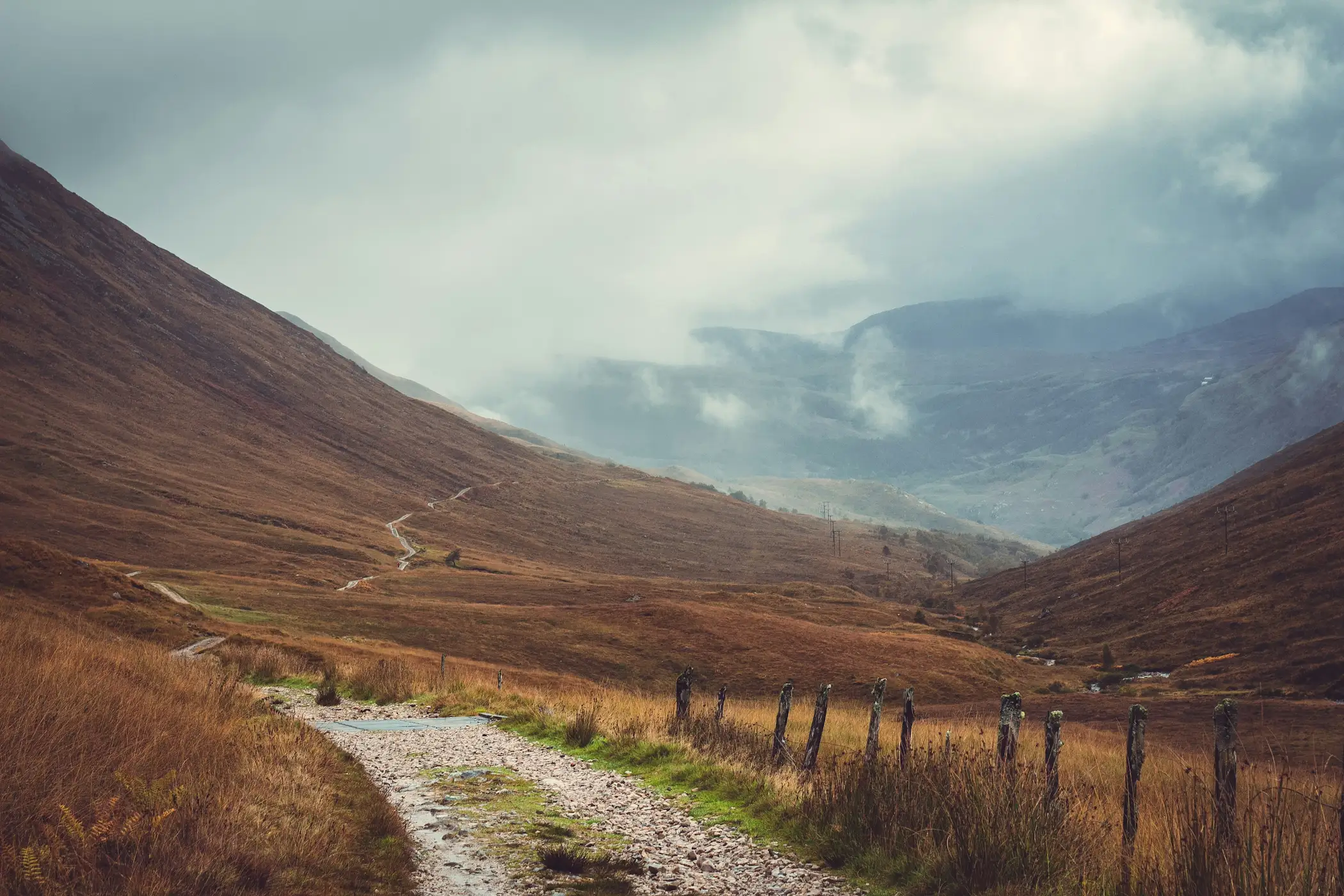
There is a particular kind of emptiness you only meet on the old roads of the Scottish Highlands. You crest a rise in Glen Builg, and the track unspools ahead for kilometres — no fence, no car, no other soul — just heather, peat-dark water, and a sky that takes up most of the view. The wind carries the smell of bog myrtle. Somewhere behind you a curlew calls. For a gravel rider who has spent years chasing this exact feeling on busier trails closer to home, Scotland can come as a quiet shock: some of the emptiest, most genuinely rideable gravel in Europe, and a surprising amount of it joins into one continuous line across the country.
That line is a coast-to-coast — Fort William on the Atlantic to Montrose on the North Sea — and it is the route we ride. This guide is the long version: what gravel cycling in Scotland is actually like, the route glen by glen, the terrain and the season, the bike and kit that suit it, and how to ride the whole traverse across a week without carrying your own logistics. It’s written for riders who already know their way around a gravel bike and a long day in the saddle, and who are deciding where to spend a precious week of it.
Why Scotland is one of Europe’s great gravel destinations
Most of the Highlands’ best gravel was never built for bicycles, and that is precisely what makes it so good. After the Jacobite risings of the eighteenth century, General George Wade and his successors cut a network of military roads through the glens to move troops and artillery. Three hundred years later, long stretches of those roads survive as firm, well-drained gravel and estate track — graded for cartwheels and field guns, which turns out to be close to ideal for a loaded gravel bike. Add the forestry roads, the old drove routes by which cattle were once walked to the lowland markets, and the rights of way that thread the estates, and you have a backcountry network that crosses almost the entire country off tarmac.
What sets it apart from the well-known gravel regions of the Alps or Tuscany is the scale of the emptiness. You can ride for an hour and a half between settlements. The Highlands are one of the least densely populated areas in Europe, and the riding reflects it: long, open valleys where you settle into a rhythm and the landscape changes slowly and enormously around you. This is not a destination of café stops every twenty minutes. It is a destination of distance, weather, light, and the deep satisfaction of moving through big country under your own power.
The riding is varied rather than relentless. There are fast, firm estate tracks where you can hold a good pace for an hour. There are sustained gravel climbs over the watersheds, rewarded by long descents on the far side. There are rougher, looser sections of original military road that ask for a little care and a little tyre, and occasional wet, peaty stretches that keep you honest. It earns its grade of intermediate to challenging — a real week in the saddle — but it is paced for riders who would rather travel through a landscape than race across it.
The coast-to-coast route, glen by glen
The traverse runs from the west coast to the east over five days of riding, with a rest day in the middle at Tomintoul. It begins at Fort William, in the Atlantic west under the bulk of Ben Nevis, and finishes at Montrose on the North Sea. Here is how the week unfolds.
Fort William to Fort Augustus — into the Great Glen
The first day takes you out of the wet, dramatic west and into the Great Glen, the vast geological fault that splits the Highlands from coast to coast. You ride above and away from the tarmac on forestry and estate tracks, with the long ribbon of Loch Lochy and then the approach to Loch Ness opening up below. It’s a settling-in day — a chance to feel the surfaces under your tyres, find the legs, and watch the landscape begin to empty out. By the time you reach Fort Augustus at the foot of Loch Ness, the west coast already feels a long way behind you.
Fort Augustus to Kingussie — towards the Cairngorms
The second day climbs out of the Great Glen and strikes east towards the Cairngorms, the largest tract of high, wild land in Britain. The character of the riding changes here: bigger, more open country, longer gravel climbs, and the first real sense of the plateau looming ahead. You drop towards Kingussie and the Spey valley, on the western edge of the national park. This is classic Highland gravel — sustained, rhythmic, and increasingly remote.
Kingussie to Tomintoul — Scotland’s highest village, and a rest day
The third day is the climb into the heart of it: up and over towards Tomintoul, the highest village in the Highlands, sitting at around 350 metres on the edge of the Cairngorm massif. The gravel here is older and rawer in places, the air noticeably cooler, the views vast. Reaching Tomintoul is an achievement in itself — and then you stop. The rest day here is deliberately placed: a chance to let the legs recover, walk the village, eat well, and look at the map of where you’ve come from and where you’re going. Experienced riders know the value of a mid-week rest day on a traverse like this; it’s the difference between arriving at the coast strong and arriving at it merely relieved.
Tomintoul to Tarland — Glen Builg and the empty heart
If the week has a signature day, this is it. The route from Tomintoul runs through Glen Builg and the high, open moorland of the eastern Cairngorms — long stretches with few people, firm gravel underfoot, and the enormous, rolling views that draw riders to Scotland in the first place. There is a particular stretch where the track simply runs and runs, and you find yourself riding faster than you mean to, just for the joy of the surface and the space. The day descends gradually towards Tarland, in the gentler, greener country of Aberdeenshire’s Deeside.
Tarland to Montrose — down to the North Sea
The final day carries you out of the hills and down to the North Sea at Montrose. The country softens — farmland, river valleys, the salt smell of the east coast arriving on the wind — and then, quite suddenly, the land runs out and the sea is in front of you. Atlantic to North Sea, coast to coast, under your own legs, in a week. There is a celebration dinner at the finish, and it is well earned. Crossing an entire country by gravel bike is the kind of line that stays with you.
The terrain: what the riding actually demands
For a rider used to gravel at home, the Scottish surfaces will feel familiar in type but bigger in scale. Expect:
- Fast estate and forestry track — firm, well-drained, the stuff you can carry pace on for long stretches.
- Original military road — older, looser, sometimes rough or rutted; not technical in the mountain-bike sense, but it asks for a relaxed grip and a little tyre.
- Open moorland tracks — exposed, occasionally peaty or wet underwheel, with the weather doing whatever it likes overhead.
- Sustained climbs — not Alpine in gradient, but long, and there are several each day; the week’s 5,100–6,500 m of total ascent adds up.
None of it is beyond a confident gravel rider. What it rewards is endurance, sensible pacing, and the patience to keep turning the pedals through a long, exposed valley when the wind is in your face. This is a connoisseur’s terrain rather than a beginner’s, which is exactly why it suits the riders who tend to come with us.
When to go: season, weather and light
The riding window in the Highlands runs from late June to mid-September, and our departures sit inside it — high summer and early autumn.
- High summer (late July) brings the longest days. This far north, the light lingers until late evening, and the tracks are typically at their firmest and driest.
- Early autumn (mid-September) brings quieter trails, the first turn of colour across the moor, cooler and often more stable riding temperatures, and — a real consideration in Scotland — far fewer midges.
A word on weather, honestly: the Highlands are changeable in any month. You may get a week of clear, golden riding; you may get a day of horizontal drizzle followed by an afternoon of sun. The trick is not to ride around the weather but to ride prepared for it — a packable waterproof shell, warm layers for the high, exposed sections, and the knowledge that the support van is carrying everything else and will meet you at lunch. Experienced riders tend to make their peace with Scottish weather quickly; it’s part of the character of the place, not an obstacle to it.
How hard is it, really?
Across the week: 520–540 km and 5,100–6,500 m of climbing, over five riding days with a rest day. That works out to roughly 80–110 km and 1,000–1,300 m per day — a proper endurance week, but a very achievable one for a rider with a base of long days behind them.
Two things make it manageable regardless of how you’re feeling on the day. First, most stages run as two pace options — a fuller line and a steadier one — so a couple riding at different speeds, or a group with mixed legs, can share the same week and the same hotel each night without anyone feeling held back or left behind. Second, the support vehicle is on the route: if a day turns out longer than your legs wanted, the van is there. You are never committing to “finish or bust” in the middle of nowhere.
If you can ride 80 km on gravel at home and still enjoy your dinner, you’ll be at home here. Our tour levels explain the two paces in more detail.
Bike and kit for Scottish gravel
You don’t need anything exotic, but a few choices make the week more comfortable:
- Tyres: 40–45 mm is the sweet spot. The extra volume takes the edge off the rougher military road and the wet stretches, and a file-to-medium tread copes with everything from firm track to loose climb. Run them tubeless and a touch softer than your road-gravel pressure.
- Gearing: bring low gears. The climbs are long rather than savagely steep, but by day three a 1:1 ratio or lower is very welcome on a sustained ascent into a headwind.
- Weatherproofing: a genuinely waterproof, packable shell; warm gloves and a cap that fits under a helmet; something for the eyes against wind and grit. You’ll ride light each day — your main luggage travels in the van — so pack the daily bag for the worst hour you might meet, not the best.
- The rest: a basic roadside kit (pump, tubes, multitool, levers) in your day bag for self-sufficiency; the support vehicle carries a full tool kit and a spare bike, with mechanic help on hand.
We cover the full picture in our packing guide for a multi-day gravel tour, but the Scottish-specific note is simple: respect the weather and the remoteness, and you’ll have a wonderful week.
Guided or self-guided in the Highlands
This route can be ridden either way, and the choice is more meaningful in Scotland than in gentler, more populated regions.
On a guided tour, you ride with the group — a maximum of ten riders per guide — and the guide handles the navigation. In remote moorland, where a junction of two estate tracks can look identical in every direction and a low cloud can roll in quickly, having someone who knows the line is a genuine comfort, and it lets you simply ride and look around. It’s also the more sociable way to do it, and the easiest if this is your first supported traverse.
On a self-guided tour, you take the full GPS route for Garmin, Wahoo and Komoot and ride at your own pace, not tied to a group. You still get the same hotels, the same daily luggage transfer and the same support vehicle on the route — you just navigate yourself, which experienced, independent riders often prefer. Either way, how our tours work walks through the support in detail.
How a supported Highland week works
The point of riding this as a supported tour is that you carry the riding and we carry everything else. Concretely:
- You ride point to point and sleep in a different hotel each night — comfortable, well-placed Highland hotels and lodges, chosen for character and a good dinner.
- Your luggage travels in the support van between hotels; you ride with only a day bag and collect your main bag on arrival each evening.
- The support vehicle is on the route through the day for a mechanical, a spare, or a lift, and it carries spares, a spare bike and a clothing bag.
- The van meets the group most days at lunch, where you can change kit and refill your energy drink free of charge (energy bars and chews are available to buy).
- The week includes seven nights with breakfast and three dinners — among them the celebration dinner at the North Sea finish — plus a return bus transfer between Edinburgh Airport and Fort William, GPS routes for self-guided riders, and a Gravel-Adventure jersey to take home.
You arrange your flights to Edinburgh; we handle the rest from the moment you land.
The country you’re riding through
Part of what makes a Highland traverse more than a fitness exercise is the country itself, and it pays to ride with some sense of what’s around you. The middle of the route runs through Speyside, the heart of Scotch whisky — the valley of the River Spey holds the greatest concentration of distilleries in the country, and Tomintoul sits on its southern edge. You don’t have to be a drinker to feel the texture of it: the maltings, the warehouses, the place names that read like a shelf in a good bar.
You also spend two days in and around the Cairngorms National Park, the largest national park in Britain and one of its last genuinely wild places. This is the realm of golden eagles, red deer on the high ground, mountain hare that turn white in winter, and the ancient remnants of the Caledonian pine forest. Ride quietly and look around: a herd of deer moving across a far hillside, a bird of prey hanging in the wind over the moor, the light shifting across a plateau that has barely changed in centuries. The military roads you’re riding tell a harder story — built to subdue the glens after the Jacobite risings — and the emptiness you enjoy today is, in part, the long aftermath of the Highland Clearances that emptied these straths of people two hundred years ago. None of this is a history lecture from the saddle; it’s simply the depth that turns a good week of riding into a memorable one.
The hospitality is part of it too. Highland hotels and lodges do a particular kind of welcome well — a warm room, a serious dinner, a dram if you want one, and the easy understanding that you’ve earned all three. After a long day into the wind, arriving somewhere genuinely comfortable, with your bag already in the room, is no small thing.
Who rides the Highland traverse
This is not a beginner’s trip, and we don’t pretend otherwise. It suits experienced riders who are comfortable with long days on mixed surfaces and who value the quality of a route over the noise of an event. In practice, the riders who come with us are experienced — people who have ridden for decades, who pace themselves intelligently, and who would far rather travel thoughtfully across a great landscape than sprint through it. The Highland week rewards exactly that: endurance over raw speed, judgement over bravado, the patience to keep a steady rhythm through a long valley.
It works beautifully for couples and friends riding at different speeds, thanks to the two daily pace options and the shared hotel each night — you ride your own day and meet for dinner. It works for the solo rider who wants the structure and company of a small group without the faff of organising anything. And it works for clubs and groups of friends who want a shared objective with the logistics taken off their hands; for a group of six or more we can also arrange a private departure on dates that suit you.
If you’re weighing whether a supported tour is right for you at all — versus going self-supported, or versus a guided road trip — our guide to choosing a supported gravel tour lays out the honest trade-offs.
What you’ll remember
Ask a rider what stays with them from the Highland traverse, and it’s rarely a single climb. It’s the emptiness of Glen Builg, the track running on and on. It’s reaching Tomintoul and realising how far the legs have carried you. It’s a stretch of Wade’s military road under your wheels and the strange pleasure of riding something built three centuries before the bicycle. It’s the moment near Montrose when the farmland opens and the North Sea is suddenly there, and the week resolves into a single clean line drawn across an entire country.
Ride the Highland coast-to-coast with us
If a full Scottish traverse is on your list, this is the route — Fort William to Montrose, Atlantic to North Sea, on the old roads and empty moorland that make Scotland one of the best gravel destinations in Europe. We run it guided or self-guided, with the hotels, the luggage transfer, the support vehicle and the airport transfers all handled, so you arrive at the start with nothing to think about but the riding.
The full day-by-day, the 2026 and 2027 departure dates and what’s included are on the Highlands Scotland Gravel tour page. If you’re weighing it against another route, how our tours work explains the supported model, and our other destination guides in the Journal cover the rest of the calendar. Come and ride coast to coast with us — we’ll carry the rest.
Questions riders ask
How fit do I need to be to ride gravel across the Scottish Highlands?
You should be comfortable riding five to six hours a day for several days on mixed surfaces — roughly 80–110 km with 1,000–1,300 m of climbing per day. Across the week the Highland traverse covers 520–540 km and 5,100–6,500 m of ascent, graded intermediate to challenging. You don't need to be fast: there are two pace options each day and the support vehicle means a long afternoon never becomes a problem. If you already ride long days on gravel at home, you have the engine for this.
When is the best time of year to ride gravel in Scotland?
Late June to mid-September is the window — long daylight, the tracks at their driest and firmest, and the high passes clear. Our departures sit inside it: high summer (late July) and early autumn (mid-September). Autumn brings quieter trails, turning colour on the moor and fewer midges; high summer brings the longest days. Scottish weather is changeable in any month, so you ride prepared rather than ride around it.
Should I ride it guided or self-guided?
Both work, and the support is identical. Guided groups are capped at ten riders per guide, who handles the navigation — useful in remote terrain where a junction on the moor isn't always obvious. Self-guided riders get the full GPS route for Garmin, Wahoo and Komoot and set their own rhythm. Either way you get the same hotels, the same daily luggage transfer and the same vehicle behind you.
What bike and tyres work best for Scottish gravel?
A gravel bike with clearance for 40–45 mm tyres is the sweet spot. The surfaces range from fast estate track to rougher, looser military road and the odd wet, rooty section, so a little more volume and a file-to-medium tread pays off. Bring low gearing for the sustained climbs — a 1:1 ratio or lower is welcome by day three. You're welcome to bring your own bike or rent one for the week.
How do I get there, and is travel included?
Fly to Edinburgh. The tour includes a return bus transfer between Edinburgh Airport and the start in Fort William, and a transfer back from the North Sea finish, so the only thing you book is your flights. Your main luggage travels in the support van between hotels for the whole week.
Who is the Highland traverse suitable for?
It's for experienced riders comfortable with long days on mixed surfaces. The week rewards endurance and good pacing over raw speed rather than flat-out fitness, so it's the self-aware, experienced rider who gets the most from it. Ride within yourself, use the steadier of the two daily routes when you want it, and let the support crew carry the logistics.
Planning a gravel week of your own?